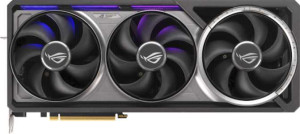
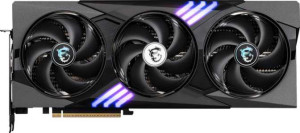
Both cards share an identical base GPU clock of 2295 MHz, but they diverge sharply under sustained load. The Asus ROG Astral RTX 5080 OC boosts to 2760 MHz versus the MSI RTX 5070 Ti Gaming Trio Plus at 2452 MHz — a gap of over 300 MHz that translates directly into higher sustained frame rates and better headroom during demanding workloads. This turbo advantage, combined with a higher memory speed of 1875 MHz versus 1750 MHz, means the 5080 can feed its shader array faster and maintain peak throughput more consistently.
The shader and compute architecture tells a similar story. The RTX 5080 features 10,752 shading units, 336 TMUs, and 112 ROPs, compared to 8,960, 280, and 96 on the 5070 Ti. These differences compound into a floating-point performance gap of 59.35 TFLOPS versus 43.94 TFLOPS — roughly a 35% advantage in raw compute throughput. In practice, this means faster ray tracing, higher frame rates at 4K, and significantly more headroom for AI-accelerated features. The texture rate gap (927.4 GTexels/s vs 686.6 GTexels/s) further reinforces the 5080's edge in rendering complex, detail-heavy scenes.
Both cards support Double Precision Floating Point, which is relevant for compute and professional workloads. However, in virtually every performance dimension — boost clock, memory speed, shading units, pixel fill rate, and raw FLOPS — the RTX 5080 OC holds a clear and consistent advantage. This is not a marginal difference; the 5080 outperforms the 5070 Ti by a meaningful margin across the board, making it the unambiguous winner in this performance category for users prioritizing maximum throughput.