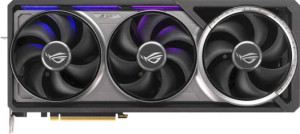
At their core, both the BTF Edition and the OC Edition share the same fundamental silicon configuration: identical base clocks of 2017 MHz, the same 21,760 shading units, 680 TMUs, 176 ROPs, and equal memory speeds of 1750 MHz. This means the two cards are essentially the same GPU at rest, and any performance gap between them is entirely a function of how aggressively each is factory-overclocked.
That gap becomes clear when looking at boost clocks and the throughput metrics that flow from them. The OC Edition hits a turbo of 2580 MHz versus 2437 MHz on the BTF Edition — a difference of roughly 6%. Because pixel fill rate, texture throughput, and compute performance all scale directly with clock speed, that single delta propagates across every throughput figure: the OC Edition delivers 112.3 TFLOPS of FP32 compute versus 106.1 TFLOPS, and 1754 GTexels/s versus 1657.2 GTexels/s. In practice, this translates to a modest but measurable lead in GPU-bound workloads — think high-resolution gaming, ray tracing, and AI-accelerated rendering — where sustained boost clocks directly determine frame output.
The OC Edition holds a clear performance edge in this group. While the gap is not dramatic enough to represent a generational leap, the higher factory overclock gives it a consistent, across-the-board throughput advantage over the BTF Edition. Users prioritizing maximum out-of-the-box performance should favor the OC Edition; those drawn to the BTF Edition's connector design (suggested by its naming) will accept a slight performance trade-off in exchange for other form-factor benefits.