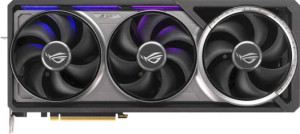
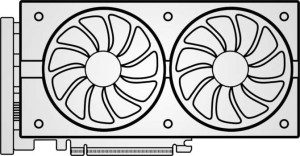
The most telling performance story here is raw compute throughput. The Asus ROG Astral RTX 5090 OC delivers 112.3 TFLOPS of floating-point performance versus 54.94 TFLOPS on the Nvidia RTX Pro 4500 Blackwell — roughly a 2x lead. This gap is structural, not incidental: the RTX 5090 packs 21,760 shading units against the Pro 4500's 10,496, meaning it simply has twice the parallel compute fabric. In practice, this translates to significantly higher frame rates in rasterized games, faster AI inference in GPU-accelerated workloads, and greater headroom for real-time ray tracing at high resolutions.
The texture and pixel pipelines tell the same story. With a texture rate of 1,754 GTexels/s (versus 858.4) and a pixel fill rate of 454.1 GPixel/s (versus 293.1), the RTX 5090 can push substantially more geometry and shading detail per second — directly relevant to ultra-high-resolution rendering. One nuance worth noting: the RTX Pro 4500 actually edges out a marginally higher GPU turbo clock of 2,617 MHz versus 2,580 MHz, but this minor peak-clock advantage is effectively drowned out by the Pro 4500's far smaller shader array. Both cards share an identical GPU memory speed of 1,750 MHz and both support Double Precision Floating Point (DPFP), which is meaningful for scientific or CAD workloads — though the RTX 5090's larger shader count will still produce higher absolute DPFP throughput.
Based strictly on the provided specs, the RTX 5090 OC holds a decisive performance advantage in every throughput-oriented metric. The RTX Pro 4500 Blackwell is not designed to compete on raw gaming or consumer compute performance — it is a professional-tier card with a leaner, power-efficient configuration. Users prioritizing maximum rendering speed, AI workloads, or high-framerate gaming should consider the RTX 5090 the clear winner here; those with workstation-specific requirements may find the Pro 4500's architecture more appropriate for their use case, but not on performance grounds alone.