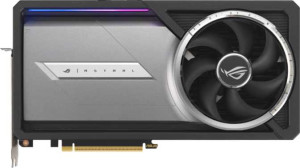
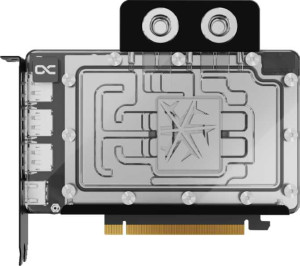
At the foundation, both the Asus ROG Astral LC and the Inno3D iChill Frostbite share the same RTX 5090 silicon: identical base clocks of 2017 MHz, the same 21,760 shading units, 680 TMUs, and 176 ROPs. This means the underlying compute architecture and memory subsystem — running at 1750 MHz on both cards — offer no differentiation at rest. The practical implication is that in workloads that do not push the GPU into boost territory, these two cards are functionally interchangeable in terms of raw throughput.
The only meaningful performance gap emerges at peak boost. The iChill Frostbite reaches a GPU turbo of 2467 MHz versus 2437 MHz on the ROG Astral LC — a 30 MHz advantage that cascades into every derived metric. This translates to a pixel rate of 434.2 GPixel/s versus 428.9 GPixel/s, a texture rate of 1677.6 GTexels/s versus 1657 GTexels/s, and floating-point performance of 107.4 TFLOPS versus 106.1 TFLOPS. In absolute terms these are marginal deltas — roughly 1.2% across the board — which will not produce perceptible frame rate differences in gaming or measurable throughput gains in most creative workloads.
In summary, the iChill Frostbite holds a narrow but real performance edge on paper, courtesy of its slightly higher factory boost clock. However, at a delta of just ~1.2% across all throughput metrics, this advantage is essentially academic under real-world conditions. Both cards support Double Precision Floating Point, which matters for scientific and professional compute tasks. For users choosing strictly on performance specs within this group, the iChill Frostbite wins by a razor-thin margin, but the ROG Astral LC is not meaningfully slower.