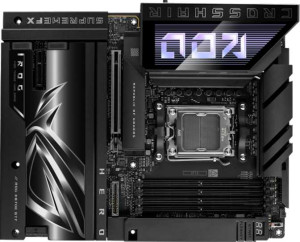
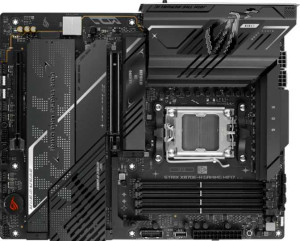
Asus ROG Crosshair X870E Hero BTF
Asus ROG Strix X870E-H Gaming Wi-Fi7

Asus ROG Crosshair X870E Hero BTF Asus ROG Strix X870E-H Gaming Wi-Fi7

Common Features

  • Both products have an AM5 CPU socket.
  • Both products use an X870 chipset.
  • Both products are ATX form factor motherboards.
  • Both products support Wi-Fi 4, Wi-Fi 5, Wi-Fi 6, Wi-Fi 6E, and Wi-Fi 7.
  • Both products have Bluetooth version 5.4.
  • Both products support HDMI 2.1.
  • Both products support a maximum memory amount of 256GB.
  • Both products have 4 memory slots.
  • Both products support DDR5 memory.
  • Both products have 2 memory channels.
  • Both products do not support ECC memory.
  • Both products have 2 USB 4 40Gbps ports.
  • Both products have 6 USB 3.2 Gen 2 ports (USB-A).
  • Both products have an HDMI output.
  • Both products have 4 SATA 3 connectors.
  • Both products support RAID 1, RAID 10, and RAID 0.
  • Both products have 1 PCIe 5.0 x16 slot.
  • Both products have 1 PCIe 4.0 x16 slot.
  • Both products have 7.1 audio channels.
  • Both products have an S/PDIF Out port.

Main Differences

  • RGB lighting is present on Asus ROG Crosshair X870E Hero BTF but not available on Asus ROG Strix X870E-H Gaming Wi-Fi7.
  • Dual BIOS is available on Asus ROG Crosshair X870E Hero BTF but not supported on Asus ROG Strix X870E-H Gaming Wi-Fi7.
  • Asus ROG Crosshair X870E Hero BTF supports overclocked RAM speeds up to 8200 MHz, while Asus ROG Strix X870E-H Gaming Wi-Fi7 supports 8000 MHz.
  • Asus ROG Crosshair X870E Hero BTF has 6 USB 3.2 Gen 2 ports (USB-A), while Asus ROG Strix X870E-H Gaming Wi-Fi7 has 3.
  • Asus ROG Crosshair X870E Hero BTF has 2 USB 3.2 Gen 1 ports (USB-A), while Asus ROG Strix X870E-H Gaming Wi-Fi7 has 6.
  • Asus ROG Crosshair X870E Hero BTF has 2 USB 3.2 Gen 2 ports (USB-C), while Asus ROG Strix X870E-H Gaming Wi-Fi7 has 1.
  • Asus ROG Crosshair X870E Hero BTF has 4 USB 3.0 ports (through expansion), while Asus ROG Strix X870E-H Gaming Wi-Fi7 has 2.
  • Asus ROG Crosshair X870E Hero BTF has 5 M.2 sockets, while Asus ROG Strix X870E-H Gaming Wi-Fi7 has 4.
  • Asus ROG Crosshair X870E Hero BTF supports RAID 5, while Asus ROG Strix X870E-H Gaming Wi-Fi7 does not.
Specs Comparison
Asus ROG Crosshair X870E Hero BTF

Asus ROG Crosshair X870E Hero BTF

Asus ROG Strix X870E-H Gaming Wi-Fi7

Asus ROG Strix X870E-H Gaming Wi-Fi7

General info:
CPU socket AM5 AM5
chipset X870 X870
form factor ATX ATX
release date August 2025 August 2025
supports Wi-Fi
Wi-Fi version Wi-Fi 4 (802.11n), Wi-Fi 5 (802.11ac), Wi-Fi 6 (802.11ax), Wi-Fi 6E (802.11ax), Wi-Fi 7 (802.11be) Wi-Fi 4 (802.11n), Wi-Fi 5 (802.11ac), Wi-Fi 6 (802.11ax), Wi-Fi 6E (802.11ax), Wi-Fi 7 (802.11be)
Has Bluetooth
Bluetooth version 5.4 5.4
HDMI version HDMI 2.1 HDMI 2.1
Easy to overclock
has RGB lighting
Easy to reset BIOS
Has dual BIOS
has aptX
CPU sockets 1 1
Has integrated graphics
warranty period 3 years 3 years
height 244 mm 244 mm
width 305 mm 305 mm
Has integrated CPU

The Asus ROG Crosshair X870E Hero BTF and the Asus ROG Strix X870E-H Gaming Wi-Fi7 both use the AM5 CPU socket and X870 chipset, providing similar foundation specs. They also share the same ATX form factor, making them compatible with standard cases. Both motherboards support Wi-Fi, including Wi-Fi 4 (802.11n), Wi-Fi 5 (802.11ac), Wi-Fi 6 (802.11ax), Wi-Fi 6E (802.11ax), and Wi-Fi 7 (802.11be), ensuring modern wireless connectivity for both products. The Bluetooth version is the same as well, both featuring Bluetooth 5.4 for stable and fast connections.

In terms of HDMI support, both motherboards are equipped with HDMI 2.1, which allows for high-definition video output. Both also support easy overclocking and BIOS resetting, making them user-friendly for enthusiasts. However, the Asus ROG Crosshair X870E Hero BTF includes dual BIOS support, while the Asus ROG Strix X870E-H Gaming Wi-Fi7 does not. Neither motherboard features aptX support, which may be a consideration for users who prioritize high-quality Bluetooth audio streaming.

As for physical dimensions, both motherboards share identical height (244 mm) and width (305 mm), and neither includes integrated graphics or an integrated CPU. Both models come with a 3-year warranty period, ensuring long-term reliability. The ROG Crosshair X870E Hero BTF, however, features RGB lighting, while the Strix X870E-H Gaming Wi-Fi7 lacks this aesthetic feature.

Memory:
maximum memory amount 256GB 256GB
overclocked RAM speed 8200 MHz 8000 MHz
memory slots 4 4
DDR memory version 5 5
memory channels 2 2
Supports ECC memory

The Asus ROG Crosshair X870E Hero BTF and the Asus ROG Strix X870E-H Gaming Wi-Fi7 both support a maximum memory amount of 256GB, ensuring ample capacity for high-performance setups. They are equipped with four memory slots and both support DDR5 memory, which offers improved bandwidth compared to older DDR versions. Additionally, both motherboards operate with dual memory channels for efficient data transfer.

When it comes to overclocking, the two motherboards differ slightly. The Asus ROG Crosshair X870E Hero BTF supports an overclocked RAM speed of 8200 MHz, while the Asus ROG Strix X870E-H Gaming Wi-Fi7 supports a slightly lower overclocked RAM speed of 8000 MHz. This difference is relatively small, but it may be of interest to users aiming for the highest possible memory speeds.

Neither motherboard supports ECC memory, which means neither is designed for error-correcting code memory. This is common in high-end gaming or general-purpose systems, but users needing ECC memory for tasks like server work will need to consider alternatives.

Ports:
USB 3.2 Gen 2 ports (USB-A) 6 3
USB 3.2 Gen 1 ports (USB-A) 0 6
USB 3.2 Gen 2 ports (USB-C) 2 1
USB 3.2 Gen 1 ports (USB-C) 0 0
USB 2.0 ports 0 2
USB 3.2 Gen 2x2 ports 0 0
USB 4 40Gbps ports 2 2
USB 4 20Gbps ports 0 0
Thunderbolt 4 ports 2 2
Thunderbolt 3 ports 0 0
has an HDMI output
DisplayPort outputs 0 0
RJ45 ports 2 1
Has USB Type-C
eSATA ports 0 0
DVI outputs 0 0
has a VGA connector
PS/2 ports 0 0

The Asus ROG Crosshair X870E Hero BTF and the Asus ROG Strix X870E-H Gaming Wi-Fi7 have several similar and differing features when it comes to ports. Both motherboards offer HDMI output, but neither includes DisplayPort outputs, DVI outputs, or a VGA connector. Both models also feature USB Type-C ports, with the ROG Crosshair X870E Hero BTF having 2 USB 3.2 Gen 2 USB-C ports, while the ROG Strix X870E-H Gaming Wi-Fi7 has 1 USB 3.2 Gen 2 USB-C port.

For USB-A ports, the Asus ROG Crosshair X870E Hero BTF includes 6 USB 3.2 Gen 2 ports, whereas the Asus ROG Strix X870E-H Gaming Wi-Fi7 has 3 USB 3.2 Gen 2 ports and 6 USB 3.2 Gen 1 ports. Both motherboards offer USB 4 40Gbps ports (2 each), and Thunderbolt 4 ports (also 2 each), providing high-speed data transfer options. However, the ROG Strix X870E-H Gaming Wi-Fi7 includes 2 USB 2.0 ports, while the ROG Crosshair X870E Hero BTF does not have any USB 2.0 ports.

When it comes to networking, the ROG Crosshair X870E Hero BTF has 2 RJ45 ports, while the ROG Strix X870E-H Gaming Wi-Fi7 includes just 1. Both motherboards have no eSATA ports or PS/2 ports. The ROG Strix X870E-H Gaming Wi-Fi7 offers more USB 2.0 connectivity, while the ROG Crosshair X870E Hero BTF stands out with more USB 3.2 Gen 2 ports and additional RJ45 ports.

Connectors:
USB 3.2 Gen 1 ports (through expansion) 4 2
USB 3.2 Gen 2x2 ports (through expansion) 2 1
USB 2.0 ports (through expansion) 4 4
SATA 3 connectors 4 4
fan headers 6 7
USB 3.0 ports (through expansion) 4 2
M.2 sockets 5 4
Has TPM connector
U.2 sockets 0 0
Has mSATA connector
SATA 2 connectors 0 0

The Asus ROG Crosshair X870E Hero BTF and the Asus ROG Strix X870E-H Gaming Wi-Fi7 both feature a solid set of connectors for expansion and additional storage. The ROG Crosshair X870E Hero BTF offers more USB 3.2 Gen 1 (4 ports) and USB 3.2 Gen 2x2 (2 ports) through expansion compared to the ROG Strix X870E-H Gaming Wi-Fi7, which has 2 USB 3.2 Gen 1 ports and 1 USB 3.2 Gen 2x2 port. Both motherboards include 4 USB 2.0 ports through expansion and 4 SATA 3 connectors, ensuring broad compatibility for peripheral devices and storage options.

When it comes to fan headers, the ROG Strix X870E-H Gaming Wi-Fi7 offers one more than the ROG Crosshair X870E Hero BTF, with 7 fan headers compared to 6 on the ROG Crosshair X870E Hero BTF. This may be relevant for users with extensive cooling setups. The two motherboards both provide a similar number of M.2 sockets—5 on the ROG Crosshair X870E Hero BTF and 4 on the ROG Strix X870E-H Gaming Wi-Fi7—allowing for a variety of SSD storage configurations.

Neither motherboard includes a TPM connector, mSATA connector, or U.2 sockets, which are features that could be useful for specific types of builds. Additionally, both motherboards lack SATA 2 connectors, meaning they focus exclusively on more modern storage connections like SATA 3.

Expansion slots:
PCIe 4.0 x16 slots 1 1
PCIe 5.0 x16 slots 1 1
PCIe 3.0 x16 slots 0 0
PCIe x1 slots 0 0
PCI slots 0 0
PCIe 2.0 x16 slots 0 0
PCIe x8 slots 0 0

The Asus ROG Crosshair X870E Hero BTF and the Asus ROG Strix X870E-H Gaming Wi-Fi7 have identical configurations when it comes to expansion slots. Both motherboards are equipped with 1 PCIe 4.0 x16 slot and 1 PCIe 5.0 x16 slot, which provide high-speed connectivity for modern GPUs and expansion cards. Neither motherboard includes any PCIe 3.0 x16, PCIe 2.0 x16, PCIe x8, PCIe x1, or PCI slots, meaning they both focus on the latest PCIe 4.0 and PCIe 5.0 standards for expansion, and neither offers support for older expansion card types.

In summary, the expansion slot configurations are the same for both models, with no differences in the number or types of slots offered. Both motherboards cater to users looking for high-performance PCIe slots for their builds.

Audio:
Signal-to-Noise ratio (DAC) 130 dB 120 dB
audio channels 7.1 7.1
Has S/PDIF Out port
audio connectors 2 2

The Asus ROG Crosshair X870E Hero BTF and the Asus ROG Strix X870E-H Gaming Wi-Fi7 both offer high-quality audio setups, supporting 7.1 audio channels for immersive sound. They also both include 2 audio connectors and an S/PDIF Out port for digital audio output. The primary difference between the two models lies in the signal-to-noise ratio (SNR) of the DAC. The ROG Crosshair X870E Hero BTF has a slightly higher SNR of 130 dB, while the ROG Strix X870E-H Gaming Wi-Fi7 has an SNR of 120 dB. This difference could have a slight impact on audio clarity, with the ROG Crosshair X870E Hero BTF offering a slightly cleaner output.

Overall, both motherboards provide similar audio features, including support for 7.1 audio channels and the same audio connectors and S/PDIF Out port. The key distinction is the signal-to-noise ratio, with the ROG Crosshair X870E Hero BTF having a marginally higher value for a potentially quieter audio experience.

Storage:
Supports RAID 1
Supports RAID 10 (1+0)
Supports RAID 5
Supports RAID 0
Supports RAID 0+1

The Asus ROG Crosshair X870E Hero BTF and the Asus ROG Strix X870E-H Gaming Wi-Fi7 both support a variety of RAID configurations. Both motherboards support RAID 1 (mirroring) and RAID 10 (1+0, combining mirroring and striping). Additionally, the ROG Crosshair X870E Hero BTF supports RAID 5 (striping with parity), while the ROG Strix X870E-H Gaming Wi-Fi7 does not. Neither motherboard supports RAID 0+1 (a mirrored version of RAID 0), which limits certain RAID configurations.

Overall, the main difference in storage options is that the ROG Crosshair X870E Hero BTF offers RAID 5 support, while the ROG Strix X870E-H Gaming Wi-Fi7 does not. Both motherboards, however, provide RAID 1 and RAID 10 support, allowing users to choose from common configurations for redundancy or performance.

Comparison Summary

This is a specification comparison between Asus ROG Crosshair X870E Hero BTF and Asus ROG Strix X870E-H Gaming Wi-Fi7. Both motherboards share common features such as an AM5 CPU socket, X870 chipset, and support for Wi-Fi 4 to Wi-Fi 7 standards. However, there are some key differences: the Asus ROG Crosshair X870E Hero BTF includes RGB lighting and dual BIOS, which are not found on the Asus ROG Strix X870E-H Gaming Wi-Fi7. Additionally, the Crosshair model supports higher overclocked RAM speeds (8200 MHz vs. 8000 MHz), has more USB 3.2 Gen 2 ports (6 vs. 3), and features additional USB 3.0 ports (through expansion) (4 vs. 2). Finally, the Crosshair model supports RAID 5, while the Strix does not.