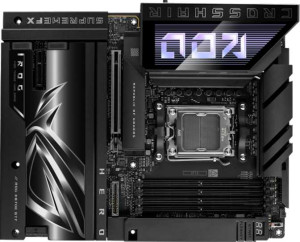
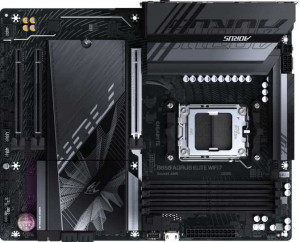
At a foundational level, both boards share a remarkably similar profile: identical ATX form factor, the same AM5 socket, matching dimensions (244 × 305 mm), identical wireless connectivity up to Wi-Fi 7 (802.11be) and Bluetooth 5.4, a 3-year warranty, dual BIOS, and RGB lighting. For buyers focused purely on platform compatibility or wireless capability, these two boards are effectively tied — neither offers anything the other does not in those areas.
The most significant general differentiator is the chipset. The Asus ROG Crosshair X870E Hero BTF runs AMD's flagship X870 chipset, while the Gigabyte B850 Aorus Elite WiFi7 uses the mid-range B850. In practice, this matters most for users who need maximum PCIe lane availability, USB bandwidth headroom, and more granular control over memory and CPU tuning — areas where X870 has architectural advantages by design. That said, both boards are listed as easy to overclock, so casual tuners are not locked out on the B850 side.
A smaller but notable practical edge goes to the Asus: it supports easy BIOS reset, while the Gigabyte does not. This is a quality-of-life feature that matters most during overclocking experiments or system troubleshooting, where a failed POST can otherwise become a frustrating recovery process. Overall, the Asus ROG Crosshair X870E Hero BTF holds a clear advantage in this group — both through its higher-tier chipset and its more recovery-friendly BIOS handling — making it the stronger choice for power users and enthusiasts.