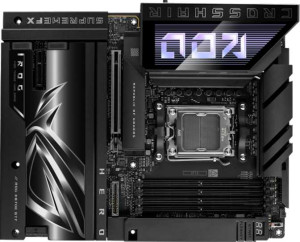
Asus ROG Crosshair X870E Hero BTF
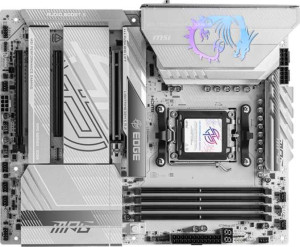
MSI MPG X870E Edge TI WiFi

Asus ROG Crosshair X870E Hero BTF MSI MPG X870E Edge TI WiFi

Overview

This head-to-head comparison between the Asus ROG Crosshair X870E Hero BTF and the MSI MPG X870E Edge TI WiFi puts two premium AM5 motherboards under the microscope. While they share an impressive common foundation, key battlegrounds emerge around storage and connectivity options, audio quality, memory overclocking headroom, and board-level features. Explore the full breakdown below to determine which X870E platform best suits your build.

Common Features

  • Both motherboards use the AM5 CPU socket.
  • Both motherboards feature the X870 chipset.
  • Both motherboards have an ATX form factor.
  • Both motherboards support Wi-Fi, including Wi-Fi 4, Wi-Fi 5, Wi-Fi 6, Wi-Fi 6E, and Wi-Fi 7.
  • Both motherboards have Bluetooth 5.4.
  • Both motherboards feature HDMI 2.1 output.
  • Both motherboards support up to 256 GB of DDR5 memory across 4 slots in a dual-channel configuration.
  • ECC memory support is not available on either motherboard.
  • Both motherboards have 2 USB 4 40Gbps ports and 2 Thunderbolt 4 ports, with no USB 3.2 Gen 1, USB 3.2 Gen 2x2, USB 4 20Gbps, or Thunderbolt 3 ports on the rear panel.
  • Both motherboards provide 4 USB 3.2 Gen 1, 4 USB 2.0, and 4 USB 3.0 ports through expansion headers.
  • Both motherboards have 4 SATA 3 connectors and no SATA 2 connectors, mSATA connector, or U.2 sockets.
  • Both motherboards feature 1 PCIe 5.0 x16 slot and 1 PCIe 4.0 x16 slot, with no PCIe 3.0, PCIe 2.0, PCI, PCIe x4, or PCIe x8 slots.
  • Both motherboards deliver 7.1 audio channels with 2 audio connectors and an S/PDIF Out port.
  • Both motherboards support RAID 0, RAID 1, and RAID 10, but neither supports RAID 0+1.

Main Differences

  • Dual BIOS is available on Asus ROG Crosshair X870E Hero BTF but not on MSI MPG X870E Edge TI WiFi.
  • aptX support is present on MSI MPG X870E Edge TI WiFi but not on Asus ROG Crosshair X870E Hero BTF.
  • Height is 244 mm on Asus ROG Crosshair X870E Hero BTF and 243.8 mm on MSI MPG X870E Edge TI WiFi.
  • Width is 305 mm on Asus ROG Crosshair X870E Hero BTF and 304.8 mm on MSI MPG X870E Edge TI WiFi.
  • Maximum overclocked RAM speed is 8200 MHz on Asus ROG Crosshair X870E Hero BTF and 8400 MHz on MSI MPG X870E Edge TI WiFi.
  • USB 3.2 Gen 2 Type-A ports count is 6 on Asus ROG Crosshair X870E Hero BTF and 5 on MSI MPG X870E Edge TI WiFi.
  • USB 3.2 Gen 2 Type-C ports count is 2 on Asus ROG Crosshair X870E Hero BTF and 1 on MSI MPG X870E Edge TI WiFi.
  • USB 2.0 rear panel ports number is 0 on Asus ROG Crosshair X870E Hero BTF and 4 on MSI MPG X870E Edge TI WiFi.
  • RJ45 port count is 2 on Asus ROG Crosshair X870E Hero BTF and 1 on MSI MPG X870E Edge TI WiFi.
  • USB 3.2 Gen 2x2 expansion ports count is 2 on Asus ROG Crosshair X870E Hero BTF and 1 on MSI MPG X870E Edge TI WiFi.
  • Fan headers count is 6 on Asus ROG Crosshair X870E Hero BTF and 8 on MSI MPG X870E Edge TI WiFi.
  • M.2 sockets count is 5 on Asus ROG Crosshair X870E Hero BTF and 4 on MSI MPG X870E Edge TI WiFi.
  • A TPM connector is present on MSI MPG X870E Edge TI WiFi but not on Asus ROG Crosshair X870E Hero BTF.
  • PCIe x1 slot count is 0 on Asus ROG Crosshair X870E Hero BTF and 1 on MSI MPG X870E Edge TI WiFi.
  • Audio signal-to-noise ratio is 130 dB on Asus ROG Crosshair X870E Hero BTF and 120 dB on MSI MPG X870E Edge TI WiFi.
  • RAID 5 support is available on Asus ROG Crosshair X870E Hero BTF but not on MSI MPG X870E Edge TI WiFi.
Specs Comparison
Asus ROG Crosshair X870E Hero BTF

Asus ROG Crosshair X870E Hero BTF

MSI MPG X870E Edge TI WiFi

MSI MPG X870E Edge TI WiFi

General info:
CPU socket AM5 AM5
chipset X870 X870
form factor ATX ATX
release date August 2025 January 2025
supports Wi-Fi
Wi-Fi version Wi-Fi 4 (802.11n), Wi-Fi 5 (802.11ac), Wi-Fi 6 (802.11ax), Wi-Fi 6E (802.11ax), Wi-Fi 7 (802.11be) Wi-Fi 4 (802.11n), Wi-Fi 5 (802.11ac), Wi-Fi 6 (802.11ax), Wi-Fi 6E (802.11ax), Wi-Fi 7 (802.11be)
Has Bluetooth
Bluetooth version 5.4 5.4
HDMI version HDMI 2.1 HDMI 2.1
Easy to overclock
has RGB lighting
Easy to reset BIOS
Has dual BIOS
has aptX
CPU sockets 1 1
Has integrated graphics
warranty period 3 years 3 years
height 244 mm 243.8 mm
width 305 mm 304.8 mm
Has integrated CPU

At the platform level, the Asus ROG Crosshair X870E Hero BTF and the MSI MPG X870E Edge TI WiFi are remarkably well-matched. Both are full-size ATX boards built on the AMD X870 chipset with an AM5 socket, and they share an identical wireless stack — Wi-Fi 7 (802.11be) with backward compatibility down to Wi-Fi 4, plus Bluetooth 5.4 — meaning neither board has a connectivity edge over the other. Physical dimensions are virtually the same (a difference of less than 0.2 mm in both directions), so both will fit any standard ATX case without issue.

The meaningful differentiators are two: the Asus ROG includes a dual BIOS feature, while the MSI MPG counters with aptX audio support. Dual BIOS is a tangible reliability and experimentation advantage — it provides a hardware-level fallback if a BIOS flash goes wrong, which is especially relevant for enthusiasts who push firmware updates or overclock aggressively. aptX, on the other hand, improves Bluetooth audio codec efficiency for compatible headsets, but its practical benefit is limited to users who specifically use aptX-capable wireless audio gear over Bluetooth — a narrower use case. Both boards otherwise offer RGB lighting, easy BIOS reset, and straightforward overclocking access, so day-to-day usability is effectively tied.

On balance, the Asus ROG Crosshair X870E Hero BTF holds a slight edge in this category. Dual BIOS offers a broader, more universally applicable safety net than aptX audio support, making it the more impactful exclusive feature for the typical high-performance build. Users who rely heavily on Bluetooth audio with aptX hardware may see value in the MSI, but for most builders, the ROG's firmware redundancy is the more meaningful differentiator.
Memory:
maximum memory amount 256GB 256GB
overclocked RAM speed 8200 MHz 8400 MHz
memory slots 4 4
DDR memory version 5 5
memory channels 2 2
Supports ECC memory

Memory support across these two boards is almost a carbon copy: both offer 4 DDR5 slots, a 256GB capacity ceiling, dual-channel architecture, and no ECC support. For the vast majority of builds — from gaming rigs to content creation workstations — 256GB is a ceiling nobody will realistically approach, and dual-channel DDR5 delivers the bandwidth needed for modern AM5 processors without compromise.

The sole differentiator here is the maximum overclocked RAM speed. The MSI MPG X870E Edge TI WiFi edges ahead with a rated overclock ceiling of 8400 MHz, compared to 8200 MHz on the Asus ROG Crosshair X870E Hero BTF. In practice, the gap is narrow — 200 MHz at these frequencies translates to a marginal real-world performance difference in memory-bandwidth-sensitive workloads, and most users running even high-end DDR5 kits will never push either board to its rated limit.

The MSI MPG X870E Edge TI WiFi holds a technical edge in this category, but only just. The higher overclocked frequency ceiling gives extreme memory enthusiasts slightly more headroom, while day-to-day users will find both boards functionally equivalent for memory configuration and capacity.

Ports:
USB 3.2 Gen 2 ports (USB-A) 6 5
USB 3.2 Gen 1 ports (USB-A) 0 0
USB 3.2 Gen 2 ports (USB-C) 2 1
USB 3.2 Gen 1 ports (USB-C) 0 0
USB 2.0 ports 0 4
USB 3.2 Gen 2x2 ports 0 0
USB 4 40Gbps ports 2 2
USB 4 20Gbps ports 0 0
Thunderbolt 4 ports 2 2
Thunderbolt 3 ports 0 0
has an HDMI output
DisplayPort outputs 0 0
RJ45 ports 2 1
Has USB Type-C
eSATA ports 0 0
DVI outputs 0 0
has a VGA connector
PS/2 ports 0 0

Where these two boards truly diverge is in rear I/O port configuration. Both share a strong high-speed foundation — 2x USB4 40Gbps and 2x Thunderbolt 4 ports each — delivering the bandwidth needed for fast external SSDs, docks, and next-generation peripherals. Beyond that shared core, however, the Asus ROG Crosshair X870E Hero BTF pulls ahead meaningfully. It offers 6 USB 3.2 Gen 2 Type-A ports versus 5 on the MSI MPG X870E Edge TI WiFi, plus 2 USB 3.2 Gen 2 Type-C ports compared to just 1 — giving it a broader selection of 10Gbps connections for mice, keyboards, audio interfaces, and other speed-sensitive peripherals.

The dual RJ45 Ethernet ports on the Asus ROG are a significant real-world differentiator. Two independent LAN ports allow simultaneous connections to two networks — useful for streamers routing game and stream traffic separately, NAS users maximizing throughput via link aggregation, or lab setups requiring network isolation. The MSI carries only a single RJ45. On the flip side, the MSI includes 4 USB 2.0 ports where the Asus has none, which can be convenient for legacy input devices or wireless receivers that don't benefit from higher bandwidth anyway — though this is a modest concession compared to what the Asus gains elsewhere.

The Asus ROG Crosshair X870E Hero BTF has a clear advantage in this category. More high-speed USB ports across both Type-A and Type-C, combined with dual Ethernet, make it the more versatile and future-oriented I/O platform — particularly for power users and content creators who juggle multiple high-bandwidth devices simultaneously.

Connectors:
USB 3.2 Gen 1 ports (through expansion) 4 4
USB 3.2 Gen 2x2 ports (through expansion) 2 1
USB 2.0 ports (through expansion) 4 4
SATA 3 connectors 4 4
fan headers 6 8
USB 3.0 ports (through expansion) 4 4
M.2 sockets 5 4
Has TPM connector
U.2 sockets 0 0
Has mSATA connector
SATA 2 connectors 0 0

Internal connectivity tells an interesting story of competing priorities. The Asus ROG Crosshair X870E Hero BTF leads on storage expandability with 5 M.2 sockets against the MSI MPG X870E Edge TI WiFi's 4 — a meaningful difference for builders who want to run multiple NVMe SSDs without relying on SATA. Both boards provide 4 SATA 3 connectors, so traditional drive arrays are equally supported, but that extra M.2 slot on the Asus gives it a genuine advantage for storage-heavy configurations like video editing workstations or large game libraries.

Thermal management headroom flips the advantage to the MSI. With 8 fan headers versus the Asus's 6, the MSI MPG accommodates more elaborate cooling setups without requiring a fan hub — relevant for full-tower builds with numerous case fans, custom water cooling loops with multiple pumps, or anyone pursuing aggressive thermal control. The MSI also includes a dedicated TPM connector, which the Asus lacks; for enterprise users, security-conscious builders, or those running Windows 11 with hardware-based security features, this is a useful addition. The Asus counters with 2 USB 3.2 Gen 2x2 internal headers (20Gbps) versus just 1 on the MSI, offering faster front-panel USB expansion potential.

This category is genuinely split by use case. The Asus ROG has the edge for storage enthusiasts who want maximum NVMe flexibility, while the MSI MPG is better suited for complex cooling setups and security-oriented builds. Neither board holds an unambiguous overall lead here — the right choice depends on whether M.2 slots or fan headers matter more to the individual builder.

Expansion slots:
PCIe 4.0 x16 slots 1 1
PCIe 5.0 x16 slots 1 1
PCIe 3.0 x16 slots 0 0
PCIe x1 slots 0 1
PCI slots 0 0
PCIe 2.0 x16 slots 0 0
PCIe x4 slots 0 0
PCIe x8 slots 0 0

Expansion slot configurations are nearly identical between these two boards. Both provide the essentials for a modern high-performance build: one PCIe 5.0 x16 slot for a primary GPU or next-generation add-in card, and one PCIe 4.0 x16 slot for a secondary device. The PCIe 5.0 primary slot is particularly important at this tier — it ensures the board is ready for current and upcoming graphics cards and NVMe expansion cards without any bandwidth bottleneck.

The only differentiator is the MSI MPG X870E Edge TI WiFi's additional PCIe x1 slot, which the Asus ROG Crosshair X870E Hero BTF lacks entirely. PCIe x1 slots accommodate smaller add-in cards — sound cards, capture cards, additional USB or SATA controllers — without consuming a full x16 slot. It is a modest but practical inclusion for builders who want to extend functionality without sacrificing their secondary x16 slot.

The MSI MPG holds a narrow edge here solely due to that extra PCIe x1 slot. For the majority of users running a single GPU with no legacy or specialty add-in cards, both boards are functionally equivalent. The Asus's omission only becomes a real constraint in niche scenarios requiring three simultaneous expansion cards.

Audio:
Signal-to-Noise ratio (DAC) 130 dB 120 dB
audio channels 7.1 7.1
Has S/PDIF Out port
audio connectors 2 2

Audio is one of the clearer-cut categories in this comparison. Both boards deliver 7.1-channel output, 2 analog audio connectors, and an S/PDIF optical output for connecting to external receivers or DACs — a solid and equivalent foundation for most listening setups. The key differentiator, however, is the signal-to-noise ratio of the onboard DAC: the Asus ROG Crosshair X870E Hero BTF rates at 130 dB SNR, while the MSI MPG X870E Edge TI WiFi comes in at 120 dB SNR.

That 10 dB gap is more significant than it might appear. SNR measures how cleanly the audio signal is reproduced relative to background noise — a higher number means less audible hiss, more dynamic range, and greater fidelity, particularly at high volumes or with sensitive headphones and studio monitors. At 120 dB, the MSI is already beyond the threshold of what most consumer-grade equipment can fully resolve, but the Asus's 130 dB rating provides a more comfortable margin for audiophiles using high-impedance headphones or recording applications where noise floor matters.

The Asus ROG Crosshair X870E Hero BTF has a clear advantage in this category. For casual gaming or general media use the difference may be imperceptible, but for users who prioritize onboard audio quality — particularly those with high-end headphones or who use the analog outputs for music production — the 130 dB SNR rating is a meaningful step up over the MSI's 120 dB.

Storage:
Supports RAID 1
Supports RAID 10 (1+0)
Supports RAID 5
Supports RAID 0
Supports RAID 0+1

RAID support between these two boards is largely aligned, with both handling the most common configurations: RAID 0 for maximum throughput, RAID 1 for mirroring and redundancy, and RAID 10 for a balance of both. For the overwhelming majority of enthusiast builders, these three modes cover every realistic multi-drive scenario — from fast scratch disk arrays to basic data protection setups.

The single point of divergence is RAID 5 support, which the Asus ROG Crosshair X870E Hero BTF includes and the MSI MPG X870E Edge TI WiFi does not. RAID 5 distributes parity data across three or more drives, offering fault tolerance with more usable capacity than RAID 1 — making it attractive for small NAS-style configurations where storage efficiency matters alongside redundancy. Its absence on the MSI is a tangible omission for anyone planning a multi-drive array where maximizing usable space while retaining a safety net is a priority.

The Asus ROG Crosshair X870E Hero BTF has the edge here. RAID 5 is an uncommon requirement in consumer desktop builds, but for users who specifically intend to configure a multi-drive redundant array with capacity efficiency in mind, the Asus is the only option of the two that accommodates it.

Comparison Summary & Verdict

Both boards deliver a near-identical feature-rich foundation — AM5 socket, X870 chipset, Wi-Fi 7, Bluetooth 5.4, PCIe 5.0, Thunderbolt 4, and 7.1 audio — making either a strong choice for a high-end AMD build. The Asus ROG Crosshair X870E Hero BTF pulls ahead for users who need more storage flexibility with its 5 M.2 sockets, dual network ports, more USB 3.2 Gen 2 ports, higher 130 dB audio SNR, dual BIOS for added resilience, and RAID 5 support. The MSI MPG X870E Edge TI WiFi is the better fit for builders who prioritize greater fan header count (8 vs 6) for complex cooling setups, a higher maximum RAM overclock of 8400 MHz, a TPM connector, aptX audio support, and a rear USB 2.0 presence for legacy peripherals. Neither board has a clear overall winner — your ideal pick depends on whether storage expansion or thermal control flexibility matters more to you.

Asus ROG Crosshair X870E Hero BTF
Buy Asus ROG Crosshair X870E Hero BTF if...

Buy the Asus ROG Crosshair X870E Hero BTF if you need more M.2 slots, dual LAN ports, a higher audio SNR of 130 dB, dual BIOS support, and RAID 5 capability.

MSI MPG X870E Edge TI WiFi
Buy MSI MPG X870E Edge TI WiFi if...

Buy the MSI MPG X870E Edge TI WiFi if you want more fan headers for advanced cooling, a higher RAM overclock ceiling of 8400 MHz, a TPM connector, and aptX audio support.