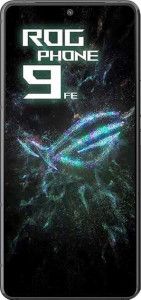
Asus ROG Phone 9 FE
ZTE Nubia Red Magic 10S Pro

Asus ROG Phone 9 FE ZTE Nubia Red Magic 10S Pro

Overview

Welcome to our in-depth comparison of the Asus ROG Phone 9 FE and the ZTE Nubia Red Magic 10S Pro — two powerhouse gaming smartphones that take very different approaches to key areas like display performance, raw processing power, and battery endurance. Whether you care most about chipset generation, camera versatility, or day-to-day protection, this side-by-side breakdown covers every spec that matters to help you make the right choice.

Common Features

  • Both phones share the same thickness of 8.9 mm.
  • Neither phone can be folded.
  • Both phones feature an OLED/AMOLED display type.
  • Both phones have branded damage-resistant glass on the display.
  • Always-On Display is available on both phones.
  • Both phones have a touchscreen.
  • Both phones run Android 15.
  • Both phones support 5G connectivity.
  • Both phones have a Bluetooth version of 5.4.
  • Both phones support Wi-Fi 7 (802.11be), Wi-Fi 6E, Wi-Fi 6, Wi-Fi 5, and Wi-Fi 4.
  • Both phones have a USB Type-C port.
  • Both phones support NFC.
  • Both phones have a maximum download speed of 10000 MBits/s.
  • Both phones support fast charging.
  • Neither phone has a removable battery.
  • Both phones have a 3.5 mm audio jack.
  • Both phones feature stereo speakers.
  • Both phones support aptX HD, aptX Adaptive, and aptX Lossless.
  • Both phones have a multi-lens main camera with built-in optical image stabilization.
  • Both phones support slow-motion video recording and have a built-in HDR mode.
  • Both phones use 2 SIM cards and have no external memory slot.
  • Neither phone has a radio.
  • Both phones have a flat (non-curved) display.
  • Both phones have a video light.

Main Differences

  • Water resistance is rated as Waterproof (IP68) on Asus ROG Phone 9 FE and Water resistant (IP54) on ZTE Nubia Red Magic 10S Pro.
  • Weight is 225 g on Asus ROG Phone 9 FE and 229 g on ZTE Nubia Red Magic 10S Pro.
  • Width is 76.8 mm on Asus ROG Phone 9 FE and 76.1 mm on ZTE Nubia Red Magic 10S Pro.
  • Height is 163.8 mm on Asus ROG Phone 9 FE and 163.4 mm on ZTE Nubia Red Magic 10S Pro.
  • Screen size is 6.78″ on Asus ROG Phone 9 FE and 6.85″ on ZTE Nubia Red Magic 10S Pro.
  • Pixel density is 388 ppi on Asus ROG Phone 9 FE and 431 ppi on ZTE Nubia Red Magic 10S Pro.
  • Resolution is 1080 x 2400 px on Asus ROG Phone 9 FE and 1216 x 2688 px on ZTE Nubia Red Magic 10S Pro.
  • Refresh rate is 185Hz on Asus ROG Phone 9 FE and 144Hz on ZTE Nubia Red Magic 10S Pro.
  • Touch sampling rate is 720Hz on Asus ROG Phone 9 FE and 960Hz on ZTE Nubia Red Magic 10S Pro.
  • Typical brightness is 1600 nits on Asus ROG Phone 9 FE and 2000 nits on ZTE Nubia Red Magic 10S Pro.
  • Gorilla Glass version is Gorilla Glass Victus 2 on Asus ROG Phone 9 FE and Gorilla Glass 5 on ZTE Nubia Red Magic 10S Pro.
  • HDR10 support is present on Asus ROG Phone 9 FE but not available on ZTE Nubia Red Magic 10S Pro.
  • HDR10+ support is present on Asus ROG Phone 9 FE but not available on ZTE Nubia Red Magic 10S Pro.
  • Chipset is Qualcomm Snapdragon 8 Gen 3 on Asus ROG Phone 9 FE and Qualcomm Snapdragon 8 Elite on ZTE Nubia Red Magic 10S Pro.
  • GPU is Adreno 750 on Asus ROG Phone 9 FE and Adreno 830 on ZTE Nubia Red Magic 10S Pro.
  • RAM is 16GB on Asus ROG Phone 9 FE and 12GB on ZTE Nubia Red Magic 10S Pro.
  • Internal storage is 256GB on Asus ROG Phone 9 FE and 512GB on ZTE Nubia Red Magic 10S Pro.
  • Geekbench 6 multi-core score is 7325 on Asus ROG Phone 9 FE and 10059 on ZTE Nubia Red Magic 10S Pro.
  • Geekbench 6 single-core score is 2213 on Asus ROG Phone 9 FE and 3234 on ZTE Nubia Red Magic 10S Pro.
  • Semiconductor size is 4 nm on Asus ROG Phone 9 FE and 3 nm on ZTE Nubia Red Magic 10S Pro.
  • Main camera megapixels are 50 & 13 & 5 MP on Asus ROG Phone 9 FE and 50 & 50 & 2 MP on ZTE Nubia Red Magic 10S Pro.
  • Front camera resolution is 32MP on Asus ROG Phone 9 FE and 16MP on ZTE Nubia Red Magic 10S Pro.
  • Maximum video recording resolution is 2160 x 30 fps on Asus ROG Phone 9 FE and 4320 x 30 fps on ZTE Nubia Red Magic 10S Pro.
  • A BSI sensor is present on ZTE Nubia Red Magic 10S Pro but not on Asus ROG Phone 9 FE.
  • Laser autofocus is available on Asus ROG Phone 9 FE but not on ZTE Nubia Red Magic 10S Pro.
  • An under-display front-facing camera is featured on ZTE Nubia Red Magic 10S Pro but not on Asus ROG Phone 9 FE.
  • Battery capacity is 5500 mAh on Asus ROG Phone 9 FE and 7050 mAh on ZTE Nubia Red Magic 10S Pro.
  • Wireless charging is supported on Asus ROG Phone 9 FE but not available on ZTE Nubia Red Magic 10S Pro.
  • Wired charging speed is 65W on Asus ROG Phone 9 FE and 80W on ZTE Nubia Red Magic 10S Pro.
  • aptX support is present on Asus ROG Phone 9 FE but not available on ZTE Nubia Red Magic 10S Pro.
  • An infrared sensor is present on ZTE Nubia Red Magic 10S Pro but not on Asus ROG Phone 9 FE.
Specs Comparison
Asus ROG Phone 9 FE

Asus ROG Phone 9 FE

ZTE Nubia Red Magic 10S Pro

ZTE Nubia Red Magic 10S Pro

Design:
water resistance Waterproof Water resistant
weight 225 g 229 g
thickness 8.9 mm 8.9 mm
width 76.8 mm 76.1 mm
height 163.8 mm 163.4 mm
volume 111.960576 cm³ 110.669186 cm³
Ingress Protection (IP) rating IP68 IP54
can be folded

In terms of physical footprint, the Asus ROG Phone 9 FE and ZTE Nubia Red Magic 10S Pro are remarkably close siblings. Both share identical 8.9 mm thickness and nearly the same height and width, making them virtually indistinguishable in hand from a size perspective. The ROG Phone 9 FE is fractionally wider and taller, resulting in a marginally larger volume, while the Red Magic 10S Pro trims a slight 4 g off the scale at 229 g vs. 225 g — a difference so small it would be imperceptible in daily use. Neither phone can be folded, as expected for gaming-oriented slabs.

Where the two genuinely diverge is in water and dust protection. The ROG Phone 9 FE carries an IP68 rating, meaning it is fully waterproof and can withstand submersion in up to 1.5 meters of fresh water for 30 minutes. The Red Magic 10S Pro, by contrast, is rated only IP54, which offers splash and dust resistance but provides no protection against submersion — even a brief dunk could cause damage. For gaming phones used in intense, sweaty sessions or unpredictable environments, this is a meaningful real-world distinction.

The ROG Phone 9 FE holds a clear design edge in this group, not because of its dimensions — which are essentially a tie — but because its superior IP68 waterproofing offers significantly greater durability and peace of mind over the Red Magic 10S Pro's more limited IP54 resistance.

Display:
Display type OLED/AMOLED OLED/AMOLED
screen size 6.78" 6.85"
pixel density 388 ppi 431 ppi
resolution 1080 x 2400 px 1216 x 2688 px
refresh rate 185Hz 144Hz
touch sampling rate 720Hz 960Hz
brightness (typical) 1600 nits 2000 nits
has branded damage-resistant glass
Gorilla Glass version Gorilla Glass Victus 2 Gorilla Glass 5
supports HDR10
supports HDR10+
Always-On Display
has a touch screen

Both phones use OLED/AMOLED panels, so the baseline display quality is strong on each side — deep blacks, vibrant colors, and good contrast are a given. The real story is how they diverge on the metrics that matter most. The Red Magic 10S Pro pairs a larger 6.85″ screen with a substantially higher 431 ppi pixel density at a 1216 x 2688 resolution, versus the ROG Phone 9 FE's 388 ppi at 1080 x 2400. In practice, that gap is visible — text edges are crisper and fine game textures render with more detail on the Red Magic. Its 2000 nits of typical brightness also gives it a meaningful outdoor usability advantage over the ROG's 1600 nits.

On the gaming-responsiveness side, the picture is more nuanced. The ROG Phone 9 FE counters with a higher 185Hz refresh rate compared to the Red Magic's 144Hz, which translates to smoother motion in fast-paced titles — though the Red Magic's superior 960Hz touch sampling rate (vs. 720Hz) means it registers finger inputs with greater precision and lower latency. For HDR content, the ROG holds an exclusive edge: it supports both HDR10 and HDR10+, while the Red Magic supports neither, making the ROG the better screen for streaming compatible video. The ROG also benefits from the newer Gorilla Glass Victus 2, a tangible durability upgrade over the Red Magic's Gorilla Glass 5.

This group is genuinely split, and the right winner depends on priorities. For raw visual fidelity and brightness, the Red Magic 10S Pro holds the edge. But if HDR streaming, higher refresh rate, or superior glass protection matter more, the ROG Phone 9 FE makes a compelling case. On balance, the Red Magic's sharpness and brightness lead gives it a slight overall display advantage for gaming use.

Performance:
internal storage 256GB 512GB
RAM 16GB 12GB
Chipset (SoC) name Qualcomm Snapdragon 8 Gen 3 Qualcomm Snapdragon 8 Elite
GPU name Adreno 750 Adreno 830
CPU speed 3 x 3.15 & 2 x 2.96 & 2 x 2.26 & 1 x 3.3 GHz 2 x 4.47 & 6 x 3.53 GHz
Geekbench 6 result (multi) 7325 10059
Geekbench 6 result (single) 2213 3234
GPU clock speed 900 MHz 1100 MHz
Has integrated LTE
RAM speed 4800 MHz 5300 MHz
semiconductor size 4 nm 3 nm
Supports 64-bit
DirectX version DirectX 12 DirectX 12
Has integrated graphics
OpenGL version 3.2 3.2
OpenGL ES version 3.2 3.2
Uses big.LITTLE technology
CPU threads 8 threads 8 threads
Uses HMP
Has TrustZone
maximum memory bandwidth 76.6 GB/s 85.1 GB/s
OpenCL version 2 3
memory channels 2 2
L2 cache 1 MB 12 MB
maximum memory amount 24GB 24GB
uses multithreading
Thermal Design Power (TDP) 12.5W 8.2W
DDR memory version 5 5
supported displays 1 2
L3 cache 12 MB 8 MB

The chipset gap here is significant and drives nearly every other performance difference. The ROG Phone 9 FE runs on the Snapdragon 8 Gen 3, a capable 4 nm flagship chip, but the Red Magic 10S Pro steps up to the newer Snapdragon 8 Elite built on a 3 nm process — a full generation ahead. That architectural leap shows plainly in the benchmarks: the Red Magic achieves a Geekbench 6 multi-core score of 10,059 versus the ROG's 7,325, and a single-core score of 3,234 against 2,213. These are not marginal differences — they translate to noticeably faster app launches, smoother AI-driven processing, and more headroom under sustained gaming loads.

The GPU story follows the same pattern. The Red Magic's Adreno 830 clocks at 1100 MHz with 85.1 GB/s memory bandwidth, compared to the ROG's Adreno 750 at 900 MHz and 76.6 GB/s. For demanding 3D titles, this gap means higher sustained frame rates and better visual fidelity at peak settings. Notably, the Red Magic also achieves this with a lower TDP of 8.2W versus the ROG's 12.5W, meaning the newer chip does more while generating less heat — a crucial advantage in a gaming phone where thermal throttling is a real concern during long sessions.

The ROG Phone 9 FE does counter with more RAM — 16 GB versus the Red Magic's 12 GB — which benefits heavy multitasking and keeping more apps resident in memory. The Red Magic, however, doubles the base storage at 512 GB. On balance, the Red Magic 10S Pro holds a clear and decisive performance advantage in this group, driven by a generationally superior chipset that leads on raw compute, GPU throughput, memory bandwidth, and thermal efficiency.

Cameras:
megapixels (main camera) 50 & 13 & 5 MP 50 & 50 & 2 MP
wide aperture (main camera) 1.9 & 2.2 & 2.4f 1.9 & 2 & 2.4f
Has a dual-lens (or multi-lens) main camera
megapixels (front camera) 32MP 16MP
has built-in optical image stabilization
video recording (main camera) 2160 x 30 fps 4320 x 30 fps
has a BSI sensor
has a CMOS sensor
has continuous autofocus when recording movies
Has phase-detection autofocus for photos
supports slow-motion video recording
has a built-in HDR mode
has manual exposure
has a flash
has manual ISO
has a serial shot mode
has manual focus
has a front camera
Has laser autofocus
Shoots 360° panorama
has manual white balance
has touch autofocus
has manual shutter speed
can create panoramas in-camera
Has timelapse function
Has a front-facing LED flash
has a dual-lens (or multi-lens) front camera
has a front-facing camera under the display
Has a RGB LED flash

Both phones share a 50 MP primary sensor with an f/1.9 aperture and OIS, so the foundation of their main cameras is comparable. The divergence comes in the secondary lenses. The ROG Phone 9 FE opts for a 13 MP ultrawide and a 5 MP macro, while the Red Magic 10S Pro pairs its main sensor with a second 50 MP camera — a substantially more capable secondary shooter that captures far more detail for portraits or close-range subjects. The Red Magic also adds a BSI sensor, which improves light gathering efficiency, particularly in low-light conditions, an advantage the ROG lacks entirely.

The video recording gap is equally notable. The Red Magic 10S Pro tops out at 8K (4320p) at 30 fps, while the ROG Phone 9 FE caps at 4K (2160p) at 30 fps. For most users, 4K is more than sufficient, but the 8K ceiling signals a more capable video pipeline overall. In return, the ROG brings laser autofocus, which aids in faster and more reliable subject locking — something the Red Magic omits. On the selfie side, the ROG offers a higher-resolution 32 MP front camera versus the Red Magic's 16 MP, a meaningful gap for self-portraits and video calls. The Red Magic counters with an under-display front camera, preserving a fully uninterrupted screen — a design choice that trades raw resolution for visual cleanliness.

The Red Magic 10S Pro holds the camera edge overall, primarily due to its far superior secondary rear camera, BSI sensor advantage, and 8K video capability. However, users who prioritize selfie quality or faster autofocus will find the ROG Phone 9 FE's 32 MP front camera and laser AF a worthwhile trade-off.

Operating system:
Android version Android 15 Android 15
has clipboard warnings
has location privacy options
has camera/microphone privacy options
has Mail Privacy Protection
has theme customization
can block app tracking
blocks cross-site tracking
has on-device machine learning
has notification permissions
has media picker
Can play games while they download
has dark mode
has Wi-Fi password sharing
has battery health check
has an extra dim mode
has focus modes
has dynamic theming
can offload apps
Has customizable notifications
has Live Text
has full-page screenshots
supports split screen
gets direct OS updates
has PiP
Can be used as a PC
Has sharing intents
has a child lock
Supports widgets
Is free and open source
Has offline voice recognition
has voice commands
Tracks the current position of a mobile device
is a multi-user system
has Quick Start

This is the rare group where the data tells a single, unambiguous story: the Asus ROG Phone 9 FE and ZTE Nubia Red Magic 10S Pro are identical across every listed operating system specification. Both ship with Android 15, share the same privacy feature set — including location controls, camera and microphone permissions, and app tracking blocks — and offer the same suite of usability tools such as dark mode, dynamic theming, split-screen, Picture-in-Picture, and offline voice recognition.

Notable shared absences are worth flagging. Neither phone receives direct OS updates, meaning both rely on their respective manufacturers for software patches rather than pulling updates straight from Google. Neither supports cross-site tracking blocks or Wi-Fi password sharing either. These are not differentiators between the two, but they are features some users coming from other ecosystems may expect.

This group is a complete tie. With no divergence across any single data point, the operating system experience offers no basis to favor one phone over the other — the decision here must rest entirely on the hardware and feature differences covered in other spec groups.

Battery:
battery power 5500 mAh 7050 mAh
has wireless charging
Supports fast charging
charging speed 65W 80W
has a removable battery
has a battery level indicator
has a rechargeable battery

Battery capacity is where the Red Magic 10S Pro makes one of its boldest statements. Its 7050 mAh cell dwarfs the ROG Phone 9 FE's already-generous 5500 mAh — a 28% larger reserve that, on a power-hungry gaming phone, translates to meaningfully longer sessions before reaching for a cable. For a device class known for draining batteries fast through sustained high-frame-rate gameplay and bright displays, that extra headroom is not a luxury; it is a practical advantage during extended use.

Wired charging favors the Red Magic as well, with an 80W charging speed versus the ROG's 65W. Given that the Red Magic also has a larger battery to replenish, the faster charger helps offset that gap — in real terms, both phones should reach a full charge in a reasonably comparable window. The one area where the ROG Phone 9 FE pulls ahead is wireless charging, a convenience feature the Red Magic 10S Pro omits entirely. For users who rely on wireless pads at a desk or nightstand, this is a tangible lifestyle difference.

Overall, the Red Magic 10S Pro holds a clear battery edge. The combination of a significantly larger cell and faster wired charging outweighs the ROG's wireless charging support for most gaming-focused users, where raw endurance typically matters more than charging convenience.

Audio:
has a socket for a 3.5 mm audio jack
has stereo speakers
has aptX
has aptX HD
has aptX Adaptive
has aptX Lossless
Has a radio

For wired and speaker audio, these two phones are evenly matched. Both retain the increasingly rare 3.5 mm audio jack — a welcome inclusion for gaming phones where wired headsets remain popular for their zero-latency advantage — and both deliver stereo speakers for immersive on-device sound. Neither includes an FM radio, so that is a shared omission rather than a differentiator.

The only gap in this group is a narrow one in Bluetooth audio codec support. The ROG Phone 9 FE supports the full aptX stack: aptX, aptX HD, aptX Adaptive, and aptX Lossless. The Red Magic 10S Pro matches three of those four, missing only the base-tier aptX codec. In practice, this is a minimal real-world disadvantage — aptX HD, Adaptive, and Lossless are the codecs that actually matter for quality wireless audio, and the Red Magic supports all of them. The absence of standard aptX would only be relevant when pairing with older Bluetooth accessories that lack support for the higher-tier codecs.

This group is effectively a near-complete tie, with the ROG Phone 9 FE holding a very slight technical edge due to its complete aptX codec lineup. For the vast majority of users, however, the audio experience on both phones will be indistinguishable in daily use.

Connectivity & Features:
release date February 2025 May 2025
has 5G support
Wi-Fi version Wi-Fi 4 (802.11n), Wi-Fi 6E (802.11ax), Wi-Fi 6 (802.11ax), Wi-Fi 5 (802.11ac), Wi-Fi 7 (802.11be) Wi-Fi 4 (802.11n), Wi-Fi 6E (802.11ax), Wi-Fi 6 (802.11ax), Wi-Fi 5 (802.11ac), Wi-Fi 7 (802.11be)
SIM cards 2 SIM 2 SIM
Bluetooth version 5.4 5.4
has an external memory slot
Has USB Type-C
has NFC
download speed 10000 MBits/s 10000 MBits/s
upload speed 3500 MBits/s 3500 MBits/s
Has a fingerprint scanner
has a gyroscope
Has a heart rate monitor
has GPS
has a compass
supports Wi-Fi
Has an infrared sensor
has an accelerometer
has a cellular module
Has a barometer
Uses 3D facial recognition
Has an iris scanner
Stylus included
supports Galileo

Across the core connectivity pillars, these two phones are a mirror image. Both support 5G, Wi-Fi 7 (with backward compatibility through Wi-Fi 4), Bluetooth 5.4, NFC, and USB Type-C, and both hit identical cellular throughput figures of 10,000 Mbits/s download and 3,500 Mbits/s upload. For users prioritizing raw connectivity capability, neither phone offers any advantage over the other — they are spec-for-spec identical on every major wireless standard.

The sensor suite tells a nearly identical story as well, with one exception: the Red Magic 10S Pro includes an infrared sensor, which the ROG Phone 9 FE lacks. An IR blaster lets the phone act as a universal remote for TVs, air conditioners, and other home appliances — a small but genuinely useful convenience feature for users who want it. Beyond this, both phones share the same motion and positioning sensors, including a gyroscope, accelerometer, compass, GPS, and Galileo satellite support.

This group is dominated by parity, with the Red Magic 10S Pro claiming a narrow edge solely due to its infrared sensor. It is not a performance differentiator, but for users who value smart home or device control integration, it is a feature the ROG Phone 9 FE simply cannot match.

Miscellaneous:
has a video light
Has a curved display

With only two data points in this group — and both shared equally — there is nothing to separate the Asus ROG Phone 9 FE and ZTE Nubia Red Magic 10S Pro here. Each has a video light (useful for illuminating subjects during video recording in low-light conditions) and each opts for a flat display over a curved one, a choice that tends to suit gaming phones well by reducing accidental edge touches during intense gameplay.

This group is a complete tie. With just two specs and no divergence between them, any differentiation between these phones must be drawn from the other specification groups.

Comparison Summary & Verdict

After examining every specification, both phones are formidable gaming devices, but each serves a distinct kind of user. The Asus ROG Phone 9 FE stands out with its superior IP68 waterproof rating, higher 185Hz refresh rate, HDR10 and HDR10+ display support, wireless charging, and a stronger 32MP front camera — making it ideal for users who want well-rounded daily protection and a more versatile multimedia experience. The ZTE Nubia Red Magic 10S Pro, on the other hand, dominates in raw performance thanks to the Snapdragon 8 Elite chipset, significantly higher Geekbench scores, a sharper display, a massive 7050 mAh battery, 8K video recording, and double the internal storage at 512GB — making it the clear pick for hardcore gamers and power users who demand maximum performance and longevity above all else.

Asus ROG Phone 9 FE
Buy Asus ROG Phone 9 FE if...

Buy the Asus ROG Phone 9 FE if you want a fully waterproof (IP68) gaming phone with wireless charging, HDR10+ display support, and a higher-resolution front camera for a more well-rounded everyday experience.

ZTE Nubia Red Magic 10S Pro
Buy ZTE Nubia Red Magic 10S Pro if...

Buy the ZTE Nubia Red Magic 10S Pro if you prioritize top-tier raw performance with the Snapdragon 8 Elite chipset, a vastly larger 7050 mAh battery, 8K video recording, and 512GB of built-in storage.