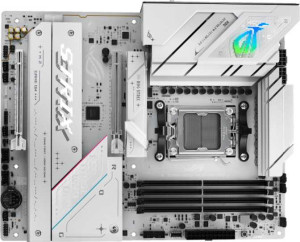
Asus ROG Strix B850-A Gaming WiFi
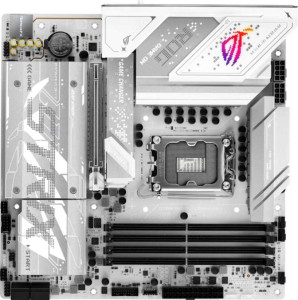
Asus ROG Strix B860-G Gaming WiFi

Asus ROG Strix B850-A Gaming WiFi Asus ROG Strix B860-G Gaming WiFi

Overview

Choosing between the Asus ROG Strix B850-A Gaming WiFi and the Asus ROG Strix B860-G Gaming WiFi means navigating two distinct motherboard philosophies built for different platforms and use cases. One embraces the AMD AM5 ecosystem in a full-size ATX footprint, while the other targets Intel LGA 1851 builders in a more compact Micro-ATX chassis. In this head-to-head, we explore the key battlegrounds: form factor and socket compatibility, memory capacity, rear I/O connectivity, and internal expansion options to help you pick the right board for your build.

Common Features

  • Both boards support Wi-Fi 4 (802.11n), Wi-Fi 5 (802.11ac), Wi-Fi 6 (802.11ax), Wi-Fi 6E (802.11ax), and Wi-Fi 7 (802.11be).
  • Bluetooth 5.4 is available on both boards.
  • Both boards include an HDMI 2.1 port.
  • Overclocking is supported on both boards.
  • RGB lighting is present on both boards.
  • Easy BIOS reset functionality is available on both boards.
  • Both boards have 4 memory slots.
  • Both boards use DDR5 memory.
  • Both boards operate in dual-channel memory mode.
  • ECC memory is not supported on either board.
  • Neither board has any USB 3.2 Gen 1 Type-C ports on the rear I/O.
  • Both boards include one USB 3.2 Gen 2x2 port.
  • Neither board has any USB 4 20Gbps ports.
  • Thunderbolt 3 is not available on either board.
  • An HDMI output is present on both boards.
  • Both boards have one DisplayPort output.
  • Both boards include one RJ45 Ethernet port.
  • USB Type-C connectivity is available on both boards.
  • Both boards provide 2 USB 3.2 Gen 1 ports via internal expansion headers.
  • Both boards offer one USB-C 3.2 Gen 2 port via internal expansion header.
  • Both boards provide 2 USB 3.0 ports via internal expansion headers.
  • Both boards are equipped with 4 M.2 sockets.
  • Neither board has a TPM connector.
  • Neither board has any U.2 sockets.
  • An mSATA connector is not present on either board.
  • Neither board has any SATA 2 connectors.
  • Both boards include one PCIe 5.0 x16 slot.
  • Neither board has any PCIe 3.0 x16, PCIe 2.0 x16, PCIe x8, PCIe x4, PCIe x1, or legacy PCI slots.
  • Both boards achieve a 120 dB signal-to-noise ratio on their DAC.
  • Both boards support 7.1 audio channels.
  • An S/PDIF Out port is present on both boards.
  • Both boards have 2 audio connectors.
  • RAID 0, RAID 1, RAID 5, and RAID 10 (1+0) are supported on both boards.
  • RAID 0+1 is not supported on either board.

Main Differences

  • The CPU socket is AM5 on the Asus ROG Strix B850-A Gaming WiFi and LGA 1851 on the Asus ROG Strix B860-G Gaming WiFi.
  • The chipset is B850 on the Asus ROG Strix B850-A Gaming WiFi and B860 on the Asus ROG Strix B860-G Gaming WiFi.
  • The form factor is ATX on the Asus ROG Strix B850-A Gaming WiFi and Micro-ATX on the Asus ROG Strix B860-G Gaming WiFi.
  • The board width is 305 mm on the Asus ROG Strix B850-A Gaming WiFi and 244 mm on the Asus ROG Strix B860-G Gaming WiFi.
  • The maximum supported memory is 192 GB on the Asus ROG Strix B850-A Gaming WiFi and 256 GB on the Asus ROG Strix B860-G Gaming WiFi.
  • The maximum overclocked RAM speed is 8000 MHz on the Asus ROG Strix B850-A Gaming WiFi and 9066 MHz on the Asus ROG Strix B860-G Gaming WiFi.
  • There are 2 USB 3.2 Gen 2 Type-A ports on the Asus ROG Strix B850-A Gaming WiFi and 1 on the Asus ROG Strix B860-G Gaming WiFi.
  • There are 4 USB 3.2 Gen 1 Type-A ports on the Asus ROG Strix B850-A Gaming WiFi and 3 on the Asus ROG Strix B860-G Gaming WiFi.
  • A USB 3.2 Gen 2 Type-C port is present on the Asus ROG Strix B850-A Gaming WiFi but not available on the Asus ROG Strix B860-G Gaming WiFi.
  • There are 2 USB 2.0 ports on the Asus ROG Strix B850-A Gaming WiFi and 4 on the Asus ROG Strix B860-G Gaming WiFi.
  • A USB 4 40Gbps port is present on the Asus ROG Strix B860-G Gaming WiFi but not available on the Asus ROG Strix B850-A Gaming WiFi.
  • A Thunderbolt 4 port is present on the Asus ROG Strix B860-G Gaming WiFi but not available on the Asus ROG Strix B850-A Gaming WiFi.
  • There are 4 USB 2.0 ports via internal expansion on the Asus ROG Strix B850-A Gaming WiFi and 3 on the Asus ROG Strix B860-G Gaming WiFi.
  • There are 2 SATA 3 connectors on the Asus ROG Strix B850-A Gaming WiFi and 4 on the Asus ROG Strix B860-G Gaming WiFi.
  • There are 6 fan headers on the Asus ROG Strix B850-A Gaming WiFi and 4 on the Asus ROG Strix B860-G Gaming WiFi.
  • There is 1 PCIe 4.0 x16 slot on the Asus ROG Strix B850-A Gaming WiFi and none on the Asus ROG Strix B860-G Gaming WiFi.
Specs Comparison
Asus ROG Strix B850-A Gaming WiFi

Asus ROG Strix B850-A Gaming WiFi

Asus ROG Strix B860-G Gaming WiFi

Asus ROG Strix B860-G Gaming WiFi

General info:
CPU socket AM5 LGA 1851
chipset B850 B860
form factor ATX Micro-ATX
release date January 2025 January 2025
supports Wi-Fi
Wi-Fi version Wi-Fi 4 (802.11n), Wi-Fi 5 (802.11ac), Wi-Fi 6 (802.11ax), Wi-Fi 6E (802.11ax), Wi-Fi 7 (802.11be) Wi-Fi 4 (802.11n), Wi-Fi 5 (802.11ac), Wi-Fi 6 (802.11ax), Wi-Fi 6E (802.11ax), Wi-Fi 7 (802.11be)
Has Bluetooth
Bluetooth version 5.4 5.4
HDMI version HDMI 2.1 HDMI 2.1
Easy to overclock
has RGB lighting
Easy to reset BIOS
Has dual BIOS
has aptX
CPU sockets 1 1
Has integrated graphics
warranty period 3 years 3 years
height 244 mm 244 mm
width 305 mm 244 mm
Has integrated CPU

The most fundamental difference between these two boards lies in their platform compatibility: the ROG Strix B850-A targets AMD AM5 builders, while the B860-G is designed for Intel LGA 1851 systems. This means the two are not interchangeable — your CPU choice dictates which board is even an option. Beyond platform, the form factor splits them further: the B850-A is a full ATX board (305 × 244 mm), offering more expansion slots and better thermal headroom, while the B860-G is a compact Micro-ATX (244 × 244 mm), making it a stronger fit for smaller cases where space is a constraint.

Where these boards converge is notable. Both carry identical wireless credentials — Wi-Fi 7 (802.11be) with backward compatibility down to Wi-Fi 4, plus Bluetooth 5.4 — ensuring future-ready connectivity regardless of which you choose. Both also share HDMI 2.1 output, dual BIOS, easy BIOS reset, RGB lighting, and a 3-year warranty. Neither board integrates a CPU or graphics, and both are marked as easy to overclock — a welcome trait given that B-series chipsets traditionally impose some overclocking limits.

In terms of a general-info edge, neither board is strictly superior: the B850-A has the advantage of the larger ATX footprint for builders who want maximum expandability, while the B860-G wins on physical compactness for small-form-factor builds. The decisive factor here is simply ecosystem — AMD or Intel — making platform choice the real differentiator in this category.

Memory:
maximum memory amount 192GB 256GB
overclocked RAM speed 8000 MHz 9066 MHz
memory slots 4 4
DDR memory version 5 5
memory channels 2 2
Supports ECC memory

The Asus ROG Strix B850-A Gaming WiFi and the Asus ROG Strix B860-G Gaming WiFi differ in their memory specifications, particularly in terms of maximum memory amount and overclocked RAM speed. The B850-A supports a maximum memory of 192GB, while the B860-G can handle up to 256GB of memory. The overclocked RAM speed of the B850-A is 8000 MHz, whereas the B860-G supports a slightly higher overclocked speed of 9066 MHz.

Both motherboards feature 4 memory slots, DDR5 memory version, and 2 memory channels. Neither of them supports ECC memory, making them similar in that regard.

Overall, while both motherboards offer solid memory capabilities, the B860-G stands out with its higher maximum memory support and faster overclocked RAM speed.

Ports:
USB 3.2 Gen 2 ports (USB-A) 2 1
USB 3.2 Gen 1 ports (USB-A) 4 3
USB 3.2 Gen 2 ports (USB-C) 1 0
USB 3.2 Gen 1 ports (USB-C) 0 0
USB 2.0 ports 2 4
USB 3.2 Gen 2x2 ports 1 1
USB 4 40Gbps ports 0 1
USB 4 20Gbps ports 0 0
Thunderbolt 4 ports 0 1
Thunderbolt 3 ports 0 0
has an HDMI output
DisplayPort outputs 1 1
RJ45 ports 1 1
Has USB Type-C
eSATA ports 0 0
DVI outputs 0 0
has a VGA connector
PS/2 ports 0 0

The Asus ROG Strix B850-A Gaming WiFi and the Asus ROG Strix B860-G Gaming WiFi offer a range of similar ports, with a few notable differences. Both motherboards feature USB 3.2 Gen 2x2 ports, DisplayPort outputs, and HDMI outputs, along with a single RJ45 port for network connectivity. They also both support USB Type-C, and neither includes eSATA, DVI, or VGA connectors.

One of the key differences is in the USB ports. The B850-A offers 2 USB 3.2 Gen 2 ports (USB-A), 4 USB 3.2 Gen 1 ports (USB-A), and 1 USB 3.2 Gen 2 (USB-C) port, while the B860-G has fewer USB 3.2 Gen 2 (USB-A) ports, with only 1, and 3 USB 3.2 Gen 1 (USB-A) ports. Additionally, the B860-G offers a USB 4 40Gbps port, which is not present on the B850-A.

Another difference is the Thunderbolt ports: the B860-G includes 1 Thunderbolt 4 port, while the B850-A lacks Thunderbolt support entirely. Both motherboards have the same number of USB 2.0 ports, but the B850-A has more USB 3.2 Gen 2 (USB-A) and USB 3.2 Gen 1 (USB-C) ports compared to the B860-G.

Connectors:
USB 3.2 Gen 1 ports (through expansion) 2 2
USB-C 3.2 Gen 2 ports (through expansion) 1 1
USB 2.0 ports (through expansion) 4 3
SATA 3 connectors 2 4
fan headers 6 4
USB 3.0 ports (through expansion) 2 2
M.2 sockets 4 4
Has TPM connector
U.2 sockets 0 0
Has mSATA connector
SATA 2 connectors 0 0

The Asus ROG Strix B850-A Gaming WiFi and the Asus ROG Strix B860-G Gaming WiFi have similar connector options, with a few differences in quantity. Both motherboards offer 2 USB 3.2 Gen 1 ports, 1 USB-C 3.2 Gen 2 port, and 2 USB 3.0 ports (through expansion). However, the B860-G has 1 fewer USB 2.0 port (3 versus 4 on the B850-A) and 2 more SATA 3 connectors (4 versus 2 on the B850-A).

Both motherboards support 4 M.2 sockets and do not include U.2 or mSATA connectors. Additionally, neither has a TPM connector. The B850-A provides 6 fan headers, whereas the B860-G has only 4 fan headers.

In summary, the B860-G offers more SATA 3 connectors and fewer fan headers compared to the B850-A, while other connectors and expansion options remain identical across both products.

Expansion slots:
PCIe 4.0 x16 slots 1 0
PCIe 5.0 x16 slots 1 1
PCIe 3.0 x16 slots 0 0
PCIe x1 slots 0 0
PCI slots 0 0
PCIe 2.0 x16 slots 0 0
PCIe x4 slots 0 0
PCIe x8 slots 0 0

The Asus ROG Strix B850-A Gaming WiFi and the Asus ROG Strix B860-G Gaming WiFi have differences in their PCIe slot configurations. The B850-A offers 1 PCIe 4.0 x16 slot and 1 PCIe 5.0 x16 slot, while the B860-G has 1 PCIe 5.0 x16 slot but lacks a PCIe 4.0 x16 slot. Both motherboards do not include any PCIe 3.0 x16, PCIe x1, PCI, PCIe 2.0 x16, PCIe x4, or PCIe x8 slots.

Overall, while both motherboards offer a single PCIe 5.0 x16 slot, the B850-A provides additional PCIe 4.0 x16 support, which the B860-G does not.

Audio:
Signal-to-Noise ratio (DAC) 120 dB 120 dB
audio channels 7.1 7.1
Has S/PDIF Out port
audio connectors 2 2

The Asus ROG Strix B850-A Gaming WiFi and the Asus ROG Strix B860-G Gaming WiFi have identical audio specifications. Both motherboards feature a signal-to-noise ratio (DAC) of 120 dB, 7.1 audio channels, and support for an S/PDIF Out port. They also both include 2 audio connectors.

As such, there are no differences in the audio capabilities between these two products based on the provided specifications.

Storage:
Supports RAID 1
Supports RAID 10 (1+0)
Supports RAID 5
Supports RAID 0
Supports RAID 0+1

The Asus ROG Strix B850-A Gaming WiFi and the Asus ROG Strix B860-G Gaming WiFi have identical storage capabilities. Both motherboards support RAID 1, RAID 10 (1+0), RAID 5, and RAID 0 configurations, but neither supports RAID 0+1.

As there are no differences between the two models in terms of storage options, their RAID support is exactly the same.

Comparison Summary & Verdict

Both boards share an impressive common foundation, including Wi-Fi 7, Bluetooth 5.4, four M.2 sockets, a PCIe 5.0 x16 slot, DDR5 memory, and 7.1 high-fidelity audio, making either a capable choice for a modern build. The divergence, however, is meaningful. The Asus ROG Strix B850-A Gaming WiFi is best suited for AMD AM5 enthusiasts who need a full ATX layout, more fan headers for elaborate cooling setups, an extra PCIe 4.0 x16 slot for additional cards, and a richer rear USB selection including a dedicated Type-C Gen 2 port. Meanwhile, the Asus ROG Strix B860-G Gaming WiFi appeals to Intel LGA 1851 builders working in a compact case, who will benefit from a higher 256 GB memory ceiling, faster overclocked RAM at 9066 MHz, four SATA 3 ports for storage-heavy systems, and cutting-edge connectivity through USB 4 40Gbps and Thunderbolt 4.

Asus ROG Strix B850-A Gaming WiFi
Buy Asus ROG Strix B850-A Gaming WiFi if...

Buy the Asus ROG Strix B850-A Gaming WiFi if you are building on the AMD AM5 platform and want a full ATX board with 6 fan headers, an additional PCIe 4.0 x16 slot, and a broader rear USB port selection including a Type-C Gen 2 output.

Asus ROG Strix B860-G Gaming WiFi
Buy Asus ROG Strix B860-G Gaming WiFi if...

Buy the Asus ROG Strix B860-G Gaming WiFi if you are building on the Intel LGA 1851 platform in a compact Micro-ATX case and need Thunderbolt 4, USB 4 40Gbps, a higher 256 GB memory ceiling, faster 9066 MHz RAM overclocking, and more SATA 3 connectors for storage-heavy configurations.