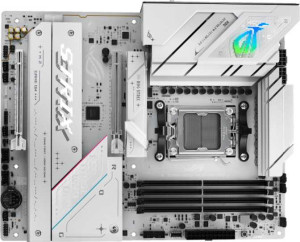
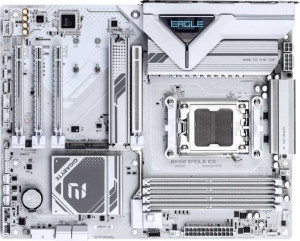
At the structural level, these two boards are identical in memory architecture: both use DDR5, offer 4 DIMM slots across 2 channels, and drop ECC support — standard fare for consumer B850 platforms. The meaningful story is in how they diverge on capacity and speed tuning.
The Gigabyte B850 Eagle Ice has the edge on raw capacity, supporting up to 256 GB versus the ROG Strix's 192 GB ceiling. That 64 GB gap is largely irrelevant for gaming or everyday use, but it matters for memory-hungry workloads like large virtual machines, video editing with heavy timelines, or professional simulation software. On speed, the picture is more nuanced: the ROG Strix lists its maximum at 8000 MHz, which is also its overclocked ceiling — suggesting that figure reflects real-world XMP/EXPO headroom. The Eagle Ice quotes a much lower native max of 5200 MHz, but pushes to 8200 MHz when overclocked, a slight lead at the very top. In practice, the gap between 8000 and 8200 MHz delivers negligible real-world performance difference in most scenarios.
The verdict here depends on use case. For users who might eventually populate all four slots with high-capacity DIMMs for professional workloads, the Eagle Ice's 256 GB ceiling is a genuine, if niche, advantage. For everyone else, the ROG Strix's cleaner, more consistent speed specification makes it the easier board to configure out of the box. On balance, this group is close to a tie, with each board holding a specific edge that only certain users will actually benefit from.