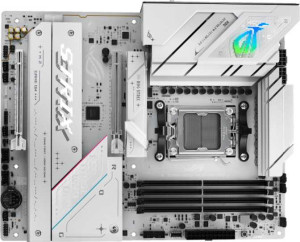
Asus ROG Strix B850-A Gaming WiFi
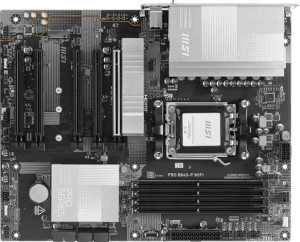
MSI Pro B840-P WiFi

Asus ROG Strix B850-A Gaming WiFi MSI Pro B840-P WiFi

Overview

Welcome to our in-depth comparison of the Asus ROG Strix B850-A Gaming WiFi and the MSI Pro B840-P WiFi — two AM5 motherboards that share a surprising amount of common ground yet diverge in meaningful ways. Both boards offer ATX form factors, Wi-Fi 7, and DDR5 support, but key battlegrounds emerge around expansion slot generations, storage connectivity, and maximum memory capacity. Read on to discover which board best suits your next build.

Common Features

  • Both motherboards use the AM5 CPU socket.
  • Both boards have an ATX form factor.
  • Wi-Fi is supported on both boards, covering Wi-Fi 4, Wi-Fi 5, Wi-Fi 6, Wi-Fi 6E, and Wi-Fi 7.
  • Bluetooth 5.4 is available on both products.
  • Both boards feature HDMI 2.1 output.
  • Overclocking is supported on both products.
  • Both boards support DDR5 memory.
  • Both boards have 4 memory slots across 2 memory channels.
  • The maximum overclocked RAM speed is 8000 MHz on both boards.
  • ECC memory is not supported on either product.
  • Both boards include 1 USB 3.2 Gen 2 port (USB-C) on the rear panel.
  • Neither board has USB 3.2 Gen 1 (USB-C), USB 4, or Thunderbolt ports.
  • Both boards include 1 RJ45 port.
  • Both boards have an HDMI output.
  • Both boards provide 2 USB 3.2 Gen 1 ports and 4 USB 2.0 ports through expansion headers.
  • Both boards include 6 fan headers.
  • Neither board has an mSATA connector or U.2 sockets.
  • Both boards include 1 PCIe 4.0 x16 slot.
  • Both boards support 7.1 audio channels.
  • RAID 0, RAID 1, and RAID 10 are supported on both boards, while RAID 0+1 is not supported on either.

Main Differences

  • The chipset is B850 on Asus ROG Strix B850-A Gaming WiFi and B840 on MSI Pro B840-P WiFi.
  • The board height is 244 mm on Asus ROG Strix B850-A Gaming WiFi and 243.8 mm on MSI Pro B840-P WiFi.
  • The board width is 305 mm on Asus ROG Strix B850-A Gaming WiFi and 304.8 mm on MSI Pro B840-P WiFi.
  • Maximum memory capacity is 192 GB on Asus ROG Strix B850-A Gaming WiFi and 256 GB on MSI Pro B840-P WiFi.
  • Maximum native RAM speed is 8000 MHz on Asus ROG Strix B850-A Gaming WiFi and 5600 MHz on MSI Pro B840-P WiFi.
  • USB 3.2 Gen 2 (USB-A) port count is 2 on Asus ROG Strix B850-A Gaming WiFi and 1 on MSI Pro B840-P WiFi.
  • USB 3.2 Gen 1 (USB-A) port count is 4 on Asus ROG Strix B850-A Gaming WiFi and 2 on MSI Pro B840-P WiFi.
  • USB 2.0 port count is 2 on Asus ROG Strix B850-A Gaming WiFi and 4 on MSI Pro B840-P WiFi.
  • A USB 3.2 Gen 2x2 port is present on Asus ROG Strix B850-A Gaming WiFi but not available on MSI Pro B840-P WiFi.
  • A DisplayPort output is present on Asus ROG Strix B850-A Gaming WiFi but not available on MSI Pro B840-P WiFi.
  • SATA 3 connector count is 2 on Asus ROG Strix B850-A Gaming WiFi and 4 on MSI Pro B840-P WiFi.
  • M.2 socket count is 4 on Asus ROG Strix B850-A Gaming WiFi and 2 on MSI Pro B840-P WiFi.
  • A TPM connector is present on MSI Pro B840-P WiFi but not available on Asus ROG Strix B850-A Gaming WiFi.
  • A PCIe 5.0 x16 slot is present on Asus ROG Strix B850-A Gaming WiFi but not available on MSI Pro B840-P WiFi.
  • A PCIe 3.0 x16 slot is present on MSI Pro B840-P WiFi but not available on Asus ROG Strix B850-A Gaming WiFi.
  • PCIe x1 slot count is 0 on Asus ROG Strix B850-A Gaming WiFi and 3 on MSI Pro B840-P WiFi.
  • An S/PDIF Out port is present on Asus ROG Strix B850-A Gaming WiFi but not available on MSI Pro B840-P WiFi.
  • Audio connector count is 2 on Asus ROG Strix B850-A Gaming WiFi and 3 on MSI Pro B840-P WiFi.
  • RAID 5 support is present on Asus ROG Strix B850-A Gaming WiFi but not available on MSI Pro B840-P WiFi.
Specs Comparison
Asus ROG Strix B850-A Gaming WiFi

Asus ROG Strix B850-A Gaming WiFi

MSI Pro B840-P WiFi

MSI Pro B840-P WiFi

General info:
CPU socket AM5 AM5
chipset B850 B840
form factor ATX ATX
release date January 2025 January 2025
supports Wi-Fi
Wi-Fi version Wi-Fi 4 (802.11n), Wi-Fi 5 (802.11ac), Wi-Fi 6 (802.11ax), Wi-Fi 6E (802.11ax), Wi-Fi 7 (802.11be) Wi-Fi 4 (802.11n), Wi-Fi 5 (802.11ac), Wi-Fi 6 (802.11ax), Wi-Fi 6E (802.11ax), Wi-Fi 7 (802.11be)
Has Bluetooth
Bluetooth version 5.4 5.4
HDMI version HDMI 2.1 HDMI 2.1
Easy to overclock
has RGB lighting
Easy to reset BIOS
Has dual BIOS
has aptX
CPU sockets 1 1
Has integrated graphics
warranty period 3 years 3 years
height 244 mm 243.8 mm
width 305 mm 304.8 mm
Has integrated CPU

At a glance, the Asus ROG Strix B850-A and the MSI Pro B840-P are nearly identical in their general profile: both use the AM5 socket with an ATX form factor, ship with Wi-Fi 7 and Bluetooth 5.4, support HDMI 2.1, feature RGB lighting, dual BIOS, and carry a 3-year warranty. Their physical footprints are also virtually the same, differing by less than 0.5 mm in each dimension. For most users scanning this category, the two boards look like a dead heat.

The single meaningful differentiator here is the chipset: the ROG Strix runs on B850, while the MSI Pro uses the lower-tier B840. Within AMD's hierarchy, B850 sits above B840 and unlocks full memory overclocking support, including EXPO profiles for high-speed DDR5 kits. B840, by contrast, is AMD's entry-level chipset in this generation and imposes tighter restrictions on memory tuning. Both boards are listed as ″easy to overclock,″ but that descriptor is more meaningful on the B850, where the platform actually supports it without limitations. If you plan to pair either board with fast DDR5 RAM, the B850 chipset on the ROG Strix will let you run those kits at their rated speeds, whereas the B840 on the MSI Pro may not.

Edge: Asus ROG Strix B850-A. Every shared feature in this group is equivalent, but the B850 chipset gives the ROG Strix a tangible, real-world advantage for anyone who wants to get full performance from modern DDR5 memory. The MSI Pro B840-P is a reasonable alternative only if memory overclocking is not a priority and the lower platform cost is the goal.
Memory:
maximum memory amount 192GB 256GB
RAM speed (max) 8000 MHz 5600 MHz
overclocked RAM speed 8000 MHz 8000 MHz
memory slots 4 4
DDR memory version 5 5
memory channels 2 2
Supports ECC memory

The Asus ROG Strix B850-A Gaming WiFi and MSI Pro B840-P WiFi motherboards differ in several key memory-related specifications. The Asus model supports a maximum memory amount of 192GB, while the MSI model can handle up to 256GB. Both motherboards feature 4 memory slots and support DDR5 memory, with 2 memory channels available on each board. They also both support overclocked RAM speeds of 8000 MHz.

When it comes to maximum RAM speed, the Asus ROG Strix B850-A Gaming WiFi supports a higher RAM speed of 8000 MHz, which is significantly faster than the MSI Pro B840-P WiFi's maximum of 5600 MHz. However, both models are listed with the same overclocked RAM speed of 8000 MHz, indicating they can reach that speed when overclocked.

Both motherboards do not support ECC memory, which is typically used for error-correcting in high-reliability applications. Overall, while the MSI model can accommodate more RAM, the Asus model offers a higher maximum RAM speed.

Ports:
USB 3.2 Gen 2 ports (USB-A) 2 1
USB 3.2 Gen 1 ports (USB-A) 4 2
USB 3.2 Gen 2 ports (USB-C) 1 1
USB 3.2 Gen 1 ports (USB-C) 0 0
USB 2.0 ports 2 4
USB 3.2 Gen 2x2 ports 1 0
USB 4 40Gbps ports 0 0
USB 4 20Gbps ports 0 0
Thunderbolt 4 ports 0 0
Thunderbolt 3 ports 0 0
has an HDMI output
DisplayPort outputs 1 0
RJ45 ports 1 1
Has USB Type-C
eSATA ports 0 0
DVI outputs 0 0
has a VGA connector
PS/2 ports 0 0

The Asus ROG Strix B850-A Gaming WiFi and MSI Pro B840-P WiFi motherboards both offer a variety of USB ports but differ in the number and types of ports available. The Asus model provides 2 USB 3.2 Gen 2 (USB-A) ports, 4 USB 3.2 Gen 1 (USB-A) ports, and 1 USB 3.2 Gen 2 (USB-C) port, while the MSI model has 1 USB 3.2 Gen 2 (USB-A) port, 2 USB 3.2 Gen 1 (USB-A) ports, and 1 USB 3.2 Gen 2 (USB-C) port. The Asus board also includes 2 USB 2.0 ports, while the MSI board offers 4. Additionally, the Asus model has 1 USB 3.2 Gen 2x2 port, while the MSI board lacks this feature.

Both motherboards have 1 HDMI output, but only the Asus model includes a DisplayPort output, while the MSI model does not. Both products feature an RJ45 port for networking. Neither motherboard offers Thunderbolt 3 or Thunderbolt 4 ports, USB 4 40Gbps ports, eSATA ports, or DVI outputs. Additionally, neither product has a VGA connector or PS/2 ports.

In summary, the Asus ROG Strix B850-A Gaming WiFi offers more USB ports, including a USB 3.2 Gen 2x2 port and an extra DisplayPort output, compared to the MSI Pro B840-P WiFi. The MSI model, however, provides more USB 2.0 ports than the Asus model.

Connectors:
USB 3.2 Gen 1 ports (through expansion) 2 2
USB 2.0 ports (through expansion) 4 4
SATA 3 connectors 2 4
fan headers 6 6
USB 3.0 ports (through expansion) 2 2
M.2 sockets 4 2
Has TPM connector
U.2 sockets 0 0
Has mSATA connector
SATA 2 connectors 0 0

The Asus ROG Strix B850-A Gaming WiFi and MSI Pro B840-P WiFi motherboards have several similarities and differences when it comes to connectors. Both models offer 2 USB 3.2 Gen 1 ports (through expansion) and 4 USB 2.0 ports (through expansion). They also both provide 2 USB 3.0 ports (through expansion) and 6 fan headers. The Asus model has 2 SATA 3 connectors, while the MSI model offers 4 SATA 3 connectors, giving the MSI board a slight advantage in terms of storage connectivity.

For M.2 sockets, the Asus ROG Strix B850-A Gaming WiFi includes 4 M.2 sockets, which is double the number of M.2 sockets on the MSI Pro B840-P WiFi, which has only 2. This could be a key factor for users needing more M.2 storage options. The MSI board, however, has a TPM connector, which the Asus model lacks.

Both motherboards lack U.2 sockets and mSATA connectors, and neither offers SATA 2 connectors. Overall, while both motherboards offer a similar set of expansion options, the Asus model stands out with more M.2 sockets, while the MSI model provides a TPM connector for enhanced security.

Expansion slots:
PCIe 4.0 x16 slots 1 1
PCIe 5.0 x16 slots 1 0
PCIe 3.0 x16 slots 0 1
PCIe x1 slots 0 3
PCI slots 0 0
PCIe 2.0 x16 slots 0 0
PCIe x4 slots 0 0
PCIe x8 slots 0 0

The Asus ROG Strix B850-A Gaming WiFi and MSI Pro B840-P WiFi motherboards differ in their expansion slot configurations. The Asus model offers 1 PCIe 4.0 x16 slot and 1 PCIe 5.0 x16 slot, but it does not have any PCIe 3.0 x16, x1, x4, or x8 slots. On the other hand, the MSI model also has 1 PCIe 4.0 x16 slot, but it features 1 PCIe 3.0 x16 slot, along with 3 PCIe x1 slots. The MSI board does not have any PCIe 5.0 x16 slots, unlike the Asus model, which provides a PCIe 5.0 x16 slot for faster performance.

Both motherboards lack PCI slots, PCIe 2.0 x16 slots, and PCIe x4 or x8 slots. The key difference is the Asus model’s support for a PCIe 5.0 x16 slot, which the MSI model does not include. Additionally, the MSI board offers more PCIe x1 slots, with 3 available, while the Asus board provides none.

In summary, the Asus ROG Strix B850-A Gaming WiFi offers the advantage of a PCIe 5.0 x16 slot, while the MSI Pro B840-P WiFi has more PCIe x1 slots, making it more suitable for those needing multiple expansion cards.

Audio:
audio channels 7.1 7.1
Has S/PDIF Out port
audio connectors 2 3

Both the Asus ROG Strix B850-A Gaming WiFi and the MSI Pro B840-P WiFi motherboards support 7.1 audio channels, providing high-quality sound for users. However, they differ in their audio features. The Asus model includes an S/PDIF Out port, which allows for digital audio output, while the MSI model does not offer this feature.

In terms of audio connectors, the Asus board has 2 audio connectors, whereas the MSI board has 3. This gives the MSI motherboard an additional audio connection option compared to the Asus model.

In summary, both motherboards support 7.1 audio channels, but the Asus ROG Strix B850-A Gaming WiFi has the advantage of an S/PDIF Out port, while the MSI Pro B840-P WiFi offers an extra audio connector.

Storage:
Supports RAID 1
Supports RAID 10 (1+0)
Supports RAID 5
Supports RAID 0
Supports RAID 0+1

The Asus ROG Strix B850-A Gaming WiFi and MSI Pro B840-P WiFi motherboards both support several RAID configurations, with some key differences. Both models support RAID 1 (mirroring) and RAID 10 (1+0, a combination of mirroring and striping). However, the Asus model also supports RAID 5 (striping with parity), which is not supported by the MSI model. Neither motherboard supports RAID 0+1, a combination of RAID 0 and RAID 1.

In summary, the Asus ROG Strix B850-A Gaming WiFi offers more flexibility in storage configurations with its support for RAID 5, while the MSI Pro B840-P WiFi lacks this support but retains the same RAID 1 and RAID 10 options as the Asus model.

Comparison Summary & Verdict

After examining the full specification set, both boards serve distinct audiences. The Asus ROG Strix B850-A Gaming WiFi is the stronger choice for enthusiasts who want cutting-edge performance: its PCIe 5.0 x16 slot, four M.2 sockets, USB 3.2 Gen 2x2 port, DisplayPort output, and S/PDIF Out make it a feature-rich platform for high-end gaming and content creation rigs. The MSI Pro B840-P WiFi, on the other hand, appeals to users who prioritize maximum memory capacity (up to 256 GB), more SATA 3 ports, a TPM connector, and additional PCIe x1 slots — qualities that make it a sensible pick for professional workloads and business-oriented builds where expandability and compatibility matter more than raw cutting-edge specs.

Asus ROG Strix B850-A Gaming WiFi
Buy Asus ROG Strix B850-A Gaming WiFi if...

Buy the Asus ROG Strix B850-A Gaming WiFi if you want a feature-rich enthusiast board with a PCIe 5.0 x16 slot, four M.2 sockets, a DisplayPort output, and USB 3.2 Gen 2x2 support for a high-performance gaming or creative workstation build.

MSI Pro B840-P WiFi
Buy MSI Pro B840-P WiFi if...

Buy the MSI Pro B840-P WiFi if you need a higher maximum memory capacity of 256 GB, more SATA 3 connectors, a TPM connector, or additional PCIe x1 expansion slots for a professional or business-focused system.