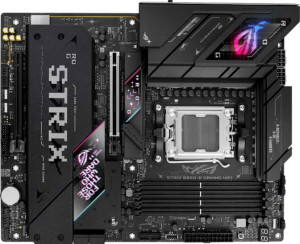
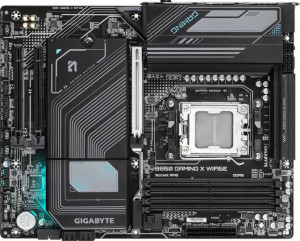
Both the Asus ROG Strix B850-E Gaming WiFi and the Gigabyte B850 Gaming X WiFi6E share a strong common foundation: identical AM5 socket / B850 chipset pairing, standard ATX dimensions (244 × 305 mm), HDMI 2.1 output, dual BIOS, RGB lighting, overclocking support, and a matching 3-year warranty. For a buyer focused purely on platform fit and build compatibility, either board is effectively interchangeable at this level.
The meaningful splits appear in wireless connectivity and usability features. The ROG Strix extends its Wi-Fi stack all the way to Wi-Fi 7 (802.11be), while the Gigabyte tops out at Wi-Fi 6E (802.11ax). In practical terms, Wi-Fi 7 delivers substantially higher theoretical throughput and lower latency — relevant today only if you own a Wi-Fi 7 router, but it future-proofs the board as that ecosystem matures. Similarly, the ROG Strix ships with Bluetooth 5.4 versus the Gigabyte's 5.3; the newer revision offers marginally improved connection stability and power efficiency, a modest but real benefit for wireless peripherals. The ROG Strix also supports easy BIOS reset, a convenience the Gigabyte lacks — a small but genuinely useful feature when troubleshooting overclocks or recovering from a bad flash.
Overall, the Asus ROG Strix B850-E holds a clear edge in this group. Its Wi-Fi 7 support is the single most impactful differentiator — it is the only board here that will not require an upgrade to take full advantage of next-generation networking hardware. The Gigabyte remains a competitive option for users who have no interest in Wi-Fi 7 and prioritize cost, but on a pure general-spec comparison, the ROG Strix is the more forward-looking choice.