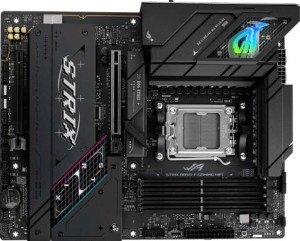
Asus ROG Strix B850-F Gaming WiFi
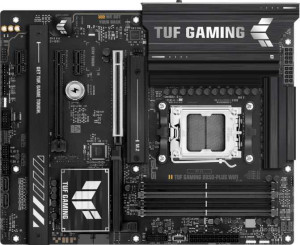
Asus TUF Gaming B850-Plus WiFi

Asus ROG Strix B850-F Gaming WiFi Asus TUF Gaming B850-Plus WiFi

Overview

Comparing the Asus ROG Strix B850-F Gaming WiFi and the Asus TUF Gaming B850-Plus WiFi reveals two ATX motherboards built on the same AM5 platform and B850 chipset, yet catering to subtly different builder priorities. Both bring Wi-Fi 7, DDR5 support, and a robust PCIe lineup to the table, but they diverge on storage options, USB port configurations, audio connectivity, and expansion flexibility. Explore the full breakdown below to see which board is the right fit for your next build.

Common Features

  • Both boards use the AM5 CPU socket.
  • Both boards feature the B850 chipset.
  • Both boards use the ATX form factor.
  • Wi-Fi is supported on both boards, covering Wi-Fi 4, Wi-Fi 5, Wi-Fi 6, Wi-Fi 6E, and Wi-Fi 7.
  • Bluetooth 5.4 is available on both boards.
  • Both boards include an HDMI 2.1 output.
  • Both boards support a maximum memory amount of 192GB.
  • Both boards support overclocked RAM speeds up to 8000 MHz.
  • Both boards have 4 memory slots and 2 memory channels.
  • Both boards use DDR5 memory.
  • ECC memory is not supported on either board.
  • Both boards have 4 USB 3.2 Gen 1 ports (USB-A) and no USB 3.2 Gen 1 ports (USB-C).
  • Both boards include 1 USB 3.2 Gen 2x2 port.
  • Neither board has USB 4, Thunderbolt 3, or Thunderbolt 4 ports.
  • Both boards provide 2 USB 3.2 Gen 1 ports through expansion, 1 USB-C 3.2 Gen 2 port through expansion, 4 USB 2.0 ports through expansion, and 2 USB 3.0 ports through expansion.
  • Both boards have 6 fan headers.
  • A TPM connector is not present on either board.
  • Both boards include 1 PCIe 5.0 x16 slot and 1 PCIe 4.0 x16 slot, with no PCIe 3.0, 2.0, x4, or x8 slots.
  • Both boards deliver a 120 dB signal-to-noise ratio (DAC) and support 7.1 audio channels.
  • Both boards support RAID 0, RAID 1, RAID 5, and RAID 10, but neither supports RAID 0+1.

Main Differences

  • Easy BIOS reset is available on the Asus ROG Strix B850-F Gaming WiFi but not on the Asus TUF Gaming B850-Plus WiFi.
  • USB 3.2 Gen 2 ports (USB-A) number 2 on the Asus ROG Strix B850-F Gaming WiFi and 3 on the Asus TUF Gaming B850-Plus WiFi.
  • A USB 3.2 Gen 2 port (USB-C) is present on the Asus ROG Strix B850-F Gaming WiFi but not available on the Asus TUF Gaming B850-Plus WiFi.
  • USB 2.0 ports number 4 on the Asus ROG Strix B850-F Gaming WiFi and 2 on the Asus TUF Gaming B850-Plus WiFi.
  • SATA 3 connectors number 2 on the Asus ROG Strix B850-F Gaming WiFi and 4 on the Asus TUF Gaming B850-Plus WiFi.
  • M.2 sockets number 4 on the Asus ROG Strix B850-F Gaming WiFi and 3 on the Asus TUF Gaming B850-Plus WiFi.
  • PCIe x1 slots are absent on the Asus ROG Strix B850-F Gaming WiFi, while the Asus TUF Gaming B850-Plus WiFi includes 2.
  • An S/PDIF Out port is present on the Asus ROG Strix B850-F Gaming WiFi but not available on the Asus TUF Gaming B850-Plus WiFi.
  • Audio connectors number 2 on the Asus ROG Strix B850-F Gaming WiFi and 5 on the Asus TUF Gaming B850-Plus WiFi.
Specs Comparison
Asus ROG Strix B850-F Gaming WiFi

Asus ROG Strix B850-F Gaming WiFi

Asus TUF Gaming B850-Plus WiFi

Asus TUF Gaming B850-Plus WiFi

General info:
CPU socket AM5 AM5
chipset B850 B850
form factor ATX ATX
release date January 2025 January 2025
supports Wi-Fi
Wi-Fi version Wi-Fi 4 (802.11n), Wi-Fi 5 (802.11ac), Wi-Fi 6 (802.11ax), Wi-Fi 6E (802.11ax), Wi-Fi 7 (802.11be) Wi-Fi 4 (802.11n), Wi-Fi 5 (802.11ac), Wi-Fi 6 (802.11ax), Wi-Fi 6E (802.11ax), Wi-Fi 7 (802.11be)
Has Bluetooth
Bluetooth version 5.4 5.4
HDMI version HDMI 2.1 HDMI 2.1
Easy to overclock
has RGB lighting
Easy to reset BIOS
Has dual BIOS
has aptX
CPU sockets 1 1
Has integrated graphics
warranty period 3 years 3 years
height 244 mm 244 mm
width 305 mm 305 mm
Has integrated CPU

The Asus ROG Strix B850-F Gaming WiFi and Asus TUF Gaming B850-Plus WiFi share an almost identical general profile: both use the AM5 socket with a B850 chipset, arrive in standard ATX form factor (244 × 305 mm), and offer the same modern connectivity suite — Wi-Fi 7 (backward-compatible through Wi-Fi 4), Bluetooth 5.4, and HDMI 2.1. Both boards also carry a 3-year warranty, support overclocking, include RGB lighting, and feature a dual BIOS for firmware redundancy. For most users evaluating platform fundamentals, these two boards are effectively tied.

The one meaningful differentiator in this group is Easy to reset BIOS: the ROG Strix B850-F supports it, while the TUF B850-Plus does not. In practice, this means the ROG board can recover from a bad BIOS flash or a failed overclock without needing a POST — a genuine convenience for enthusiasts who push settings or update firmware frequently. It is a small but real quality-of-life advantage that aligns with the ROG line's more enthusiast-focused positioning.

Overall, the ROG Strix B850-F holds a narrow edge in this group purely due to its easy BIOS reset capability. Everything else — platform, connectivity, dimensions, and warranty — is identical between the two.

Memory:
maximum memory amount 192GB 192GB
overclocked RAM speed 8000 MHz 8000 MHz
memory slots 4 4
DDR memory version 5 5
memory channels 2 2
Supports ECC memory

The Asus ROG Strix B850-F Gaming WiFi and the Asus TUF Gaming B850-Plus WiFi share identical memory specifications across the board. Both motherboards support a maximum memory amount of 192GB, feature 4 memory slots, and utilize DDR5 memory, with 2 memory channels. Additionally, both support overclocked RAM speeds of up to 8000 MHz. Neither motherboard supports ECC memory.

Overall, there are no differences between the two products in terms of memory specifications. Both offer the same maximum capacity, memory configuration, and support for high-speed RAM overclocking.

Ports:
USB 3.2 Gen 2 ports (USB-A) 2 3
USB 3.2 Gen 1 ports (USB-A) 4 4
USB 3.2 Gen 2 ports (USB-C) 1 0
USB 3.2 Gen 1 ports (USB-C) 0 0
USB 2.0 ports 4 2
USB 3.2 Gen 2x2 ports 1 1
USB 4 40Gbps ports 0 0
USB 4 20Gbps ports 0 0
Thunderbolt 4 ports 0 0
Thunderbolt 3 ports 0 0
has an HDMI output
DisplayPort outputs 1 1
RJ45 ports 1 1
Has USB Type-C
eSATA ports 0 0
DVI outputs 0 0
has a VGA connector
PS/2 ports 0 0

The Asus ROG Strix B850-F Gaming WiFi and the Asus TUF Gaming B850-Plus WiFi differ in their USB 3.2 Gen 2 (USB-A) ports, with the Strix model offering 2 ports and the TUF model providing 3. Both motherboards have 4 USB 3.2 Gen 1 (USB-A) ports and 1 USB 3.2 Gen 2x2 port. However, the Strix model includes 1 USB 3.2 Gen 2 (USB-C) port, while the TUF model lacks any USB 3.2 Gen 2 (USB-C) ports. The Strix also has 4 USB 2.0 ports, while the TUF has only 2.

Both motherboards feature an HDMI output, 1 DisplayPort output, 1 RJ45 port, and USB Type-C support. Neither motherboard has eSATA, DVI, or VGA connectors, and both lack Thunderbolt 3 and 4 ports. They also share the same number of PS/2 ports, which is 0.

In summary, the main differences between the two products in this group are the number of USB 3.2 Gen 2 (USB-A) ports, USB 2.0 ports, and the presence of a USB 3.2 Gen 2 (USB-C) port, with the Strix offering more flexibility in these areas compared to the TUF model.

Connectors:
USB 3.2 Gen 1 ports (through expansion) 2 2
USB-C 3.2 Gen 2 ports (through expansion) 1 1
USB 2.0 ports (through expansion) 4 4
SATA 3 connectors 2 4
fan headers 6 6
USB 3.0 ports (through expansion) 2 2
M.2 sockets 4 3
Has TPM connector
U.2 sockets 0 0
Has mSATA connector
SATA 2 connectors 0 0

The Asus ROG Strix B850-F Gaming WiFi and the Asus TUF Gaming B850-Plus WiFi offer a similar set of connectors, but there are a few differences. Both motherboards include 2 USB 3.2 Gen 1 ports (through expansion), 1 USB-C 3.2 Gen 2 port (through expansion), 4 USB 2.0 ports (through expansion), 2 USB 3.0 ports (through expansion), and 6 fan headers. They also both lack a TPM connector, U.2 sockets, and mSATA connectors.

One key difference between the two is the number of SATA 3 connectors. The Strix model has 2, while the TUF model offers 4, providing more options for connecting storage devices on the TUF board. Additionally, the Strix supports 4 M.2 sockets, whereas the TUF supports 3.

Overall, the main difference between the two motherboards in this group is the number of SATA 3 connectors and M.2 sockets, with the TUF offering slightly more in both areas.

Expansion slots:
PCIe 4.0 x16 slots 1 1
PCIe 5.0 x16 slots 1 1
PCIe 3.0 x16 slots 0 0
PCIe x1 slots 0 2
PCI slots 0 0
PCIe 2.0 x16 slots 0 0
PCIe x4 slots 0 0
PCIe x8 slots 0 0

The Asus ROG Strix B850-F Gaming WiFi and the Asus TUF Gaming B850-Plus WiFi are similar in their primary PCIe configuration, each offering 1 PCIe 4.0 x16 slot and 1 PCIe 5.0 x16 slot. Neither board includes PCIe 3.0 x16 slots, PCIe 2.0 x16 slots, or PCIe x4 or PCIe x8 slots.

However, the two motherboards differ in the number of PCIe x1 slots. The Strix model does not include any PCIe x1 slots, while the TUF model has 2 PCIe x1 slots, providing more expansion options for additional peripherals or expansion cards.

Overall, the primary difference in expansion slots is the presence of PCIe x1 slots on the TUF model, whereas the Strix model does not offer this type of slot.

Audio:
Signal-to-Noise ratio (DAC) 120 dB 120 dB
audio channels 7.1 7.1
Has S/PDIF Out port
audio connectors 2 5

The Asus ROG Strix B850-F Gaming WiFi and the Asus TUF Gaming B850-Plus WiFi share the same Signal-to-Noise Ratio (DAC) of 120 dB and both support 7.1 audio channels. However, there is a key difference in their audio features. The Strix model includes an S/PDIF Out port, while the TUF model does not.

In terms of audio connectors, the Strix offers 2, while the TUF model provides 5, giving it more options for connecting audio devices.

To summarize, while both boards deliver high-quality audio with similar performance in terms of signal-to-noise ratio and channels, the TUF model offers more audio connectors, while the Strix provides the additional S/PDIF Out port.

Storage:
Supports RAID 1
Supports RAID 10 (1+0)
Supports RAID 5
Supports RAID 0
Supports RAID 0+1

The Asus ROG Strix B850-F Gaming WiFi and the Asus TUF Gaming B850-Plus WiFi offer identical storage RAID support. Both motherboards support RAID 1, RAID 10 (1+0), RAID 5, and RAID 0. Neither model supports RAID 0+1.

Overall, there are no differences between the two products in terms of storage RAID support, as both provide the same set of RAID options.

Comparison Summary & Verdict

At their core, both boards offer a near-identical foundation: Wi-Fi 7, DDR5 memory up to 192GB, identical PCIe slot bandwidth, and the same RAID support. The distinction lies in the details. The Asus ROG Strix B850-F Gaming WiFi pulls ahead with 4 M.2 sockets, an easy BIOS reset button, a USB-C Gen 2 rear port, and an S/PDIF Out connector, making it the natural choice for enthusiasts who want maximum NVMe storage capacity and streamlined system management. The Asus TUF Gaming B850-Plus WiFi responds with 4 SATA 3 connectors, 2 PCIe x1 expansion slots, 5 audio connectors, and an extra USB-A Gen 2 port, better serving builders who lean on traditional storage, broader card expansion, and a more complete analog audio setup. Neither board is a clear-cut winner overall; your ideal choice depends entirely on how you plan to build.

Asus ROG Strix B850-F Gaming WiFi
Buy Asus ROG Strix B850-F Gaming WiFi if...

Buy the Asus ROG Strix B850-F Gaming WiFi if you want 4 M.2 sockets for maximum NVMe storage, an easy BIOS reset button, and a USB-C Gen 2 rear port for a well-rounded enthusiast build.

Asus TUF Gaming B850-Plus WiFi
Buy Asus TUF Gaming B850-Plus WiFi if...

Choose the Asus TUF Gaming B850-Plus WiFi if you rely on SATA drives and need more of them, value 2 extra PCIe x1 slots for card expansion, or prefer a broader analog audio connector selection.