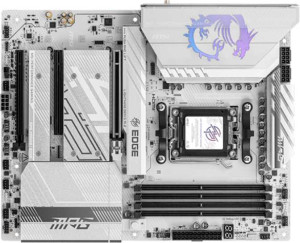
Both boards share the same AM5 socket and B850 chipset, meaning they target the same generation of AMD processors with identical platform-level capabilities. Connectivity is also a wash: both offer Wi-Fi 7 (backwards-compatible through Wi-Fi 4), Bluetooth 5.4, and HDMI 2.1, so neither has an edge in wireless or display output. The same goes for overclocking accessibility, RGB lighting, easy BIOS reset, and a shared 3-year warranty — these are features where the two boards are effectively identical on paper.
The defining difference in this group is form factor. The Asus ROG Strix B850-I is a Mini-ITX board measuring just 170 × 170 mm, while the MSI MPG B850 Edge Ti is a full ATX board at 304.8 × 243.8 mm — more than three times the surface area. This is not a minor detail: it dictates the entire build. The ROG Strix is purpose-built for compact, space-constrained cases, whereas the MSI opens the door to full-tower or mid-tower builds with room for more expansion slots, easier cable management, and better airflow headroom. Choosing between them starts here.
The one spec that tips the balance beyond form factor is dual BIOS, which the Asus ROG Strix B850-I includes and the MSI MPG B850 Edge Ti does not. A dual BIOS acts as a hardware-level safety net — if a firmware update goes wrong or the primary BIOS becomes corrupted, the board can automatically fall back to a backup chip, avoiding a potentially unbootable system. For the target audience of a Mini-ITX build — where compactness often comes at the cost of redundancy elsewhere — this is a meaningful reliability advantage. In summary, if a small-form-factor build is not a requirement, the MSI offers the practical breadth of ATX; but if compact size is the goal, the Asus also brings the added resilience of dual BIOS, giving it a slight edge within the Mini-ITX segment.