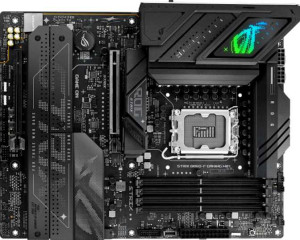
Asus ROG Strix B860-F Gaming WiFi
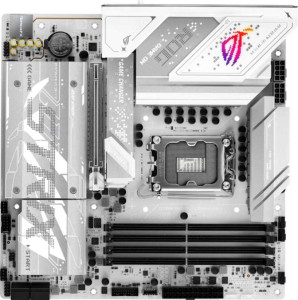
Asus ROG Strix B860-G Gaming WiFi

Asus ROG Strix B860-F Gaming WiFi Asus ROG Strix B860-G Gaming WiFi

Overview

Welcome to our in-depth spec comparison of the Asus ROG Strix B860-F Gaming WiFi and the Asus ROG Strix B860-G Gaming WiFi. Both boards share the same B860 chipset and LGA 1851 socket, yet they diverge in meaningful ways that could influence your next build. From form factor and physical footprint to connectivity options like USB port counts and expansion slots, this comparison examines every key specification to help you determine which ROG Strix board best fits your needs.

Common Features

  • Both motherboards use the LGA 1851 CPU socket.
  • Both motherboards feature the B860 chipset.
  • Wi-Fi is supported on both motherboards, covering Wi-Fi 4 (802.11n), Wi-Fi 5 (802.11ac), Wi-Fi 6 (802.11ax), Wi-Fi 6E (802.11ax), and Wi-Fi 7 (802.11be).
  • Bluetooth is available on both motherboards at version 5.4.
  • Both motherboards include an HDMI 2.1 port.
  • Overclocking is supported on both motherboards.
  • Both motherboards support a maximum memory amount of 256GB.
  • Both motherboards support an overclocked RAM speed of up to 9066 MHz.
  • Both motherboards have 4 memory slots.
  • Both motherboards use DDR5 memory.
  • Both motherboards have 2 memory channels.
  • ECC memory is not supported on either motherboard.
  • Both motherboards have 1 USB 3.2 Gen 2 port (USB-A).
  • Neither motherboard has a USB 3.2 Gen 2 port (USB-C).
  • Neither motherboard has a USB 3.2 Gen 1 port (USB-C).
  • Both motherboards have 1 USB 3.2 Gen 2x2 port.
  • Both motherboards have 1 USB 4 40Gbps port.
  • Neither motherboard has a USB 4 20Gbps port.
  • Both motherboards have 1 Thunderbolt 4 port.
  • Neither motherboard has a Thunderbolt 3 port.
  • Both motherboards offer 2 USB 3.2 Gen 1 ports through expansion.
  • Both motherboards offer 3 USB 2.0 ports through expansion.
  • Both motherboards have 4 SATA 3 connectors.
  • Both motherboards offer 2 USB 3.0 ports through expansion.
  • Both motherboards have 4 M.2 sockets.
  • A TPM connector is not present on either motherboard.
  • Neither motherboard has a U.2 socket.
  • An mSATA connector is not present on either motherboard.
  • Both motherboards have 1 PCIe 5.0 x16 slot.
  • Neither motherboard has a PCIe 3.0 x16 slot.
  • Neither motherboard has a PCIe x1 slot.
  • Neither motherboard has a PCI slot.
  • Neither motherboard has a PCIe 2.0 x16 slot.
  • Neither motherboard has a PCIe x4 slot.
  • Neither motherboard has a PCIe x8 slot.
  • Both motherboards have a signal-to-noise ratio (DAC) of 120 dB.
  • Both motherboards support 7.1 audio channels.
  • An S/PDIF Out port is available on both motherboards.
  • Both motherboards have 2 audio connectors.
  • Both motherboards support RAID 0.
  • Both motherboards support RAID 1.
  • Both motherboards support RAID 5.
  • Both motherboards support RAID 10 (1+0).
  • RAID 0+1 is not supported on either motherboard.

Main Differences

  • The form factor is ATX on the Asus ROG Strix B860-F Gaming WiFi and Micro-ATX on the Asus ROG Strix B860-G Gaming WiFi.
  • The width is 305 mm on the Asus ROG Strix B860-F Gaming WiFi and 244 mm on the Asus ROG Strix B860-G Gaming WiFi.
  • The number of USB 3.2 Gen 1 ports (USB-A) is 6 on the Asus ROG Strix B860-F Gaming WiFi and 3 on the Asus ROG Strix B860-G Gaming WiFi.
  • The number of USB 2.0 ports is 0 on the Asus ROG Strix B860-F Gaming WiFi and 4 on the Asus ROG Strix B860-G Gaming WiFi.
  • The number of fan headers is 6 on the Asus ROG Strix B860-F Gaming WiFi and 4 on the Asus ROG Strix B860-G Gaming WiFi.
  • The number of PCIe 4.0 x16 slots is 1 on the Asus ROG Strix B860-F Gaming WiFi and 0 on the Asus ROG Strix B860-G Gaming WiFi.
Specs Comparison
Asus ROG Strix B860-F Gaming WiFi

Asus ROG Strix B860-F Gaming WiFi

Asus ROG Strix B860-G Gaming WiFi

Asus ROG Strix B860-G Gaming WiFi

General info:
CPU socket LGA 1851 LGA 1851
chipset B860 B860
form factor ATX Micro-ATX
release date January 2025 January 2025
supports Wi-Fi
Wi-Fi version Wi-Fi 4 (802.11n), Wi-Fi 5 (802.11ac), Wi-Fi 6 (802.11ax), Wi-Fi 6E (802.11ax), Wi-Fi 7 (802.11be) Wi-Fi 4 (802.11n), Wi-Fi 5 (802.11ac), Wi-Fi 6 (802.11ax), Wi-Fi 6E (802.11ax), Wi-Fi 7 (802.11be)
Has Bluetooth
Bluetooth version 5.4 5.4
HDMI version HDMI 2.1 HDMI 2.1
Easy to overclock
has RGB lighting
Easy to reset BIOS
Has dual BIOS
has aptX
CPU sockets 1 1
Has integrated graphics
warranty period 3 years 3 years
height 244 mm 244 mm
width 305 mm 244 mm
Has integrated CPU

The Asus ROG Strix B860-F and B860-G Gaming WiFi share the same fundamental platform: both use the LGA 1851 socket with a B860 chipset, support identical wireless connectivity up to Wi-Fi 7 (802.11be) with Bluetooth 5.4, and offer the same feature set including dual BIOS, RGB lighting, HDMI 2.1, and a 3-year warranty. For most users, these shared specs mean both boards are equally capable in terms of connectivity, future-proofing, and everyday usability.

The single defining difference between the two is form factor. The B860-F is a full-size ATX board measuring 305 × 244 mm, while the B860-G is a Micro-ATX board at 244 × 244 mm — roughly 20% smaller in footprint. In practice, this means the B860-G is designed for more compact mid-tower or small-form-factor cases, whereas the B860-F requires a standard ATX enclosure. The smaller Micro-ATX size typically comes with fewer expansion slots and potentially less room for additional PCIe cards, though that distinction falls outside the specs provided here.

For this group, the choice comes down entirely to your case and build goals. If you are building a compact system, the B860-G has a clear practical advantage due to its smaller footprint. If you want maximum expandability and are building in a full-size tower, the B860-F is the natural fit. Neither board holds a technological edge over the other in general features — the two are effectively identical except for size.

Memory:
maximum memory amount 256GB 256GB
overclocked RAM speed 9066 MHz 9066 MHz
memory slots 4 4
DDR memory version 5 5
memory channels 2 2
Supports ECC memory

The Asus ROG Strix B860-F Gaming WiFi and the Asus ROG Strix B860-G Gaming WiFi are identical in terms of their memory specifications. Both motherboards support a maximum memory amount of 256GB and have 4 memory slots for RAM. They also feature the same DDR5 memory version and dual memory channels (2). Additionally, both motherboards support overclocked RAM speeds of up to 9066 MHz and do not support ECC (Error-Correcting Code) memory.

With no differences in memory-related specs, the performance potential for memory is the same on both boards, whether you're installing high-speed RAM or looking to upgrade to 256GB of capacity.

Overall, there is no distinction in terms of memory configuration between these two products, making them equal in this aspect.

Ports:
USB 3.2 Gen 2 ports (USB-A) 1 1
USB 3.2 Gen 1 ports (USB-A) 6 3
USB 3.2 Gen 2 ports (USB-C) 0 0
USB 3.2 Gen 1 ports (USB-C) 0 0
USB 2.0 ports 0 4
USB 3.2 Gen 2x2 ports 1 1
USB 4 40Gbps ports 1 1
USB 4 20Gbps ports 0 0
Thunderbolt 4 ports 1 1
Thunderbolt 3 ports 0 0
has an HDMI output
DisplayPort outputs 1 1
RJ45 ports 1 1
Has USB Type-C
eSATA ports 0 0
DVI outputs 0 0
has a VGA connector
PS/2 ports 0 0

The Asus ROG Strix B860-F Gaming WiFi and the Asus ROG Strix B860-G Gaming WiFi have several similarities and differences in their port configurations. Both motherboards include 1 USB 3.2 Gen 2 port (USB-A), 1 USB 3.2 Gen 2x2 port, 1 USB 4 40Gbps port, 1 Thunderbolt 4 port, 1 HDMI output, 1 DisplayPort output, and 1 RJ45 Ethernet port. Additionally, both feature USB Type-C support, but neither offers USB 3.2 Gen 2 or Gen 1 ports in USB-C format, nor do they have eSATA, DVI, or VGA connectors.

Where the two differ is in the number of USB 3.2 Gen 1 (USB-A) and USB 2.0 ports. The B860-F offers 6 USB 3.2 Gen 1 ports (USB-A) and has no USB 2.0 ports, while the B860-G has only 3 USB 3.2 Gen 1 ports (USB-A) but includes 4 USB 2.0 ports.

Both motherboards lack PS/2 ports and Thunderbolt 3 ports, but they offer the same general connectivity options in terms of HDMI, DisplayPort, and Ethernet. Overall, the key distinction is in the USB port distribution, with the B860-F providing more USB 3.2 Gen 1 ports, while the B860-G compensates with additional USB 2.0 ports.

Connectors:
USB 3.2 Gen 1 ports (through expansion) 2 2
USB 2.0 ports (through expansion) 3 3
SATA 3 connectors 4 4
fan headers 6 4
USB 3.0 ports (through expansion) 2 2
M.2 sockets 4 4
Has TPM connector
U.2 sockets 0 0
Has mSATA connector
SATA 2 connectors 0 0

The Asus ROG Strix B860-F Gaming WiFi and the Asus ROG Strix B860-G Gaming WiFi share many similar connectors, but there are a couple of differences worth noting. Both motherboards provide 2 USB 3.2 Gen 1 ports (through expansion), 3 USB 2.0 ports (through expansion), and 4 SATA 3 connectors. They also both have 2 USB 3.0 ports (through expansion) and 4 M.2 sockets.

The primary difference between the two is in the number of fan headers. The B860-F offers 6 fan headers, while the B860-G has 4 fan headers. Both motherboards lack a TPM connector, mSATA connector, and U.2 sockets, and neither provides SATA 2 connectors.

Overall, the two motherboards have very similar connector configurations, with the B860-F having the advantage of more fan headers for increased cooling options.

Expansion slots:
PCIe 4.0 x16 slots 1 0
PCIe 5.0 x16 slots 1 1
PCIe 3.0 x16 slots 0 0
PCIe x1 slots 0 0
PCI slots 0 0
PCIe 2.0 x16 slots 0 0
PCIe x4 slots 0 0
PCIe x8 slots 0 0

The Asus ROG Strix B860-F Gaming WiFi and the Asus ROG Strix B860-G Gaming WiFi have a similar approach to expansion slots, but with one key difference. The B860-F includes both a PCIe 4.0 x16 slot and a PCIe 5.0 x16 slot, while the B860-G only provides a PCIe 5.0 x16 slot and lacks the PCIe 4.0 x16 slot. Both motherboards do not feature any PCIe x1, PCIe x4, PCIe x8, or PCIe 2.0 x16 slots, nor do they have PCI slots.

In essence, the B860-F has an additional PCIe 4.0 x16 slot, while the B860-G offers just the PCIe 5.0 x16 slot for high-speed expansion cards.

Despite the differences in the number of PCIe slots, both motherboards offer strong expansion potential with the inclusion of PCIe 5.0, ensuring future compatibility with high-performance GPUs and other expansion cards.

Audio:
Signal-to-Noise ratio (DAC) 120 dB 120 dB
audio channels 7.1 7.1
Has S/PDIF Out port
audio connectors 2 2

The Asus ROG Strix B860-F Gaming WiFi and the Asus ROG Strix B860-G Gaming WiFi have identical audio specifications. Both motherboards offer a 120 dB signal-to-noise ratio (DAC), which ensures high-quality audio output. They also feature 7.1 audio channels for a full surround sound experience, and both have an S/PDIF Out port for digital audio transmission.

In terms of audio connectors, both motherboards include 2 audio connectors, providing flexibility for various audio setups.

Overall, the audio capabilities are the same on both boards, ensuring an excellent audio experience regardless of which model you choose.

Storage:
Supports RAID 1
Supports RAID 10 (1+0)
Supports RAID 5
Supports RAID 0
Supports RAID 0+1

The Asus ROG Strix B860-F Gaming WiFi and the Asus ROG Strix B860-G Gaming WiFi have identical storage capabilities. Both motherboards support RAID 1, RAID 10 (1+0), RAID 5, and RAID 0 configurations, allowing users to set up various storage arrays for performance or redundancy. Neither motherboard supports RAID 0+1, which is the only difference in storage configurations between the two models.

With matching RAID support, both boards are equipped for high-performance storage setups, making them equal in this category.

Overall, there is no significant difference between the two products when it comes to storage options, as both support a robust set of RAID configurations.

Comparison Summary & Verdict

Both the Asus ROG Strix B860-F Gaming WiFi and the Asus ROG Strix B860-G Gaming WiFi deliver a strong shared foundation: DDR5 support, Wi-Fi 7, Bluetooth 5.4, four M.2 sockets, and up to 256 GB of memory. The differences, however, are significant for certain builders. The ATX form factor of the B860-F gives it an edge in expandability, offering a second PCIe 4.0 x16 slot, six fan headers, and six USB 3.2 Gen 1 Type-A rear ports, making it the stronger pick for enthusiasts who want maximum airflow control and future expansion headroom. The Micro-ATX form factor of the B860-G suits compact builds where space is at a premium, and its four USB 2.0 rear ports may appeal to users with legacy peripherals. Choose the B860-F for a full-sized, feature-rich build, and the B860-G for a smaller, space-efficient system without sacrificing core platform capabilities.

Asus ROG Strix B860-F Gaming WiFi
Buy Asus ROG Strix B860-F Gaming WiFi if...

Buy the Asus ROG Strix B860-F Gaming WiFi if you are building a full ATX system and want more expansion options, including an extra PCIe 4.0 x16 slot, more fan headers, and a higher USB 3.2 Gen 1 Type-A port count.

Asus ROG Strix B860-G Gaming WiFi
Buy Asus ROG Strix B860-G Gaming WiFi if...

Buy the Asus ROG Strix B860-G Gaming WiFi if you need a compact Micro-ATX board for a smaller chassis build, and can benefit from its four rear USB 2.0 ports for legacy device compatibility.