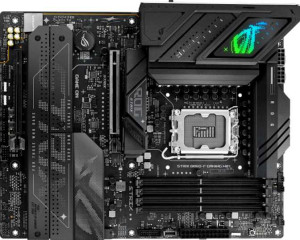
Asus ROG Strix B860-F Gaming WiFi
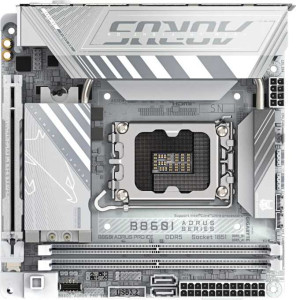
Gigabyte B860I Aorus Pro Ice

Asus ROG Strix B860-F Gaming WiFi Gigabyte B860I Aorus Pro Ice

Common Features

  • Both boards use the LGA 1851 CPU socket.
  • Both feature the B860 chipset.
  • Both support Wi-Fi, including Wi-Fi 7 (802.11be) and earlier standards.
  • Both have Bluetooth version 5.4.
  • Both include an HDMI 2.1 output.
  • Wi-Fi support is available on both boards.
  • Both support overclocking.
  • Both use DDR5 memory.
  • Both have 2 memory channels.
  • ECC memory support is not available on either board.
  • Neither board has USB 3.2 Gen 2 ports (USB-C) on the rear panel.
  • Neither board has USB 3.2 Gen 1 ports (USB-C) on the rear panel.
  • Neither board has USB 2.0 ports on the rear panel.
  • Both boards have 1 USB 4 40Gbps port.
  • Neither board has USB 4 20Gbps ports.
  • Both boards have 1 Thunderbolt 4 port.
  • Neither board has Thunderbolt 3 ports.
  • Both boards provide 2 USB 3.2 Gen 1 ports through expansion headers.
  • Both boards provide 2 USB 3.0 ports through expansion headers.
  • Neither board has a U.2 socket.
  • Neither board has an mSATA connector.
  • Neither board has SATA 2 connectors.
  • Both boards have 1 PCIe 5.0 x16 slot.
  • Neither board has PCIe 3.0 x16 slots, PCIe x1 slots, PCI slots, PCIe 2.0 x16 slots, PCIe x4 slots, or PCIe x8 slots.
  • Both boards support 7.1 audio channels.
  • Both boards have an S/PDIF Out port.
  • Both boards have 2 audio connectors.
  • Both boards support RAID 0 and RAID 1.
  • RAID 0+1 support is not available on either board.

Main Differences

  • Form factor is ATX on Asus ROG Strix B860-F Gaming WiFi and Mini-ITX on Gigabyte B860I Aorus Pro Ice.
  • RGB lighting is present on Asus ROG Strix B860-F Gaming WiFi but not on Gigabyte B860I Aorus Pro Ice.
  • Easy BIOS reset is available on Asus ROG Strix B860-F Gaming WiFi but not on Gigabyte B860I Aorus Pro Ice.
  • Height is 244 mm on Asus ROG Strix B860-F Gaming WiFi and 170 mm on Gigabyte B860I Aorus Pro Ice.
  • Width is 305 mm on Asus ROG Strix B860-F Gaming WiFi and 170 mm on Gigabyte B860I Aorus Pro Ice.
  • Maximum memory amount is 256GB on Asus ROG Strix B860-F Gaming WiFi and 128GB on Gigabyte B860I Aorus Pro Ice.
  • Overclocked RAM speed is 9066 MHz on Asus ROG Strix B860-F Gaming WiFi and 9200 MHz on Gigabyte B860I Aorus Pro Ice.
  • Memory slots count is 4 on Asus ROG Strix B860-F Gaming WiFi and 2 on Gigabyte B860I Aorus Pro Ice.
  • USB 3.2 Gen 2 ports (USB-A) count is 1 on Asus ROG Strix B860-F Gaming WiFi and 3 on Gigabyte B860I Aorus Pro Ice.
  • USB 3.2 Gen 1 ports (USB-A) count is 6 on Asus ROG Strix B860-F Gaming WiFi and 2 on Gigabyte B860I Aorus Pro Ice.
  • A USB 3.2 Gen 2x2 port is present on Asus ROG Strix B860-F Gaming WiFi but not on Gigabyte B860I Aorus Pro Ice.
  • USB 2.0 ports through expansion count is 3 on Asus ROG Strix B860-F Gaming WiFi and 2 on Gigabyte B860I Aorus Pro Ice.
  • SATA 3 connectors count is 4 on Asus ROG Strix B860-F Gaming WiFi and 2 on Gigabyte B860I Aorus Pro Ice.
  • Fan headers count is 6 on Asus ROG Strix B860-F Gaming WiFi and 3 on Gigabyte B860I Aorus Pro Ice.
  • M.2 sockets count is 4 on Asus ROG Strix B860-F Gaming WiFi and 2 on Gigabyte B860I Aorus Pro Ice.
  • A TPM connector is present on Gigabyte B860I Aorus Pro Ice but not on Asus ROG Strix B860-F Gaming WiFi.
  • A PCIe 4.0 x16 slot is present on Asus ROG Strix B860-F Gaming WiFi but not on Gigabyte B860I Aorus Pro Ice.
  • RAID 10 (1+0) support is available on Asus ROG Strix B860-F Gaming WiFi but not on Gigabyte B860I Aorus Pro Ice.
  • RAID 5 support is available on Asus ROG Strix B860-F Gaming WiFi but not on Gigabyte B860I Aorus Pro Ice.
Specs Comparison
Asus ROG Strix B860-F Gaming WiFi

Asus ROG Strix B860-F Gaming WiFi

Gigabyte B860I Aorus Pro Ice

Gigabyte B860I Aorus Pro Ice

General info:
CPU socket LGA 1851 LGA 1851
chipset B860 B860
form factor ATX Mini-ITX
release date January 2025 January 2025
supports Wi-Fi
Wi-Fi version Wi-Fi 4 (802.11n), Wi-Fi 5 (802.11ac), Wi-Fi 6 (802.11ax), Wi-Fi 6E (802.11ax), Wi-Fi 7 (802.11be) Wi-Fi 4 (802.11n), Wi-Fi 5 (802.11ac), Wi-Fi 6 (802.11ax), Wi-Fi 6E (802.11ax), Wi-Fi 7 (802.11be)
Has Bluetooth
Bluetooth version 5.4 5.4
HDMI version HDMI 2.1 HDMI 2.1
Easy to overclock
has RGB lighting
Easy to reset BIOS
Has dual BIOS
has aptX
CPU sockets 1 1
Has integrated graphics
warranty period 3 years 3 years
height 244 mm 170 mm
width 305 mm 170 mm
Has integrated CPU

Both boards share the same LGA 1851 socket and B860 chipset, meaning they target the same CPU platform with identical overclocking support, Wi-Fi 7 connectivity, Bluetooth 5.4, and HDMI 2.1 output. The three-year warranty and dual BIOS protection are also matched, so neither board has a fundamental reliability or feature edge at the platform level.

The decisive differentiator in this group is form factor. The Asus ROG Strix B860-F is a full ATX board at 305 × 244 mm, designed for standard mid- and full-tower cases; it offers more room for expansion slots, cooling mounts, and component spacing. The Gigabyte B860I Aorus Pro Ice is a Mini-ITX board at just 170 × 170 mm, roughly one-third the area, built specifically for compact or small-form-factor builds where space is the primary constraint. The Asus also adds RGB lighting and a quick BIOS-reset mechanism — conveniences the Gigabyte omits, likely as deliberate trade-offs to fit the tighter PCB real estate.

The choice here is driven entirely by your build goals. If you want a spacious, feature-rich board with aesthetic lighting and easier BIOS recovery, the Asus ROG Strix B860-F has a clear edge. If you are building a compact system and size is paramount, the Gigabyte B860I Aorus Pro Ice is purpose-built for that use case — the missing RGB and manual BIOS reset are minor sacrifices for the significant footprint reduction.

Memory:
maximum memory amount 256GB 128GB
overclocked RAM speed 9066 MHz 9200 MHz
memory slots 4 2
DDR memory version 5 5
memory channels 2 2
Supports ECC memory

The Asus ROG Strix B860-F Gaming WiFi and the Gigabyte B860I Aorus Pro Ice have notable differences when it comes to memory specifications. The Asus ROG Strix supports a maximum memory capacity of 256GB, while the Gigabyte B860I supports a smaller maximum of 128GB. Both motherboards use DDR5 memory, and both are equipped with dual memory channels, allowing for improved performance. However, the Asus board offers 4 memory slots, while the Gigabyte board only has 2 slots available.

In terms of overclocked RAM speed, the Gigabyte B860I Aorus Pro Ice slightly surpasses the Asus ROG Strix with a maximum overclocked speed of 9200 MHz, compared to the Asus board's 9066 MHz. Neither board supports ECC memory, so both are suitable for gaming or high-performance applications where error-correcting memory is not a requirement.

Overall, while the Asus ROG Strix offers more memory capacity and slots, the Gigabyte B860I has a slight advantage in terms of maximum overclocked RAM speed, though both offer strong memory performance for their respective form factors.

Ports:
USB 3.2 Gen 2 ports (USB-A) 1 3
USB 3.2 Gen 1 ports (USB-A) 6 2
USB 3.2 Gen 2 ports (USB-C) 0 0
USB 3.2 Gen 1 ports (USB-C) 0 0
USB 2.0 ports 0 0
USB 3.2 Gen 2x2 ports 1 0
USB 4 40Gbps ports 1 1
USB 4 20Gbps ports 0 0
Thunderbolt 4 ports 1 1
Thunderbolt 3 ports 0 0
has an HDMI output
DisplayPort outputs 1 1
RJ45 ports 1 1
Has USB Type-C
eSATA ports 0 0
DVI outputs 0 0
has a VGA connector
PS/2 ports 0 0

The Asus ROG Strix B860-F Gaming WiFi and the Gigabyte B860I Aorus Pro Ice have a variety of ports, with some key differences. Both motherboards feature USB 3.2 Gen 2 and USB 3.2 Gen 1 ports, but the Asus ROG Strix offers more USB 3.2 Gen 2x2 and USB 3.2 Gen 1 (USB-A) ports. Specifically, the Asus board provides 1 USB 3.2 Gen 2x2 port, 6 USB 3.2 Gen 1 (USB-A) ports, and 1 USB 3.2 Gen 2 (USB-A) port, whereas the Gigabyte B860I offers fewer USB 3.2 Gen 2 (USB-A) ports, with only 3 USB 3.2 Gen 2 (USB-A) and 2 USB 3.2 Gen 1 (USB-A) ports. Both boards do not have any USB 2.0 or USB-C ports.

Regarding USB 4 ports, the Asus ROG Strix has 1 USB 4 40Gbps port, while the Gigabyte B860I also includes a USB 4 40Gbps port but lacks the additional USB 3.2 Gen 2x2. Both motherboards are equipped with Thunderbolt 4 ports for high-speed connectivity. Additionally, both offer HDMI and DisplayPort outputs for video output and have a single RJ45 port for Ethernet connectivity.

Finally, neither board features eSATA, DVI, or VGA connectors, and both lack PS/2 ports. While both motherboards support USB Type-C, the Asus ROG Strix offers additional USB ports, especially in the USB 3.2 Gen 1 and 2x2 categories, giving it a more versatile offering in terms of USB connectivity compared to the Gigabyte B860I.

Connectors:
USB 3.2 Gen 1 ports (through expansion) 2 2
USB 2.0 ports (through expansion) 3 2
SATA 3 connectors 4 2
fan headers 6 3
USB 3.0 ports (through expansion) 2 2
M.2 sockets 4 2
Has TPM connector
U.2 sockets 0 0
Has mSATA connector
SATA 2 connectors 0 0

The Asus ROG Strix B860-F Gaming WiFi and the Gigabyte B860I Aorus Pro Ice offer different numbers and types of connectors. Both motherboards provide 2 USB 3.2 Gen 1 ports, 2 USB 3.0 ports, and 3 or 2 USB 2.0 ports through expansion, but the Asus board includes 3 USB 2.0 expansion ports, while the Gigabyte board only has 2. The Asus motherboard also supports more SATA 3 connectors (4 compared to the Gigabyte's 2) and offers more fan headers (6 compared to the Gigabyte's 3). Additionally, the Asus board provides 4 M.2 sockets, while the Gigabyte board has only 2 M.2 sockets.

In terms of additional features, the Gigabyte B860I includes a TPM connector, which the Asus board does not have. Both motherboards lack U.2 sockets and mSATA connectors, and neither has any SATA 2 connectors.

Overall, the Asus ROG Strix B860-F Gaming WiFi offers more expansion options with additional SATA and M.2 connectors, as well as more fan headers, while the Gigabyte B860I Aorus Pro Ice provides a TPM connector, which is not available on the Asus board.

Expansion slots:
PCIe 4.0 x16 slots 1 0
PCIe 5.0 x16 slots 1 1
PCIe 3.0 x16 slots 0 0
PCIe x1 slots 0 0
PCI slots 0 0
PCIe 2.0 x16 slots 0 0
PCIe x4 slots 0 0
PCIe x8 slots 0 0

The Asus ROG Strix B860-F Gaming WiFi and the Gigabyte B860I Aorus Pro Ice differ in their PCIe expansion slots. The Asus board includes one PCIe 5.0 x16 slot and one PCIe 4.0 x16 slot, providing more flexibility for high-speed graphics or expansion cards. In contrast, the Gigabyte board only has one PCIe 5.0 x16 slot, lacking the additional PCIe 4.0 x16 slot found on the Asus board.

Neither motherboard has PCIe x1, PCIe x4, PCIe x8, PCI slots, or PCIe 2.0 x16 slots, meaning both have a similar set of more modern PCIe configurations. Both motherboards also lack PCIe 3.0 x16 slots.

Overall, the Asus ROG Strix B860-F Gaming WiFi offers more expansion slot options with its additional PCIe 4.0 x16 slot, whereas the Gigabyte B860I Aorus Pro Ice is limited to a single PCIe 5.0 x16 slot.

Audio:
audio channels 7.1 7.1
Has S/PDIF Out port
audio connectors 2 2

Both the Asus ROG Strix B860-F Gaming WiFi and the Gigabyte B860I Aorus Pro Ice offer similar audio features. They both support 7.1 audio channels, providing a high-quality surround sound experience. Each motherboard is equipped with an S/PDIF Out port, allowing for digital audio output. Additionally, both motherboards include 2 audio connectors, which are typically used for connecting headphones, speakers, or other audio devices.

Overall, there is no difference in the audio specifications between the Asus and Gigabyte boards. Both provide the same audio channels, S/PDIF Out port, and number of audio connectors.

Storage:
Supports RAID 1
Supports RAID 10 (1+0)
Supports RAID 5
Supports RAID 0
Supports RAID 0+1

The Asus ROG Strix B860-F Gaming WiFi and the Gigabyte B860I Aorus Pro Ice offer different RAID support options. Both motherboards support RAID 1 (mirroring) for data redundancy. The Asus board also supports RAID 10 (1+0) and RAID 5 (striping with parity), providing more flexibility for performance and data protection. On the other hand, the Gigabyte board does not support RAID 10 or RAID 5, but it does support RAID 0 (striping) for improved performance.

Neither motherboard supports RAID 0+1, which combines RAID 0 and RAID 1 features, and this feature is not available on either product.

In summary, the Asus ROG Strix B860-F Gaming WiFi offers more RAID options with support for RAID 10 and RAID 5, while the Gigabyte B860I Aorus Pro Ice is limited to RAID 1 and RAID 0.

Comparison Summary & Verdict

This is a specification comparison between Asus ROG Strix B860-F Gaming WiFi and Gigabyte B860I Aorus Pro Ice. Both products share features like LGA 1851 CPU socket, Wi-Fi support (Wi-Fi 4, 5, 6, and 7), and 7.1 audio channels. The main differences include form factor, with the Asus being ATX and the Gigabyte Mini-ITX, memory support with the Asus supporting 256GB and the Gigabyte 128GB, and USB port counts where the Asus has fewer USB 3.2 Gen 2 and 3.2 Gen 1 ports than the Gigabyte. The Asus also supports PCIe 4.0 x16 slots and RAID 10, while the Gigabyte lacks these features. Additionally, the Asus offers RGB lighting and more fan headers, unlike the Gigabyte.