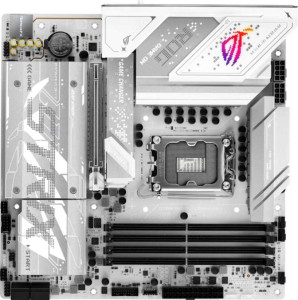
Asus ROG Strix B860-G Gaming WiFi
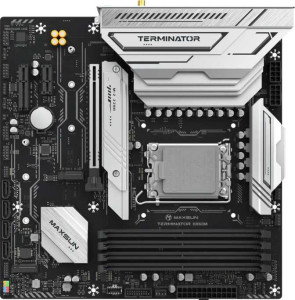
Maxsun eSport B860M Sniper WiFi

Asus ROG Strix B860-G Gaming WiFi Maxsun eSport B860M Sniper WiFi

Overview

When choosing between the Asus ROG Strix B860-G Gaming WiFi and the Maxsun eSport B860M Sniper WiFi, builders face a compelling Micro-ATX showdown on the B860 chipset. Both boards share a strong foundation, yet they diverge meaningfully across memory capacity, wireless connectivity, storage options, and audio features — making the choice far from straightforward. Read on as we break down every specification side by side.

Common Features

  • Both boards use the LGA 1851 CPU socket.
  • Both boards use the B860 chipset.
  • Both boards come in the Micro-ATX form factor.
  • Wi-Fi connectivity is available on both boards.
  • Bluetooth is available on both boards.
  • Overclocking support is present on both boards.
  • RGB lighting is featured on both boards.
  • Easy BIOS reset functionality is present on both boards.
  • Both boards use DDR5 memory.
  • Both boards support dual-channel memory.
  • ECC memory is not supported on either board.
  • Neither board has USB 3.2 Gen 2 ports with USB-C connector.
  • Neither board has USB 3.2 Gen 1 ports with USB-C connector.
  • Both boards have 4 USB 2.0 ports.
  • Both boards feature 1 USB 4 40Gbps port.
  • Neither board has any USB 4 20Gbps ports.
  • Both boards include 1 Thunderbolt 4 port.
  • Neither board has Thunderbolt 3 ports.
  • An HDMI output is present on both boards.
  • Neither board has a TPM connector.
  • Neither board has any U.2 sockets.
  • Neither board includes an mSATA connector.
  • Neither board has any SATA 2 connectors.
  • Both boards feature 1 PCIe 5.0 x16 slot.
  • Neither board has any PCIe 4.0 x16, PCIe 3.0 x16, PCIe 2.0 x16, PCIe x8, or legacy PCI slots.
  • RAID 0+1 is not supported on either board.

Main Differences

  • Wi-Fi version support extends to Wi-Fi 7 (802.11be) on Asus ROG Strix B860-G Gaming WiFi, while Maxsun eSport B860M Sniper WiFi tops out at Wi-Fi 6 (802.11ax).
  • Bluetooth version is 5.4 on Asus ROG Strix B860-G Gaming WiFi and 5.2 on Maxsun eSport B860M Sniper WiFi.
  • HDMI version is 2.1 on Asus ROG Strix B860-G Gaming WiFi and 2.0 on Maxsun eSport B860M Sniper WiFi.
  • Board height is 244 mm on Asus ROG Strix B860-G Gaming WiFi and 225 mm on Maxsun eSport B860M Sniper WiFi.
  • Board width is 244 mm on Asus ROG Strix B860-G Gaming WiFi and 245 mm on Maxsun eSport B860M Sniper WiFi.
  • Maximum supported memory is 256 GB on Asus ROG Strix B860-G Gaming WiFi and 96 GB on Maxsun eSport B860M Sniper WiFi.
  • Overclocked RAM speed reaches up to 9066 MHz on Asus ROG Strix B860-G Gaming WiFi and 8600 MHz on Maxsun eSport B860M Sniper WiFi.
  • Memory slot count is 4 on Asus ROG Strix B860-G Gaming WiFi and 2 on Maxsun eSport B860M Sniper WiFi.
  • USB 3.2 Gen 2x2 port is present on Asus ROG Strix B860-G Gaming WiFi but not available on Maxsun eSport B860M Sniper WiFi.
  • SATA 3 connector count is 4 on Asus ROG Strix B860-G Gaming WiFi and 3 on Maxsun eSport B860M Sniper WiFi.
  • Fan header count is 4 on Asus ROG Strix B860-G Gaming WiFi and 3 on Maxsun eSport B860M Sniper WiFi.
  • M.2 socket count is 4 on Asus ROG Strix B860-G Gaming WiFi and 2 on Maxsun eSport B860M Sniper WiFi.
  • PCIe x1 slot is present on Maxsun eSport B860M Sniper WiFi but not available on Asus ROG Strix B860-G Gaming WiFi.
  • PCIe x4 slot is present on Maxsun eSport B860M Sniper WiFi but not available on Asus ROG Strix B860-G Gaming WiFi.
  • S/PDIF Out port is present on Asus ROG Strix B860-G Gaming WiFi but not available on Maxsun eSport B860M Sniper WiFi.
  • Audio connector count is 2 on Asus ROG Strix B860-G Gaming WiFi and 0 on Maxsun eSport B860M Sniper WiFi.
Specs Comparison
Asus ROG Strix B860-G Gaming WiFi

Asus ROG Strix B860-G Gaming WiFi

Maxsun eSport B860M Sniper WiFi

Maxsun eSport B860M Sniper WiFi

General info:
CPU socket LGA 1851 LGA 1851
chipset B860 B860
form factor Micro-ATX Micro-ATX
release date January 2025 January 2025
supports Wi-Fi
Wi-Fi version Wi-Fi 4 (802.11n), Wi-Fi 5 (802.11ac), Wi-Fi 6 (802.11ax), Wi-Fi 6E (802.11ax), Wi-Fi 7 (802.11be) Wi-Fi 4 (802.11n), Wi-Fi 5 (802.11ac), Wi-Fi 6 (802.11ax)
Has Bluetooth
Bluetooth version 5.4 5.2
HDMI version HDMI 2.1 HDMI 2.0
Easy to overclock
has RGB lighting
Easy to reset BIOS
Has dual BIOS
has aptX
CPU sockets 1 1
Has integrated graphics
warranty period 3 years 3 years
height 244 mm 225 mm
width 244 mm 245 mm
Has integrated CPU

Both the Asus ROG Strix B860-G Gaming WiFi and the Maxsun eSport B860M Sniper WiFi share the same foundational platform: the LGA 1851 socket, B860 chipset, and Micro-ATX form factor. This means they target the same class of builds and are compatible with the same generation of processors. They also match on practical convenience features — both offer dual BIOS, easy BIOS reset, RGB lighting, and an identical 3-year warranty, so neither board holds an edge on build quality assurances or usability basics.

Where the two diverge meaningfully is in wireless and display connectivity. The ROG Strix steps up to Wi-Fi 7 (802.11be) and Bluetooth 5.4, while the Maxsun tops out at Wi-Fi 6 (802.11ax) and Bluetooth 5.2. In practice, Wi-Fi 7 offers significantly higher theoretical throughput, lower latency, and better multi-device handling — relevant if you are on a Wi-Fi 7 router or plan to upgrade. Bluetooth 5.4 over 5.2 brings improved connection stability and slightly better range. Similarly, the ROG Strix's HDMI 2.1 port supports up to 4K@120Hz or 8K output, whereas the Maxsun's HDMI 2.0 caps at 4K@60Hz — a real limitation if you intend to drive a high-refresh-rate display directly from the board's video output.

Overall, the ROG Strix B860-G holds a clear connectivity advantage in this category. Its newer wireless stack and superior HDMI output make it the stronger choice for users who prioritize future-proofed wireless performance or plan to use the board's video output at high refresh rates. The Maxsun eSport B860M Sniper is competitive on the fundamentals, but its older Wi-Fi and HDMI standards put it at a tangible disadvantage here.

Memory:
maximum memory amount 256GB 96GB
overclocked RAM speed 9066 MHz 8600 MHz
memory slots 4 2
DDR memory version 5 5
memory channels 2 2
Supports ECC memory

On the memory front, both boards run DDR5 in a dual-channel configuration, so the bandwidth architecture is identical. The meaningful differences lie in capacity ceiling, slot count, and overclocking headroom. The ROG Strix B860-G offers 4 DIMM slots with a maximum supported capacity of 256GB, while the Maxsun eSport B860M Sniper provides only 2 DIMM slots capped at 96GB. For most everyday gaming or productivity builds this gap is invisible, but for users running memory-hungry workloads — video editing, virtualization, large datasets — the ROG Strix's headroom is a genuine long-term advantage. The additional slots also allow a phased upgrade path, starting with two sticks and expanding later without replacing anything.

On overclocked RAM speed, the ROG Strix supports up to 9066 MHz versus the Maxsun's 8600 MHz. The real-world performance delta at these frequencies is modest in most applications, but it signals that the ROG Strix's power delivery and trace routing are tuned for more aggressive XMP/EXPO profiles, which matters if you plan to run high-binned DDR5 kits.

The ROG Strix B860-G wins this category decisively. Its combination of more slots, a dramatically higher capacity ceiling, and greater overclocked speed ceiling makes it the stronger platform for both current demanding builds and future memory upgrades. The Maxsun is adequate for a compact two-stick build but leaves little room to grow.

Ports:
USB 3.2 Gen 2 ports (USB-C) 0 0
USB 3.2 Gen 1 ports (USB-C) 0 0
USB 2.0 ports 4 4
USB 3.2 Gen 2x2 ports 1 0
USB 4 40Gbps ports 1 1
USB 4 20Gbps ports 0 0
Thunderbolt 4 ports 1 1
Thunderbolt 3 ports 0 0
has an HDMI output
DisplayPort outputs 1 1
RJ45 ports 1 1
Has USB Type-C
eSATA ports 0 0
DVI outputs 0 0
has a VGA connector
PS/2 ports 0 0

The rear I/O layouts of these two boards are remarkably similar. Both carry a USB4 40Gbps port, a Thunderbolt 4 port, four USB 2.0 ports, HDMI, DisplayPort, and a single RJ45 ethernet jack. For the vast majority of peripherals — external drives, docks, displays, networking — either board covers the same ground equally well. The shared Thunderbolt 4 port is particularly notable, as it delivers up to 40Gbps bandwidth, supports daisy-chaining, and is compatible with a wide range of high-speed accessories and eGPUs.

The one concrete differentiator is that the ROG Strix B860-G adds a USB 3.2 Gen 2x2 port, which provides 20Gbps throughput over a standard Type-A connector. This is useful for the latest high-speed external SSDs that can saturate a standard 10Gbps Gen 2 connection — a niche but real advantage for users who regularly move large files to and from fast external storage. The Maxsun eSport B860M Sniper omits this port entirely, leaving a small but measurable gap in high-bandwidth peripheral support.

This category is nearly a wash, but the ROG Strix edges ahead thanks to that additional Gen 2x2 port. It is a minor advantage for most users, but for those with compatible high-speed storage devices, it provides a throughput option the Maxsun simply cannot match at the rear I/O level.

Connectors:
SATA 3 connectors 4 3
fan headers 4 3
M.2 sockets 4 2
Has TPM connector
U.2 sockets 0 0
Has mSATA connector
SATA 2 connectors 0 0

Storage and cooling connectivity is where the gap between these two boards becomes quite tangible. The ROG Strix B860-G packs 4 M.2 sockets against the Maxsun eSport B860M Sniper's 2 M.2 sockets — a doubling of high-speed NVMe slot availability. For a single-drive gaming build this is irrelevant, but for anyone planning a fast system drive plus dedicated storage for games, creative assets, or a cache drive, the ROG Strix accommodates that expansion without ever touching a SATA cable.

The SATA 3 connector count follows the same pattern: 4 ports on the ROG Strix versus 3 on the Maxsun. Similarly, fan headers sit at 4 versus 3, which is a meaningful distinction in practice. A typical build with a CPU cooler, two or three case fans, and potentially a radiator fan can easily exhaust three headers, forcing the use of a splitter on the Maxsun. The ROG Strix's extra header provides cleaner, independent fan control out of the box.

Across every connector metric in this group, the ROG Strix B860-G holds a consistent advantage. None of the individual differences are dramatic, but together they paint a clear picture: it is the more expansion-friendly board, better suited to builds that will grow over time or demand more granular thermal management.

Expansion slots:
PCIe 4.0 x16 slots 0 0
PCIe 5.0 x16 slots 1 1
PCIe 3.0 x16 slots 0 0
PCIe x1 slots 0 1
PCI slots 0 0
PCIe 2.0 x16 slots 0 0
PCIe x4 slots 0 1
PCIe x8 slots 0 0

For the primary GPU slot, these boards are identical: both offer a single PCIe 5.0 x16 slot, ensuring full-bandwidth support for the latest generation of graphics cards. Neither board shortchanges discrete GPU performance, so for the core use case of dropping in a modern GPU, the choice between them makes no difference here.

Where the Maxsun eSport B860M Sniper pulls ahead is in secondary expansion. It adds a PCIe x4 slot and a PCIe x1 slot, while the ROG Strix B860-G offers no additional PCIe slots at all. That x4 slot is practically useful for add-in cards like capture cards, 10GbE NICs, or PCIe storage controllers — hardware that is increasingly common in content creation or enthusiast builds. The x1 slot covers smaller peripherals like sound cards or additional USB expansion cards.

This category goes to the Maxsun eSport B860M Sniper. Despite being the more budget-oriented board, it provides more expansion flexibility for users who want to install add-in cards alongside their GPU. The ROG Strix's single-slot layout is clean and sufficient for a pure gaming rig, but it leaves no room for future peripheral expansion beyond the primary graphics card.

Audio:
Has S/PDIF Out port
audio connectors 2 0

Audio is one of the starkest contrasts between these two boards. The ROG Strix B860-G includes 2 analog audio connectors and an S/PDIF optical output on its rear I/O, while the Maxsun eSport B860M Sniper has zero audio connectors of any kind. In practical terms, the Maxsun offers no onboard audio output whatsoever — users are entirely dependent on a discrete sound card, a USB DAC/headset, or audio routed through an HDMI/DisplayPort connected display.

The ROG Strix's S/PDIF port is worth highlighting specifically. It carries a digital audio signal over an optical cable to an external receiver or DAC, bypassing any electrical noise from the motherboard entirely — a meaningful perk for users with a home theater receiver or a high-quality external audio setup. Combined with its analog jacks for direct headphone or speaker connections, it covers a broad range of audio use cases without any additional hardware.

The ROG Strix B860-G wins this category outright. The Maxsun's complete absence of audio connectivity is a genuine limitation that forces every user to source an alternative audio solution, adding cost and complexity. For anyone who values plug-and-play audio — whether a gaming headset, desktop speakers, or a home theater system — the ROG Strix is the clear choice here.

Storage:
Supports RAID 0+1

The only data point available for this group is RAID 0+1 support, and both the Asus ROG Strix B860-G Gaming WiFi and the Maxsun eSport B860M Sniper WiFi lack it equally. RAID 0+1 combines striping and mirroring across multiple drives to deliver both performance and redundancy simultaneously — a feature more relevant to workstation or small server environments than typical consumer builds. Its absence on both boards is consistent with the B860 chipset's positioning as a mainstream consumer platform.

This group is a complete tie. Neither board holds any advantage over the other based on the provided data, and for the overwhelming majority of gaming or general-purpose PC users, the lack of RAID 0+1 support is unlikely to factor into the purchasing decision at all.

Comparison Summary & Verdict

Both boards share the same B860 chipset, LGA 1851 socket, and Micro-ATX form factor, but their differences reveal clearly distinct audiences. The Asus ROG Strix B860-G Gaming WiFi is the stronger choice for enthusiasts who demand the most from their build: it supports up to 256 GB of DDR5 RAM across four slots, reaches 9066 MHz overclocked speeds, offers Wi-Fi 7, four M.2 sockets, a USB 3.2 Gen 2x2 port, HDMI 2.1, and onboard audio with two connectors plus S/PDIF Out. The Maxsun eSport B860M Sniper WiFi, by contrast, is a more compact and budget-conscious option — its smaller footprint, two memory slots capped at 96 GB, and simpler connectivity make it suitable for entry-level builds where expandability is less of a priority but cost efficiency matters.

Asus ROG Strix B860-G Gaming WiFi
Buy Asus ROG Strix B860-G Gaming WiFi if...

Buy the Asus ROG Strix B860-G Gaming WiFi if you want maximum expandability with four RAM slots, up to 256 GB of DDR5, four M.2 sockets, Wi-Fi 7, and a full audio output setup including S/PDIF Out.

Maxsun eSport B860M Sniper WiFi
Buy Maxsun eSport B860M Sniper WiFi if...

Buy the Maxsun eSport B860M Sniper WiFi if you are building a compact, cost-conscious system and do not require extensive storage, high memory capacity, or advanced wireless connectivity beyond Wi-Fi 6.