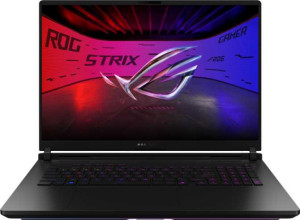
Asus ROG Strix Scar 18 (2025) G835LX 18" Intel Core Ultra 9 275HX 2.7GHz / Nvidia GeForce RTX 5090 Laptop / 32GB RAM / 2TB SSD
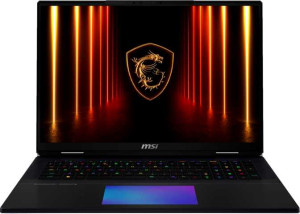
MSI Titan 18 HX AI A2XW (2025) 18"

Asus ROG Strix Scar 18 (2025) G835LX 18" Intel Core Ultra 9 275HX 2.7GHz / Nvidia GeForce RTX 5090 Laptop / 32GB RAM / 2TB SSD MSI Titan 18 HX AI A2XW (2025) 18"

Overview

Welcome to our in-depth specification comparison between the Asus ROG Strix Scar 18 (2025) G835LX and the MSI Titan 18 HX AI A2XW (2025) — two of the most powerful 18-inch gaming laptops money can buy. Both machines share the same Blackwell GPU architecture and a robust port selection, yet they diverge sharply when it comes to display resolution, RAM capacity, and overall dimensions. Read on to find out which titan of gaming performance best suits your needs.

Common Features

  • Both products are gaming laptops.
  • Neither product uses a fanless design.
  • Both products feature a backlit keyboard.
  • Neither product is weather-sealed or splashproof.
  • Both products have an 18″ screen size.
  • Neither product has a touch screen.
  • Both products support up to 4 external displays.
  • Both products use flash storage in NVMe SSD format.
  • Both products have CPUs with 24 threads.
  • Both products feature 24GB of VRAM with GDDR7 memory.
  • Both products deliver 31.8 TFLOPS of floating-point performance.
  • Both products share a texture rate of 496.9 GTexels/s and a pixel rate of 193.9 GPixel/s.
  • Both products have 0 USB 3.2 Gen 2 ports (USB-C), 3 USB 3.2 Gen 2 ports (USB-A), 2 USB 4 40Gbps ports, and no Thunderbolt ports.
  • Both products include sleep-and-charge USB ports.
  • Neither product uses a MagSafe power adapter.
  • Both products have stereo speakers and a 3.5mm audio jack.
  • Both products support ray tracing and DLSS.
  • Neither product includes a stylus or fingerprint scanner.
  • Both products feature a front camera.
  • Both products use the Blackwell GPU architecture with a 95W TDP and Intel Resizable BAR.

Main Differences

  • Weight is 3480g on Asus ROG Strix Scar 18 (2025) G835LX 18″ Intel Core Ultra 9 275HX 2.7GHz / Nvidia GeForce RTX 5090 Laptop / 32GB RAM / 2TB SSD and 3600g on MSI Titan 18 HX AI A2XW (2025) 18″.
  • Volume is 2734.746 cm³ on Asus ROG Strix Scar 18 (2025) G835LX 18″ Intel Core Ultra 9 275HX 2.7GHz / Nvidia GeForce RTX 5090 Laptop / 32GB RAM / 2TB SSD and 2976.672 cm³ on MSI Titan 18 HX AI A2XW (2025) 18″.
  • Width is 399mm on Asus ROG Strix Scar 18 (2025) G835LX 18″ Intel Core Ultra 9 275HX 2.7GHz / Nvidia GeForce RTX 5090 Laptop / 32GB RAM / 2TB SSD and 404mm on MSI Titan 18 HX AI A2XW (2025) 18″.
  • Height is 298mm on Asus ROG Strix Scar 18 (2025) G835LX 18″ Intel Core Ultra 9 275HX 2.7GHz / Nvidia GeForce RTX 5090 Laptop / 32GB RAM / 2TB SSD and 307mm on MSI Titan 18 HX AI A2XW (2025) 18″.
  • Thickness is 23mm on Asus ROG Strix Scar 18 (2025) G835LX 18″ Intel Core Ultra 9 275HX 2.7GHz / Nvidia GeForce RTX 5090 Laptop / 32GB RAM / 2TB SSD and 24mm on MSI Titan 18 HX AI A2XW (2025) 18″.
  • Display resolution is 2560 x 1600 px on Asus ROG Strix Scar 18 (2025) G835LX 18″ Intel Core Ultra 9 275HX 2.7GHz / Nvidia GeForce RTX 5090 Laptop / 32GB RAM / 2TB SSD and 3840 x 2400 px on MSI Titan 18 HX AI A2XW (2025) 18″.
  • Pixel density is 167 ppi on Asus ROG Strix Scar 18 (2025) G835LX 18″ Intel Core Ultra 9 275HX 2.7GHz / Nvidia GeForce RTX 5090 Laptop / 32GB RAM / 2TB SSD and 251 ppi on MSI Titan 18 HX AI A2XW (2025) 18″.
  • An anti-reflection coating is present on Asus ROG Strix Scar 18 (2025) G835LX 18″ Intel Core Ultra 9 275HX 2.7GHz / Nvidia GeForce RTX 5090 Laptop / 32GB RAM / 2TB SSD but not available on MSI Titan 18 HX AI A2XW (2025) 18″.
  • RAM is 32GB on Asus ROG Strix Scar 18 (2025) G835LX 18″ Intel Core Ultra 9 275HX 2.7GHz / Nvidia GeForce RTX 5090 Laptop / 32GB RAM / 2TB SSD and 96GB on MSI Titan 18 HX AI A2XW (2025) 18″.
  • RAM speed is 5600 MHz on Asus ROG Strix Scar 18 (2025) G835LX 18″ Intel Core Ultra 9 275HX 2.7GHz / Nvidia GeForce RTX 5090 Laptop / 32GB RAM / 2TB SSD and 6400 MHz on MSI Titan 18 HX AI A2XW (2025) 18″.
  • Internal storage is 2048GB on Asus ROG Strix Scar 18 (2025) G835LX 18″ Intel Core Ultra 9 275HX 2.7GHz / Nvidia GeForce RTX 5090 Laptop / 32GB RAM / 2TB SSD and 6144GB on MSI Titan 18 HX AI A2XW (2025) 18″.
  • Maximum memory capacity is 64GB on Asus ROG Strix Scar 18 (2025) G835LX 18″ Intel Core Ultra 9 275HX 2.7GHz / Nvidia GeForce RTX 5090 Laptop / 32GB RAM / 2TB SSD and 96GB on MSI Titan 18 HX AI A2XW (2025) 18″.
  • CPU speed is 8 x 2.7 & 16 x 2.1 GHz on Asus ROG Strix Scar 18 (2025) G835LX 18″ Intel Core Ultra 9 275HX 2.7GHz / Nvidia GeForce RTX 5090 Laptop / 32GB RAM / 2TB SSD and 8 x 2.8 & 16 x 2.1 GHz on MSI Titan 18 HX AI A2XW (2025) 18″.
  • Turbo clock speed is 5.4GHz on Asus ROG Strix Scar 18 (2025) G835LX 18″ Intel Core Ultra 9 275HX 2.7GHz / Nvidia GeForce RTX 5090 Laptop / 32GB RAM / 2TB SSD and 5.5GHz on MSI Titan 18 HX AI A2XW (2025) 18″.
  • PassMark result is 56426 on Asus ROG Strix Scar 18 (2025) G835LX 18″ Intel Core Ultra 9 275HX 2.7GHz / Nvidia GeForce RTX 5090 Laptop / 32GB RAM / 2TB SSD and 62297 on MSI Titan 18 HX AI A2XW (2025) 18″.
  • PassMark single-core result is 4723 on Asus ROG Strix Scar 18 (2025) G835LX 18″ Intel Core Ultra 9 275HX 2.7GHz / Nvidia GeForce RTX 5090 Laptop / 32GB RAM / 2TB SSD and 4784 on MSI Titan 18 HX AI A2XW (2025) 18″.
  • An external memory slot is present on MSI Titan 18 HX AI A2XW (2025) 18″ but not available on Asus ROG Strix Scar 18 (2025) G835LX 18″ Intel Core Ultra 9 275HX 2.7GHz / Nvidia GeForce RTX 5090 Laptop / 32GB RAM / 2TB SSD.
  • Battery size is 90 Wh on Asus ROG Strix Scar 18 (2025) G835LX 18″ Intel Core Ultra 9 275HX 2.7GHz / Nvidia GeForce RTX 5090 Laptop / 32GB RAM / 2TB SSD and 99 Wh on MSI Titan 18 HX AI A2XW (2025) 18″.
  • Dolby Atmos support is present on Asus ROG Strix Scar 18 (2025) G835LX 18″ Intel Core Ultra 9 275HX 2.7GHz / Nvidia GeForce RTX 5090 Laptop / 32GB RAM / 2TB SSD but not available on MSI Titan 18 HX AI A2XW (2025) 18″.
  • The number of microphones is 2 on Asus ROG Strix Scar 18 (2025) G835LX 18″ Intel Core Ultra 9 275HX 2.7GHz / Nvidia GeForce RTX 5090 Laptop / 32GB RAM / 2TB SSD and 1 on MSI Titan 18 HX AI A2XW (2025) 18″.
  • 3D facial recognition is present on Asus ROG Strix Scar 18 (2025) G835LX 18″ Intel Core Ultra 9 275HX 2.7GHz / Nvidia GeForce RTX 5090 Laptop / 32GB RAM / 2TB SSD but not available on MSI Titan 18 HX AI A2XW (2025) 18″.
  • The clock multiplier is 27 on Asus ROG Strix Scar 18 (2025) G835LX 18″ Intel Core Ultra 9 275HX 2.7GHz / Nvidia GeForce RTX 5090 Laptop / 32GB RAM / 2TB SSD and 28 on MSI Titan 18 HX AI A2XW (2025) 18″.
Specs Comparison
Asus ROG Strix Scar 18 (2025) G835LX 18" Intel Core Ultra 9 275HX 2.7GHz / Nvidia GeForce RTX 5090 Laptop / 32GB RAM / 2TB SSD

Asus ROG Strix Scar 18 (2025) G835LX 18" Intel Core Ultra 9 275HX 2.7GHz / Nvidia GeForce RTX 5090 Laptop / 32GB RAM / 2TB SSD

MSI Titan 18 HX AI A2XW (2025) 18"

MSI Titan 18 HX AI A2XW (2025) 18"

Design:
Type Gaming Gaming
weight 3480 g 3600 g
Uses a fanless design
Has a backlit keyboard
volume 2734.746 cm³ 2976.672 cm³
width 399 mm 404 mm
height 298 mm 307 mm
thickness 23 mm 24 mm
is weather-sealed (splashproof)

Both the Asus ROG Strix Scar 18 (2025) and the MSI Titan 18 HX AI A2XW (2025) are large-chassis gaming laptops sharing the same fundamental design philosophy: active cooling (no fanless design), backlit keyboards, and no weather sealing — all expected for high-performance desktop-replacement machines in this class.

Where the two diverge is in their physical footprint and mass. The MSI Titan is measurably larger across every dimension — 404 × 307 × 24 mm versus the Asus ROG's 399 × 298 × 23 mm — resulting in a volume of 2,976 cm³ compared to 2,735 cm³, roughly an 8.8% larger chassis. It also weighs 120 g more at 3,600 g versus 3,480 g. While neither laptop is portable by any stretch, these differences matter when moving between desk setups or fitting into a bag: the Asus ROG occupies less space and is slightly easier to transport.

The Asus ROG Strix Scar 18 holds a clear edge in the Design category. Its more compact and lighter build — without any apparent sacrifice in shared design features — makes it the more practical choice for users who occasionally need to move their machine. The MSI Titan's larger frame may allow for better internal airflow or component layout, but the provided specs alone do not confirm any such benefit, so on pure design metrics, the Asus ROG wins this comparison.

Display:
screen size 18" 18"
resolution 2560 x 1600 px 3840 x 2400 px
pixel density 167 ppi 251 ppi
Display type Mini-LED, LCD LCD, Mini-LED
has a touch screen
has anti-reflection coating
supported displays 4 4

On an 18″ chassis, both laptops deploy Mini-LED LCD panels — a technology that delivers significantly better local dimming, contrast, and peak brightness than conventional LCD, making it well-suited for the dark gaming environments these machines are built for. That shared foundation is where the similarities end, because the resolution gap between the two is substantial.

The MSI Titan 18 HX AI runs a 3840 × 2400 panel at 251 ppi, while the Asus ROG Strix Scar 18 tops out at 2560 × 1600 and 167 ppi. On an 18″ screen, that difference is perceptible: the MSI's display will render finer text, sharper textures, and more detail in creative or productivity workloads. However, driving 4K at high frame rates demands considerably more GPU headroom, which is a real trade-off in gaming scenarios. The Asus ROG's lower resolution is actually easier to push to high refresh rates, and its anti-reflection coating — absent on the MSI Titan — meaningfully reduces glare in lit environments, improving perceived contrast and eye comfort during long sessions.

This group is a genuine trade-off rather than a clean win. The MSI Titan 18 HX AI has the sharper, more detail-rich display, making it the stronger pick for content creation or anyone who prioritizes visual fidelity. The Asus ROG Strix Scar 18 counters with anti-reflection coating and a resolution that is more gaming-practical. Users who split time between gaming and creative work will lean toward the MSI; those focused purely on high-framerate gaming will find the Asus ROG the more sensible display choice.

Performance:
RAM 32GB 96GB
RAM speed 5600 MHz 6400 MHz
Uses flash storage
internal storage 2048GB 6144GB
CPU speed 8 x 2.7 & 16 x 2.1 GHz 8 x 2.8 & 16 x 2.1 GHz
CPU threads 24 threads 24 threads
VRAM 24GB 24GB
floating-point performance 31.8 TFLOPS 31.8 TFLOPS
GDDR version GDDR7 GDDR7
texture rate 496.9 GTexels/s 496.9 GTexels/s
pixel rate 193.9 GPixel/s 193.9 GPixel/s
Is an NVMe SSD
DirectX version DirectX 12 Ultimate DirectX 12 Ultimate
GPU clock speed 990 MHz 990 MHz
uses multithreading
maximum memory amount 64GB 96GB
DDR memory version 5 5
turbo clock speed 5.4GHz 5.5GHz
GPU turbo 1515 MHz 1515 MHz
memory slots 2 2
PCI Express (PCIe) version 4 4
semiconductor size 4 nm 4 nm
has XeSS (XMX)
Supports 64-bit

At the GPU level, these two machines are effectively identical: both deliver 31.8 TFLOPS of floating-point performance with 24GB of GDDR7 VRAM, matching GPU clock speeds, and the same texture and pixel fill rates. For gaming and GPU-accelerated workloads, neither laptop holds an inherent graphics advantage over the other — the real differentiators live in the CPU and system memory tiers.

The most striking gap is RAM. The Asus ROG Strix Scar 18 ships with 32GB at 5600 MHz and can be expanded to a maximum of 64GB. The MSI Titan 18 HX AI, by contrast, comes configured with 96GB at the faster 6400 MHz speed — and that 96GB is also its ceiling, meaning it ships fully loaded. For pure gaming, 32GB is sufficient today, but for memory-intensive workloads like large dataset processing, virtual machines, or professional creative applications, the MSI's headroom is in a different league entirely. The faster RAM speed is a secondary but real benefit for CPU-bound tasks. Storage follows the same pattern: the MSI offers 6TB of NVMe storage versus the Asus ROG's 2TB, which matters for users managing large game libraries, RAW video, or sample libraries.

The MSI Titan 18 HX AI wins the Performance category decisively, not because of GPU muscle — that is a draw — but because of its vastly superior memory configuration and storage capacity. The Asus ROG Strix Scar 18 is no slouch and will handle any game or workload thrown at it, but the MSI is clearly configured for users who push heavier, more professional workloads alongside gaming.
Benchmarks:
PassMark result 56426 62297
PassMark result (single) 4723 4784

PassMark scores give a standardized, real-world-adjacent measure of CPU throughput, and here the data tells a consistent story. The MSI Titan 18 HX AI scores 62,297 in the multi-core test versus 56,426 for the Asus ROG Strix Scar 18 — a gap of roughly 10.4%. In practical terms, this means the MSI pulls ahead in heavily threaded workloads: video encoding, 3D rendering, large compilation jobs, and similar CPU-saturating tasks will complete noticeably faster on the Titan.

The single-core gap is narrower but still present — 4,784 versus 4,723 — a difference of about 1.3%. Single-core performance governs the responsiveness of most everyday tasks and a significant portion of gaming frame rates, so this near-parity means both machines will feel essentially identical in day-to-day use and in most gaming scenarios. The MSI's multi-core lead is where it actually pulls away.

The MSI Titan 18 HX AI takes this category. Its multi-core advantage is meaningful enough to matter in professional and creative CPU workloads, while the single-core scores confirm neither machine has a responsiveness edge for gaming or light tasks. Users running sustained, threaded workloads will see a tangible benefit from the MSI; for everyone else, the difference is unlikely to be felt in practice.

Connectivity:
USB 3.2 Gen 2 ports (USB-C) 0 0
USB 3.2 Gen 2 ports (USB-A) 3 3
USB 4 20Gbps ports 0 0
USB 4 40Gbps ports 2 2
Thunderbolt 4 ports 0 0
USB 3.2 Gen 1 ports (USB-C) 0 0
USB 3.2 Gen 1 ports (USB-A) 0 0
Thunderbolt 3 ports 0 0
has an HDMI output
Has USB Type-C
supports Wi-Fi
Wi-Fi version Wi-Fi 7 (802.11be), Wi-Fi 6E (802.11ax), Wi-Fi 6 (802.11ax), Wi-Fi 5 (802.11ac), Wi-Fi 4 (802.11n) Wi-Fi 7 (802.11be), Wi-Fi 6E (802.11ax), Wi-Fi 6 (802.11ax), Wi-Fi 5 (802.11ac), Wi-Fi 4 (802.11n)
has an external memory slot
Bluetooth version 5.4 5.4
RJ45 ports 1 1
HDMI ports 1 1
HDMI version HDMI 2.1 HDMI 2.1
DisplayPort outputs 0 0
has AirPlay
mini DisplayPort outputs 0 0
has a VGA connector

Connectivity is one of the most evenly matched categories in this comparison. Both laptops offer an identical port lineup: three USB-A 3.2 Gen 2 ports, two USB4 40Gbps Type-C ports, a single HDMI 2.1 output, and an RJ45 Ethernet jack. Wireless capabilities are also a dead heat — Wi-Fi 7 and Bluetooth 5.4 on both machines, representing current-generation standards that deliver low latency, high throughput, and improved multi-device handling over their predecessors.

The USB4 40Gbps ports deserve a mention for users with external setups: at 40Gbps, these can drive high-resolution external displays, connect to fast external NVMe enclosures, or interface with Thunderbolt-compatible peripherals — a meaningful asset for desktop-replacement workflows. Both machines bring this capability equally. The one spec that separates them is the external memory card slot, present on the MSI Titan 18 HX AI and absent on the Asus ROG Strix Scar 18. For photographers, videographers, or anyone regularly offloading camera media, this is a practical convenience that eliminates the need for a USB card reader dongle.

The MSI Titan 18 HX AI edges this category, but narrowly. The card slot is a real-world convenience advantage, particularly for content creators — but for users who never touch SD or CF cards, this comparison is effectively a tie across the board.

Battery:
battery size 90 Wh 99 Wh
Has sleep-and-charge USB ports
Has a MagSafe power adapter

Battery expectations for flagship gaming laptops need to be calibrated carefully — machines of this class, with high-wattage CPUs and GPUs, will always lean heavily on wall power during intensive use. That context established, the capacity difference here is modest but real: the MSI Titan 18 HX AI carries a 99 Wh battery against the Asus ROG Strix Scar 18's 90 Wh — a 10% larger reserve that translates to a proportionally longer runtime during light tasks like browsing, document work, or video playback where the discrete GPU is largely idle.

Both laptops share sleep-and-charge USB ports, which is a practical feature that lets users top up phones or peripherals even when the laptop is powered off — a small but welcome convenience. Neither machine uses a MagSafe-style magnetic power connector, so both rely on standard plug-in adapters.

The MSI Titan 18 HX AI holds a slim edge here by virtue of its larger battery. In a category where neither laptop will impress on runtime during gaming, the MSI's extra 9 Wh is most meaningful during unplugged productivity use — where it may stretch battery life by a meaningful margin compared to the Asus ROG. For users who occasionally work away from an outlet, that advantage is worth noting, even if both machines ultimately belong on a desk near a power socket.

Features:
release date January 2025 February 2025
has stereo speakers
has a socket for a 3.5 mm audio jack
supports ray tracing
supports DLSS
has Dolby Atmos
Stylus included
Has a fingerprint scanner
number of microphones 2 1
Uses 3D facial recognition
has voice commands
has a front camera
Has S/PDIF Out port
has a gyroscope
has GPS
has an accelerometer
has a compass
Has an optical disc drive

Shared ground covers the gaming essentials: both machines deliver stereo speakers, a 3.5mm audio jack, ray tracing, DLSS support, and a front camera — a solid baseline for gaming, streaming, and video calls. Where the Asus ROG Strix Scar 18 starts to pull ahead is in the quality-of-life features layered on top of that foundation.

The Asus ROG includes Dolby Atmos, which processes spatial audio through the onboard speakers and any connected headset — a meaningful upgrade for immersion in games and cinematic content alike. It also ships with 3D facial recognition for Windows Hello login and a dual-microphone array versus the MSI Titan's single mic. The facial recognition difference is a daily-use convenience: hands-free, instant login without reaching for a password or fingerprint scanner. Two microphones generally improve voice pickup quality and background noise rejection during calls or voice chat, compared to a single unit.

The Asus ROG Strix Scar 18 wins this category. Its advantages — Dolby Atmos audio processing, 3D facial recognition, and a better microphone setup — are all features that affect everyday usability rather than edge-case scenarios. None are dramatic differentiators on their own, but together they represent a more refined and thoughtfully equipped feature set compared to the MSI Titan 18 HX AI.

Miscellaneous:
clock multiplier 27 28
AMD SAM / Intel Resizable BAR Intel Resizable BAR Intel Resizable BAR
GPU architecture Blackwell Blackwell
has LHR
Thermal Design Power (TDP) 95W 95W
Supports 3D
Supports multi-display technology
OpenCL version 3 3
OpenGL version 4.6 4.6
Supports ECC memory
memory bus width 256-bit 256-bit
effective memory speed 25400 MHz 25400 MHz
maximum memory bandwidth 811.5 GB/s 811.5 GB/s
render output units (ROPs) 128 128
texture mapping units (TMUs) 328 328
shading units 10496 10496
Has Double Precision Floating Point (DPFP)
GPU memory speed 2000 MHz 2000 MHz
Type Laptop Laptop
CPU socket BGA 2114 BGA 2114
instruction sets MMX, F16C, FMA3, AES, AVX, AVX2, SSE 4.1, SSE 4.2 MMX, F16C, FMA3, AES, AVX, AVX2, SSE 4.1, SSE 4.2
Has an unlocked multiplier
L3 cache 36 MB 36 MB
L2 cache 40 MB 40 MB
Has NX bit
Turbo Boost version 2 2
CPU temperature 105 °C 105 °C
Has integrated graphics
memory channels 2 2
RAM speed (max) 6400 MHz 6400 MHz
Uses big.LITTLE technology

Dig into the miscellaneous architecture specs and the picture that emerges is one of near-total parity. Both laptops are built around the same Blackwell GPU architecture, share identical GPU silicon characteristics — 10,496 shading units, 328 TMUs, 128 ROPs, a 256-bit memory bus, and 811.5 GB/s of memory bandwidth — and run the same CPU platform with matching cache sizes, instruction set support, TDP, and thermal limits. Intel Resizable BAR, ECC memory support, unlocked multipliers, and big.LITTLE CPU topology are present on both. For all practical purposes, the underlying hardware architecture is the same machine.

The sole differentiator in this entire group is the clock multiplier: the MSI Titan 18 HX AI carries a value of 28 versus 27 on the Asus ROG Strix Scar 18. A one-step multiplier difference at the CPU level corresponds to a marginal base clock increment — consistent with the slightly higher CPU turbo speed noted in the Performance group — but in isolation it represents an extremely minor architectural distinction with negligible real-world impact for the vast majority of workloads.

This category is effectively a tie. The shared Blackwell GPU foundation, identical memory subsystem, and matching CPU architecture mean neither laptop holds a meaningful technical advantage in this group. The clock multiplier difference is too small to declare a winner — it is an architectural footnote rather than a deciding factor.

Comparison Summary & Verdict

Both laptops are elite gaming powerhouses built on the same Blackwell GPU foundation, but they target subtly different buyers. The Asus ROG Strix Scar 18 (2025) G835LX is the more compact and lighter choice, offering a 2560x1600 anti-reflection display, Dolby Atmos audio, 3D facial recognition, and a dual-microphone setup — making it the better pick for users who value portability and immersive multimedia features. The MSI Titan 18 HX AI A2XW (2025), on the other hand, dominates on raw workstation-grade specs: its 96GB of high-speed RAM, massive 6TB of internal storage, a sharper 3840x2400 display, and superior PassMark scores make it the clear choice for content creators and power users who demand the absolute maximum from their hardware and never compromise on memory or storage headroom.

Asus ROG Strix Scar 18 (2025) G835LX 18
Buy Asus ROG Strix Scar 18 (2025) G835LX 18" Intel Core Ultra 9 275HX 2.7GHz / Nvidia GeForce RTX 5090 Laptop / 32GB RAM / 2TB SSD if...

Buy the Asus ROG Strix Scar 18 (2025) G835LX 18″ Intel Core Ultra 9 275HX 2.7GHz / Nvidia GeForce RTX 5090 Laptop / 32GB RAM / 2TB SSD if you want a lighter, more compact gaming laptop with an anti-reflection display, Dolby Atmos support, and 3D facial recognition at a lower entry-level RAM and storage configuration.

MSI Titan 18 HX AI A2XW (2025) 18
Buy MSI Titan 18 HX AI A2XW (2025) 18" if...

Buy the MSI Titan 18 HX AI A2XW (2025) 18″ if you need maximum memory with 96GB of RAM, vastly more internal storage at 6TB, a sharper 4K display, and higher benchmark scores for demanding creative or professional workloads alongside elite gaming performance.