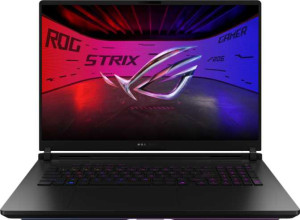
Asus ROG Strix Scar 18 (2025) G835LX 18" Intel Core Ultra 9 275HX 2.7GHz / Nvidia GeForce RTX 5090 Laptop / 64GB RAM / 2TB SSD
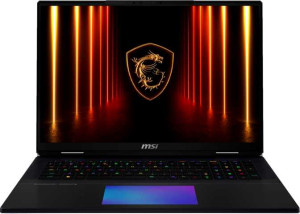
MSI Titan 18 HX AI A2XW (2025) 18"

Asus ROG Strix Scar 18 (2025) G835LX 18" Intel Core Ultra 9 275HX 2.7GHz / Nvidia GeForce RTX 5090 Laptop / 64GB RAM / 2TB SSD MSI Titan 18 HX AI A2XW (2025) 18"

Common Features

  • Both products have a fan-based cooling design.
  • Both products have a backlit keyboard.
  • Neither product is weather-sealed.
  • Both products support up to 4 displays.
  • Both products use flash storage.
  • Both products have 24 CPU threads.
  • Both products have 24GB of VRAM.
  • Both products have GDDR7 memory.
  • Both products support DLSS.
  • Both products have stereo speakers.
  • Both products have a 3.5 mm audio jack.
  • Both products include a front camera.
  • Both products support ray tracing.
  • Both products use Intel Resizable BAR.
  • Both products support multi-display technology.
  • Both products support OpenCL version 3.
  • Both products support OpenGL version 4.6.
  • Both products have Thunderbolt 4 ports.
  • Both products have USB 3.2 Gen 2 ports (USB-A).
  • Both products have a sleep-and-charge USB port.

Main Differences

  • Asus ROG Strix Scar 18 (2025) G835LX has a weight of 3480 g while MSI Titan 18 HX AI A2XW weighs 3600 g.
  • Asus ROG Strix Scar 18 (2025) G835LX has a volume of 2734.746 cm³ while MSI Titan 18 HX AI A2XW has a volume of 2976.672 cm³.
  • Asus ROG Strix Scar 18 (2025) G835LX is 399 mm wide, while MSI Titan 18 HX AI A2XW is 404 mm wide.
  • Asus ROG Strix Scar 18 (2025) G835LX is 298 mm high, while MSI Titan 18 HX AI A2XW is 307 mm high.
  • Asus ROG Strix Scar 18 (2025) G835LX is 23 mm thick, while MSI Titan 18 HX AI A2XW is 24 mm thick.
  • Asus ROG Strix Scar 18 (2025) G835LX has a screen resolution of 2560 x 1600 px, while MSI Titan 18 HX AI A2XW has a resolution of 3840 x 2400 px.
  • Asus ROG Strix Scar 18 (2025) G835LX has a pixel density of 167 ppi, while MSI Titan 18 HX AI A2XW has a pixel density of 251 ppi.
  • Asus ROG Strix Scar 18 (2025) G835LX has a Mini-LED, LCD display type, while MSI Titan 18 HX AI A2XW has an LCD, Mini-LED display type.
  • Asus ROG Strix Scar 18 (2025) G835LX has an anti-reflection coating, while MSI Titan 18 HX AI A2XW does not.
  • Asus ROG Strix Scar 18 (2025) G835LX has 64GB of RAM, while MSI Titan 18 HX AI A2XW has 96GB of RAM.
  • Asus ROG Strix Scar 18 (2025) G835LX has a RAM speed of 5600 MHz, while MSI Titan 18 HX AI A2XW has a RAM speed of 6400 MHz.
  • Asus ROG Strix Scar 18 (2025) G835LX has 2048GB of internal storage, while MSI Titan 18 HX AI A2XW has 6144GB of internal storage.
  • Asus ROG Strix Scar 18 (2025) G835LX has a CPU speed of 8 x 2.7 & 16 x 2.1 GHz, while MSI Titan 18 HX AI A2XW has a CPU speed of 8 x 2.8 & 16 x 2.1 GHz.
  • Asus ROG Strix Scar 18 (2025) G835LX has a maximum memory amount of 64GB, while MSI Titan 18 HX AI A2XW has a maximum memory amount of 96GB.
  • Asus ROG Strix Scar 18 (2025) G835LX has a turbo clock speed of 5.4GHz, while MSI Titan 18 HX AI A2XW has a turbo clock speed of 5.5GHz.
  • Asus ROG Strix Scar 18 (2025) G835LX has a PassMark result of 56426, while MSI Titan 18 HX AI A2XW has a PassMark result of 62297.
  • Asus ROG Strix Scar 18 (2025) G835LX has a PassMark single-core result of 4723, while MSI Titan 18 HX AI A2XW has a PassMark single-core result of 4784.
  • Asus ROG Strix Scar 18 (2025) G835LX does not have an external memory slot, while MSI Titan 18 HX AI A2XW has an external memory slot.
  • Asus ROG Strix Scar 18 (2025) G835LX has a battery size of 90 Wh, while MSI Titan 18 HX AI A2XW has a battery size of 99 Wh.
  • Asus ROG Strix Scar 18 (2025) G835LX has Dolby Atmos support, while MSI Titan 18 HX AI A2XW does not.
  • Asus ROG Strix Scar 18 (2025) G835LX has 2 microphones, while MSI Titan 18 HX AI A2XW has 1 microphone.
  • Asus ROG Strix Scar 18 (2025) G835LX uses 3D facial recognition, while MSI Titan 18 HX AI A2XW does not.
Specs Comparison
Asus ROG Strix Scar 18 (2025) G835LX 18" Intel Core Ultra 9 275HX 2.7GHz / Nvidia GeForce RTX 5090 Laptop / 64GB RAM / 2TB SSD

Asus ROG Strix Scar 18 (2025) G835LX 18" Intel Core Ultra 9 275HX 2.7GHz / Nvidia GeForce RTX 5090 Laptop / 64GB RAM / 2TB SSD

MSI Titan 18 HX AI A2XW (2025) 18"

MSI Titan 18 HX AI A2XW (2025) 18"

Design:
Type Gaming Gaming
weight 3480 g 3600 g
Uses a fanless design
Has a backlit keyboard
volume 2734.746 cm³ 2976.672 cm³
width 399 mm 404 mm
height 298 mm 307 mm
thickness 23 mm 24 mm
is weather-sealed (splashproof)

Both the Asus ROG Strix Scar 18 (2025) and the MSI Titan 18 HX AI A2XW (2025) are purpose-built gaming machines that share the same fundamental design philosophy: active cooling (neither uses a fanless design), backlit keyboards for low-light gaming sessions, and no weather sealing — all expected traits in the high-performance gaming laptop segment.

Where they diverge is in their physical footprint. The Asus ROG Strix Scar 18 measures 399 × 298 × 23 mm and weighs 3,480 g, while the MSI Titan 18 HX comes in at 404 × 307 × 24 mm and 3,600 g. These differences compound into a meaningful gap in total volume: 2,734 cm³ versus 2,977 cm³ — nearly an 9% larger chassis for the MSI. That extra bulk is not trivial when lugging either of these machines in a backpack, and the 120 g weight advantage of the Asus adds up over a day of travel.

For users who prioritize portability — even marginally — within this class of extreme-performance laptops, the Asus ROG Strix Scar 18 holds a clear design edge: it is slimmer, narrower, shallower, and lighter across every physical dimension. The MSI Titan 18 HX offers no compensating design advantage based on the available specs, making the Asus the more carry-friendly option of the two.

Display:
screen size 18" 18"
resolution 2560 x 1600 px 3840 x 2400 px
pixel density 167 ppi 251 ppi
Display type Mini-LED, LCD LCD, Mini-LED
has a touch screen
has anti-reflection coating
supported displays 4 4

On paper, both laptops share the same 18″ Mini-LED LCD panel technology and support up to four external displays — but their native resolutions tell very different stories. The MSI Titan 18 HX runs at 3840 × 2400 px with a pixel density of 251 ppi, while the Asus ROG Strix Scar 18 tops out at 2560 × 1600 px at 167 ppi. That 50% jump in pixel density translates to noticeably sharper text, finer detail in textures, and a more refined image overall — particularly relevant for content creators or anyone doing precision visual work on this screen.

The trade-off cuts both ways, however. Driving a 4K panel at high frame rates demands significantly more GPU headroom than a 1600p display, which means the Asus can more readily deliver maximal frame rates in GPU-intensive titles at native resolution. For competitive gaming where frame rate trumps pixel count, the lower-resolution Asus panel is arguably the more practical pairing with its hardware. The MSI's ultra-high-resolution screen, while visually impressive, creates a harder balancing act between fidelity and performance.

A critical differentiator in real-world usability is the anti-reflection coating present on the Asus but absent on the MSI. In any environment with overhead lighting or ambient light sources, the MSI's glossy surface will reflect glare directly back at the user — a genuine ergonomic drawback for extended sessions. Weighing both factors, the Asus holds the edge for gaming-focused buyers prioritizing frame rates and viewing comfort, while the MSI's display wins on raw sharpness for those who value image fidelity above all else.

Performance:
RAM 64GB 96GB
RAM speed 5600 MHz 6400 MHz
Uses flash storage
internal storage 2048GB 6144GB
CPU speed 8 x 2.7 & 16 x 2.1 GHz 8 x 2.8 & 16 x 2.1 GHz
CPU threads 24 threads 24 threads
VRAM 24GB 24GB
floating-point performance 31.8 TFLOPS 31.8 TFLOPS
GDDR version GDDR7 GDDR7
texture rate 496.9 GTexels/s 496.9 GTexels/s
pixel rate 193.9 GPixel/s 193.9 GPixel/s
Is an NVMe SSD
DirectX version DirectX 12 Ultimate DirectX 12 Ultimate
GPU clock speed 990 MHz 990 MHz
uses multithreading
maximum memory amount 64GB 96GB
DDR memory version 5 5
turbo clock speed 5.4GHz 5.5GHz
GPU turbo 1515 MHz 1515 MHz
memory slots 2 2
PCI Express (PCIe) version 4 4
semiconductor size 4 nm 4 nm
has XeSS (XMX)
Supports 64-bit

At the GPU level, these two machines are effectively identical. Both deliver 31.8 TFLOPS of floating-point performance with 24GB of GDDR7 VRAM, matching texture and pixel rates, and the same base and boost clock speeds — meaning neither has a graphics rendering advantage over the other in any workload. The same story holds for CPU architecture: both pack 24-thread processors built on a 4 nm process with near-identical clock configurations, differing only by a negligible 0.1 GHz in turbo speed on the MSI Titan 18 HX's favor.

Where the MSI Titan 18 HX pulls meaningfully ahead is in memory and storage. Its 96GB of DDR5 RAM running at 6400 MHz versus the Asus ROG Strix Scar 18's 64GB at 5600 MHz is a significant gap — both in raw capacity and bandwidth. For workloads like video editing, 3D rendering, large dataset processing, or running multiple memory-hungry applications simultaneously, that extra 32GB and faster memory bus genuinely expand what the system can handle without hitting a ceiling. Similarly, its 6TB of internal NVMe storage dwarfs the Asus's 2TB, which matters for users who store large game libraries, RAW footage, or project archives locally.

For pure gaming, where GPU performance dominates and 64GB of RAM is already well beyond any current requirement, the Asus ROG Strix Scar 18 is not at a practical disadvantage. But for power users who push these machines as mobile workstations — or who simply need headroom for future-proofing — the MSI Titan 18 HX holds a clear performance edge on the memory and storage front, making it the stronger all-around performer in this category.

Benchmarks:
PassMark result 56426 62297
PassMark result (single) 4723 4784

PassMark scores give a standardized, real-world window into CPU throughput, and the gap here is telling. The MSI Titan 18 HX posts a multi-core result of 62,297 against the Asus ROG Strix Scar 18's 56,426 — a difference of roughly 10%. In sustained multi-threaded workloads like video encoding, compilation, or simulation tasks, that margin is consistent enough to be felt rather than just measured.

Single-core performance, which governs responsiveness in everyday tasks, gaming frame pacing, and any application that cannot parallelize its workload, is much closer: 4,784 on the MSI versus 4,723 on the Asus — a gap of just 1.3%. For the vast majority of users, that difference is imperceptible in day-to-day use. Both machines will feel equally snappy in single-threaded scenarios.

The MSI Titan 18 HX holds the clear edge in this category, particularly on multi-core throughput where the advantage is tangible. This aligns with its higher RAM capacity and faster memory speed noted in the performance specs — the platform as a whole appears tuned for heavier parallel workloads. For users whose priority is maximum sustained CPU output, the MSI is the stronger performer here based on the benchmark data.

Connectivity:
USB 3.2 Gen 2 ports (USB-C) 0 0
USB 3.2 Gen 2 ports (USB-A) 3 3
USB 4 20Gbps ports 0 0
USB 4 40Gbps ports 2 2
Thunderbolt 4 ports 0 0
USB 3.2 Gen 1 ports (USB-C) 0 0
USB 3.2 Gen 1 ports (USB-A) 0 0
Thunderbolt 3 ports 0 0
has an HDMI output
Has USB Type-C
supports Wi-Fi
Wi-Fi version Wi-Fi 7 (802.11be), Wi-Fi 6E (802.11ax), Wi-Fi 6 (802.11ax), Wi-Fi 5 (802.11ac), Wi-Fi 4 (802.11n) Wi-Fi 7 (802.11be), Wi-Fi 6E (802.11ax), Wi-Fi 6 (802.11ax), Wi-Fi 5 (802.11ac), Wi-Fi 4 (802.11n)
has an external memory slot
Bluetooth version 5.4 5.4
RJ45 ports 1 1
HDMI ports 1 1
HDMI version HDMI 2.1 HDMI 2.1
DisplayPort outputs 0 0
has AirPlay
mini DisplayPort outputs 0 0
has a VGA connector

Connectivity is one of the most level playing fields in this entire comparison. Both laptops offer an identical port lineup: three USB-A 3.2 Gen 2 ports, two USB4 40Gbps Type-C ports, one HDMI 2.1 output, and a single RJ45 ethernet jack. Wireless capabilities are equally matched, with both supporting Wi-Fi 7 and Bluetooth 5.4 — the latest standards available, ensuring future-ready wireless performance with maximum throughput and minimal latency.

The only differentiator in this category is the MSI Titan 18 HX's external memory card slot, which the Asus ROG Strix Scar 18 lacks entirely. For photographers, videographers, or content creators who regularly transfer files from SD or microSD cards, this is a genuine convenience advantage — eliminating the need for a separate card reader dongle. For pure gamers who never touch removable media, it is a non-issue.

Overall, this category is essentially a tie, with the MSI Titan 18 HX claiming a narrow practical edge courtesy of its memory card slot. Users whose workflows involve removable storage will appreciate that addition; everyone else will find both machines equally well-equipped for desks, docks, and on-the-go connectivity demands.

Battery:
battery size 90 Wh 99 Wh
Has sleep-and-charge USB ports
Has a MagSafe power adapter

Battery life has never been a strong suit of extreme gaming laptops, and neither of these machines will challenge that reputation. That said, raw capacity still matters for light workloads away from the wall, and the MSI Titan 18 HX holds a modest edge with its 99 Wh cell versus the 90 Wh in the Asus ROG Strix Scar 18 — a roughly 10% larger reserve. At these power levels, that translates to a meaningful but not dramatic extension in unplugged endurance during low-demand tasks like browsing or document work.

Both laptops share sleep-and-charge USB ports, which is a welcome practical touch — it means either machine can top up a phone or peripheral even when the lid is closed and the system is asleep, without needing to keep the laptop fully powered on. Neither features a MagSafe-style magnetic power connector, so both rely on standard barrel or USB-C charging inputs.

The MSI Titan 18 HX takes a narrow win in this category on battery capacity alone. The real-world gap is unlikely to be dramatic given the power demands of the hardware inside both machines, but for users who occasionally need unplugged time, every watt-hour counts — and the MSI simply offers more of them.

Features:
release date January 2025 February 2025
has stereo speakers
has a socket for a 3.5 mm audio jack
supports ray tracing
supports DLSS
has Dolby Atmos
Stylus included
Has a fingerprint scanner
number of microphones 2 1
Uses 3D facial recognition
has voice commands
has a front camera
Has S/PDIF Out port
has a gyroscope
has GPS
has an accelerometer
has a compass
Has an optical disc drive

Gaming feature parity is strong between these two machines — both support ray tracing and DLSS, come with stereo speakers, a 3.5 mm audio jack, and a front-facing camera. For the core gaming and multimedia experience, neither is at a disadvantage relative to the other on the fundamentals.

The divergence comes in the quality-of-life details. The Asus ROG Strix Scar 18 includes Dolby Atmos support for its audio output — a meaningful addition for users who care about spatial audio immersion through headphones or the built-in speakers. More notably, it features 3D facial recognition for biometric login alongside a dual-microphone array, compared to the MSI Titan 18 HX's single microphone and absence of facial recognition entirely. In practice, 3D facial recognition offers faster and more secure Windows Hello login than a password, and the second microphone improves voice pickup quality for calls and voice chat.

None of these differences are dealbreakers, but they consistently point in one direction: the Asus ROG Strix Scar 18 is the more feature-complete machine in this category. Its combination of Dolby Atmos, 3D facial recognition, and dual microphones gives it a clear edge in everyday usability and audio-visual polish beyond raw gaming performance.

Miscellaneous:
clock multiplier 27 28
AMD SAM / Intel Resizable BAR Intel Resizable BAR Intel Resizable BAR
GPU architecture Blackwell Blackwell
has LHR
Thermal Design Power (TDP) 95W 95W
Supports 3D
Supports multi-display technology
OpenCL version 3 3
OpenGL version 4.6 4.6
Supports ECC memory
memory bus width 256-bit 256-bit
effective memory speed 25400 MHz 25400 MHz
maximum memory bandwidth 811.5 GB/s 811.5 GB/s
render output units (ROPs) 128 128
texture mapping units (TMUs) 328 328
shading units 10496 10496
Has Double Precision Floating Point (DPFP)
GPU memory speed 2000 MHz 2000 MHz
Type Laptop Laptop
CPU socket BGA 2114 BGA 2114
instruction sets MMX, F16C, FMA3, AES, AVX, AVX2, SSE 4.1, SSE 4.2 MMX, F16C, FMA3, AES, AVX, AVX2, SSE 4.1, SSE 4.2
Has an unlocked multiplier
L3 cache 36 MB 36 MB
L2 cache 40 MB 40 MB
Has NX bit
Turbo Boost version 2 2
CPU temperature 105 °C 105 °C
Has integrated graphics
memory channels 2 2
RAM speed (max) 6400 MHz 6400 MHz
Uses big.LITTLE technology

At the architectural level, these two machines are built from the same blueprint. Both run Nvidia's Blackwell GPU architecture with identical shader counts, memory bus width, bandwidth, and compute unit configurations. CPU-side, they share the same socket, cache hierarchy (36 MB L3, 40 MB L2), instruction set support, TDP, and big.LITTLE core layout. For any workload — gaming, rendering, compute — the underlying silicon is functionally the same between the two.

The only numerical difference in this entire group is the clock multiplier: 28 on the MSI Titan 18 HX versus 27 on the Asus ROG Strix Scar 18. In isolation, a single multiplier step is a marginal distinction that is unlikely to produce any perceptible real-world difference in performance — and the benchmark results from the previous group already quantify the practical ceiling of that gap. Every other advanced specification — ECC memory support, OpenCL 3 and OpenGL 4.6, Intel Resizable BAR, unlocked multiplier, double-precision floating point — is shared verbatim.

This category is effectively a dead heat. The shared GPU architecture, compute pipeline, and CPU platform mean buyers are getting the same fundamental technology regardless of which machine they choose. The single-point multiplier difference on the MSI does not represent a meaningful advantage in any real-world scenario and should not be a deciding factor in the purchase decision.

Comparison Summary & Verdict

This is a specification comparison between the Asus ROG Strix Scar 18 (2025) G835LX 18″ Intel Core Ultra 9 275HX 2.7GHz / Nvidia GeForce RTX 5090 Laptop / 64GB RAM / 2TB SSD and the MSI Titan 18 HX AI A2XW (2025) 18″. Both laptops share features like a backlit keyboard, stereo speakers, and support for ray tracing and DLSS. However, they differ in several areas: the Asus model has a screen resolution of 2560 x 1600 px, while the MSI has 3840 x 2400 px; the Asus model has 64GB of RAM, compared to the MSI's 96GB; and the Asus laptop has a 90 Wh battery, while the MSI has a larger 99 Wh battery. Additionally, the MSI model includes an external memory slot, unlike the Asus model, which does not.