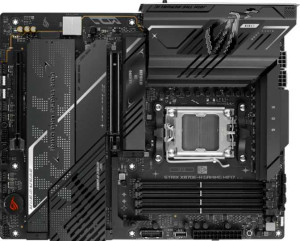
Asus ROG Strix X870E-H Gaming Wi-Fi7
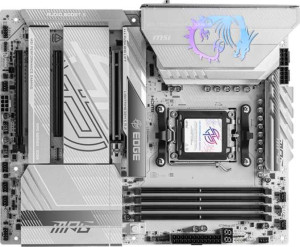
MSI MPG X870E Edge TI WiFi

Asus ROG Strix X870E-H Gaming Wi-Fi7 MSI MPG X870E Edge TI WiFi

Overview

Welcome to our in-depth specification comparison between the Asus ROG Strix X870E-H Gaming Wi-Fi7 and the MSI MPG X870E Edge TI WiFi — two high-end AM5 motherboards built around the X870 chipset. Both boards share a strong foundation of modern connectivity and memory support, yet key differences emerge across areas such as USB port configuration, overclocking headroom, and onboard feature sets that could make one a better fit for your build than the other.

Common Features

  • Both boards use the AM5 CPU socket.
  • Both boards feature the X870 chipset.
  • Both boards use the ATX form factor.
  • Wi-Fi is supported on both boards, covering Wi-Fi 4, Wi-Fi 5, Wi-Fi 6, Wi-Fi 6E, and Wi-Fi 7.
  • Bluetooth 5.4 is present on both boards.
  • Both boards include an HDMI 2.1 output.
  • Both boards support a maximum memory amount of 256GB.
  • Both boards have 4 memory slots.
  • Both boards use DDR5 memory.
  • Both boards operate on 2 memory channels.
  • ECC memory is not supported on either board.
  • Both boards include 1 USB 3.2 Gen 2 port (USB-C) and no USB 3.2 Gen 1 ports (USB-C).
  • Both boards include 2 USB 4 40Gbps ports and no USB 4 20Gbps ports.
  • Both boards feature 2 Thunderbolt 4 ports and no Thunderbolt 3 ports.
  • Both boards include 1 USB 3.2 Gen 2x2 port through expansion and 4 USB 2.0 ports through expansion.
  • Both boards have 4 SATA 3 connectors and 4 M.2 sockets, with no U.2 or mSATA connectors.
  • Both boards include 1 PCIe 5.0 x16 slot and 1 PCIe 4.0 x16 slot, with no PCIe 3.0, 2.0, x8, or PCI slots.
  • Both boards have a 120 dB signal-to-noise ratio (DAC), 7.1 audio channels, an S/PDIF Out port, and 2 audio connectors.
  • Both boards support RAID 0, RAID 1, and RAID 10, but neither supports RAID 5 or RAID 0+1.

Main Differences

  • RGB lighting is present on MSI MPG X870E Edge TI WiFi but not available on Asus ROG Strix X870E-H Gaming Wi-Fi7.
  • aptX support is present on MSI MPG X870E Edge TI WiFi but not available on Asus ROG Strix X870E-H Gaming Wi-Fi7.
  • Board height is 244 mm on Asus ROG Strix X870E-H Gaming Wi-Fi7 and 243.8 mm on MSI MPG X870E Edge TI WiFi.
  • Board width is 305 mm on Asus ROG Strix X870E-H Gaming Wi-Fi7 and 304.8 mm on MSI MPG X870E Edge TI WiFi.
  • Maximum overclocked RAM speed is 8000 MHz on Asus ROG Strix X870E-H Gaming Wi-Fi7 and 8400 MHz on MSI MPG X870E Edge TI WiFi.
  • USB 3.2 Gen 2 ports (USB-A) total 3 on Asus ROG Strix X870E-H Gaming Wi-Fi7 and 5 on MSI MPG X870E Edge TI WiFi.
  • USB 3.2 Gen 1 ports (USB-A) total 6 on Asus ROG Strix X870E-H Gaming Wi-Fi7 and 0 on MSI MPG X870E Edge TI WiFi.
  • USB 2.0 ports total 2 on Asus ROG Strix X870E-H Gaming Wi-Fi7 and 4 on MSI MPG X870E Edge TI WiFi.
  • USB 3.2 Gen 1 ports through expansion total 2 on Asus ROG Strix X870E-H Gaming Wi-Fi7 and 4 on MSI MPG X870E Edge TI WiFi.
  • USB 3.0 ports through expansion total 2 on Asus ROG Strix X870E-H Gaming Wi-Fi7 and 4 on MSI MPG X870E Edge TI WiFi.
  • Fan headers total 7 on Asus ROG Strix X870E-H Gaming Wi-Fi7 and 8 on MSI MPG X870E Edge TI WiFi.
  • A TPM connector is present on MSI MPG X870E Edge TI WiFi but not available on Asus ROG Strix X870E-H Gaming Wi-Fi7.
  • PCIe x1 slots total 0 on Asus ROG Strix X870E-H Gaming Wi-Fi7 and 1 on MSI MPG X870E Edge TI WiFi.
Specs Comparison
Asus ROG Strix X870E-H Gaming Wi-Fi7

Asus ROG Strix X870E-H Gaming Wi-Fi7

MSI MPG X870E Edge TI WiFi

MSI MPG X870E Edge TI WiFi

General info:
CPU socket AM5 AM5
chipset X870 X870
form factor ATX ATX
release date August 2025 January 2025
supports Wi-Fi
Wi-Fi version Wi-Fi 4 (802.11n), Wi-Fi 5 (802.11ac), Wi-Fi 6 (802.11ax), Wi-Fi 6E (802.11ax), Wi-Fi 7 (802.11be) Wi-Fi 4 (802.11n), Wi-Fi 5 (802.11ac), Wi-Fi 6 (802.11ax), Wi-Fi 6E (802.11ax), Wi-Fi 7 (802.11be)
Has Bluetooth
Bluetooth version 5.4 5.4
HDMI version HDMI 2.1 HDMI 2.1
Easy to overclock
has RGB lighting
Easy to reset BIOS
Has dual BIOS
has aptX
CPU sockets 1 1
Has integrated graphics
warranty period 3 years 3 years
height 244 mm 243.8 mm
width 305 mm 304.8 mm
Has integrated CPU

At a foundational level, the Asus ROG Strix X870E-H Gaming Wi-Fi 7 and the MSI MPG X870E Edge TI WiFi are built on identical architectural pillars: both use the AM5 socket with the X870 chipset, adopt the standard ATX form factor, and share the same wireless stack — full Wi-Fi 7 (802.11be) with backward compatibility down to Wi-Fi 4, plus Bluetooth 5.4. Both also output video via HDMI 2.1, support easy overclocking and easy BIOS reset, and carry a 3-year warranty. For the majority of builders, these shared traits define the platform experience, and on those fronts the two boards are effectively interchangeable.

The real differentiators emerge in smaller but meaningful details. The MSI MPG X870E Edge TI includes RGB lighting and support for aptX audio codec, neither of which is present on the Asus ROG Strix X870E-H. RGB is purely aesthetic, but for system builders investing in a themed build it matters. aptX, on the other hand, has a practical angle: it enables higher-quality, lower-latency Bluetooth audio transmission when paired with compatible headphones or speakers — a genuine advantage for users who rely on wireless audio. The Asus board omits both features entirely, which keeps its profile cleaner but objectively narrower in capability as specified.

In terms of physical dimensions, the two boards are virtually identical — separated by less than 0.2 mm in both height and width — so case compatibility is a non-issue. Overall, for this spec group, the MSI MPG X870E Edge TI WiFi holds a narrow but real edge: it offers everything the Asus does at the platform level while adding RGB aesthetics and aptX audio support. Builders who prioritize a clean, no-frills look may prefer the Asus, but on pure feature count within these specs, the MSI delivers more.
Memory:
maximum memory amount 256GB 256GB
overclocked RAM speed 8000 MHz 8400 MHz
memory slots 4 4
DDR memory version 5 5
memory channels 2 2
Supports ECC memory

The memory foundation on both boards is essentially the same: four DDR5 slots arranged in a dual-channel configuration, supporting up to 256GB of total RAM, with no ECC support. For gaming and content creation workloads, 256GB is a ceiling that virtually no consumer use case will approach, so capacity is a non-factor in any practical buying decision here.

Where the two boards diverge — modestly but measurably — is in overclocked RAM speed headroom. The Asus ROG Strix X870E-H tops out at 8000 MHz, while the MSI MPG X870E Edge TI pushes to 8400 MHz. In absolute terms, a 400 MHz gap at these frequencies translates to marginal real-world gains: memory-sensitive workloads like large dataset processing or certain rendering pipelines may see a slight uplift, but for gaming the difference is effectively imperceptible. That said, for enthusiasts specifically chasing the highest possible memory overclocks — or future-proofing against next-generation high-speed kits — the MSI's higher rated ceiling is a genuine, if niche, advantage.

On balance, the MSI MPG X870E Edge TI holds a slim edge in this category purely on overclocked speed ceiling. For the overwhelming majority of users, both boards will deliver identical real-world memory performance, making this a tiebreaker only for dedicated overclockers rather than a meaningful distinction for typical builders.

Ports:
USB 3.2 Gen 2 ports (USB-A) 3 5
USB 3.2 Gen 1 ports (USB-A) 6 0
USB 3.2 Gen 2 ports (USB-C) 1 1
USB 3.2 Gen 1 ports (USB-C) 0 0
USB 2.0 ports 2 4
USB 3.2 Gen 2x2 ports 0 0
USB 4 40Gbps ports 2 2
USB 4 20Gbps ports 0 0
Thunderbolt 4 ports 2 2
Thunderbolt 3 ports 0 0
has an HDMI output
DisplayPort outputs 0 0
RJ45 ports 1 1
Has USB Type-C
eSATA ports 0 0
DVI outputs 0 0
has a VGA connector
PS/2 ports 0 0

At the high-performance end of the port lineup, both boards are identical: two USB 4 (40Gbps) ports and two Thunderbolt 4 ports deliver the fastest available connectivity for external SSDs, docking stations, and high-bandwidth peripherals. One USB 3.2 Gen 2 Type-C, a single RJ45 ethernet jack, and an HDMI output round out the shared rear I/O in a way that will satisfy most users without distinction.

The meaningful divergence lies in how each board handles USB-A. The Asus ROG Strix X870E-H offers a larger raw count — 9 USB-A ports total (3 Gen 2 + 6 Gen 1) — making it the stronger choice for users with many peripherals: keyboards, mice, audio interfaces, hubs, and the like can all connect simultaneously without an expander. The MSI MPG X870E Edge TI, by contrast, provides only 5 USB-A ports, but all five run at the faster Gen 2 (10Gbps) speed, eliminating the slower Gen 1 (5Gbps) ports entirely. MSI also includes 4 USB 2.0 ports versus Asus's 2, which adds legacy device compatibility at the low-speed end.

The verdict here depends squarely on use case. Power users who juggle many peripherals simultaneously will appreciate the Asus's superior USB-A port count, while those who prioritize speed uniformity across fewer devices may prefer MSI's all-Gen-2 approach. Given that raw connectivity quantity is a more universal concern than per-port speed in a desktop context — where USB storage is increasingly handled by USB 4 or Thunderbolt anyway — the Asus ROG Strix X870E-H holds a practical edge in everyday port versatility.

Connectors:
USB 3.2 Gen 1 ports (through expansion) 2 4
USB 3.2 Gen 2x2 ports (through expansion) 1 1
USB 2.0 ports (through expansion) 4 4
SATA 3 connectors 4 4
fan headers 7 8
USB 3.0 ports (through expansion) 2 4
M.2 sockets 4 4
Has TPM connector
U.2 sockets 0 0
Has mSATA connector
SATA 2 connectors 0 0

Internal storage expansion is a tie: both boards provide 4 M.2 sockets and 4 SATA 3 connectors, giving builders ample room for NVMe drives and traditional storage alike. Neither supports U.2 or mSATA, which is entirely expected at this tier and irrelevant for virtually all consumer builds.

Fan and thermal management is where a small but tangible gap opens up. The MSI MPG X870E Edge TI includes 8 fan headers versus the Asus ROG Strix X870E-H's 7 — a modest but real advantage for builders running dense cooling setups with multiple radiator fans, case fans, and pump headers. MSI also pulls ahead on internal USB expansion, offering 4 USB 3.0 internal ports (versus Asus's 2) for front-panel and hub connectivity, which matters in larger cases with extensive front-panel I/O. Additionally, the MSI board includes a TPM connector, absent on the Asus — a relevant detail for enterprise adjacent users or anyone enabling hardware-based security features and full disk encryption workflows that leverage a discrete TPM module.

Taken together, the MSI MPG X870E Edge TI holds a clear edge in internal connectors. The extra fan header, doubled internal USB 3.0 expansion, and TPM connector support add up to a more feature-complete internal I/O layout — particularly appealing for high-airflow builds and security-conscious users.

Expansion slots:
PCIe 4.0 x16 slots 1 1
PCIe 5.0 x16 slots 1 1
PCIe 3.0 x16 slots 0 0
PCIe x1 slots 0 1
PCI slots 0 0
PCIe 2.0 x16 slots 0 0
PCIe x8 slots 0 0

Both boards share the same high-bandwidth backbone: one PCIe 5.0 x16 slot for the primary GPU — delivering up to 128GB/s of bidirectional bandwidth, future-proofing against next-generation graphics cards — and one PCIe 4.0 x16 slot for a secondary card or other high-speed add-in device. For the vast majority of gaming and workstation builds, this pairing is more than sufficient and represents no practical difference between the two boards.

The sole differentiator is the MSI MPG X870E Edge TI's additional PCIe x1 slot, which the Asus ROG Strix X870E-H entirely omits. While x1 slots are narrow in bandwidth, they serve a specific and valuable purpose: housing capture cards, additional audio interfaces, network adapters, or other low-throughput expansion cards without consuming a full x16 lane. For builders who need that kind of auxiliary expansion, it is a meaningful inclusion.

The MSI MPG X870E Edge TI has a narrow but concrete advantage here. The core GPU and secondary slot configurations are identical, but the extra PCIe x1 slot gives MSI's board greater flexibility for specialized builds. The Asus is not at a serious disadvantage for typical use cases, but it offers no workaround if a user needs that additional expansion card slot.

Audio:
Signal-to-Noise ratio (DAC) 120 dB 120 dB
audio channels 7.1 7.1
Has S/PDIF Out port
audio connectors 2 2

Audio is a clean sweep for parity. Both boards deliver a 120 dB signal-to-noise ratio from their DACs — a figure that sits comfortably in the range where background hiss becomes inaudible in real listening conditions, and one that will satisfy all but the most demanding audiophiles. Both also support 7.1 channel surround output, include an S/PDIF optical out for connecting to external receivers or DACs, and offer the same count of analog audio connectors.

This is a genuine tie with no meaningful differentiator to extract. Every specified audio metric — output quality, channel configuration, digital output, and connector count — is identical between the Asus ROG Strix X870E-H and the MSI MPG X870E Edge TI. Users relying solely on onboard audio can expect an equivalent experience on either platform.

Storage:
Supports RAID 1
Supports RAID 10 (1+0)
Supports RAID 5
Supports RAID 0
Supports RAID 0+1

RAID support is identical across both boards. The Asus ROG Strix X870E-H and the MSI MPG X870E Edge TI each support RAID 0 (striping for maximum throughput), RAID 1 (mirroring for redundancy), and RAID 10 (a stripe of mirrors combining speed and fault tolerance) — while neither supports RAID 5 or RAID 0+1. This covers the configurations that matter most for consumer and prosumer use cases, with RAID 10 in particular offering a well-rounded balance for users running multi-drive setups who want both performance and data protection.

This is a complete tie. There is no differentiator to weigh between the two boards on storage configuration capability — builders who need software RAID will find equivalent support on either platform, and those who do not will be equally unaffected by the omission of RAID 5.

Comparison Summary & Verdict

Both the Asus ROG Strix X870E-H Gaming Wi-Fi7 and the MSI MPG X870E Edge TI WiFi are compelling X870 platforms that share the same core DNA: DDR5 memory support up to 256GB, Wi-Fi 7, Bluetooth 5.4, four M.2 sockets, and a robust PCIe 5.0 ecosystem. However, the differences reveal distinct personalities. The MSI MPG X870E Edge TI WiFi pulls ahead with a higher overclocked RAM speed of 8400 MHz, more USB 3.2 Gen 2 Type-A ports, RGB lighting, aptX audio support, a TPM connector, an extra PCIe x1 slot, and an additional fan header — making it the stronger choice for feature-rich, enthusiast-grade builds. The Asus ROG Strix X870E-H Gaming Wi-Fi7, on the other hand, offers a cleaner port layout with six USB 3.2 Gen 1 Type-A ports, which may suit users who rely on legacy high-speed peripherals, and it forgoes extras like RGB for a more understated aesthetic.

Asus ROG Strix X870E-H Gaming Wi-Fi7
Buy Asus ROG Strix X870E-H Gaming Wi-Fi7 if...

Buy the Asus ROG Strix X870E-H Gaming Wi-Fi7 if you need a broad range of USB 3.2 Gen 1 Type-A ports for legacy peripherals and prefer a no-RGB, understated board aesthetic.

MSI MPG X870E Edge TI WiFi
Buy MSI MPG X870E Edge TI WiFi if...

Buy the MSI MPG X870E Edge TI WiFi if you want higher overclocked RAM speeds, more USB 3.2 Gen 2 Type-A ports, RGB lighting, a TPM connector, and a richer overall feature set for an enthusiast build.