Asus ROG Xbox Ally X
MSI Claw 8 AI Plus A2VM Intel Core Ultra 7 258V / 32GB RAM / 1TB SSD

Asus ROG Xbox Ally X MSI Claw 8 AI Plus A2VM Intel Core Ultra 7 258V / 32GB RAM / 1TB SSD

Overview

Welcome to our in-depth spec comparison between the Asus ROG Xbox Ally X and the MSI Claw 8 AI Plus A2VM Intel Core Ultra 7 258V / 32GB RAM / 1TB SSD. Both are feature-rich handheld gaming devices sharing a strong common foundation, yet they diverge in meaningful ways across performance, display characteristics, physical design, and connectivity. Read on to discover which device best suits your gaming needs.

Common Features

  • Both products support ray tracing.
  • Both products use an NVMe SSD.
  • Both products can connect to an external drive.
  • Both products use multithreading.
  • Both products have a 120Hz refresh rate.
  • Both products use DDR5 memory.
  • Both products are handheld devices.
  • Both products have a replaceable hard drive.
  • Both products have an internal power supply.
  • Both products use an LCD, LED-backlit, IPS display type.
  • Both products have 1024GB of internal storage.
  • Both products are region free.
  • Neither product has an optical disc drive.
  • Both products have a typical brightness of 500 nits.
  • Both products have a 3.5mm audio jack socket.
  • Both products support Wi-Fi.
  • Neither product is DLNA-certified.
  • Both products have 2 USB ports.
  • Both products have an external memory slot.
  • Both products have USB Type-C.
  • Neither product has a cellular module.
  • Both products can play games while they download.
  • Both products support quick resume.
  • Both products support Discord voice chat.
  • 3D audio support is not available on either product.
  • Dolby Vision support is not available on either product.
  • Both products support VR.
  • Neither product has a 4K Blu-ray drive.
  • Both products have 2 channels of sound output.
  • Both products include 4 controllers.
  • Adaptive triggers are not available on either product.
  • Both products are compatible with motion-sensing controllers.
  • Neither product has a wireless controller.
  • Both products have 2 analog sticks.
  • Neither product has an integrated touchpad.
  • Both products have 16 buttons.

Main Differences

  • CPU speed is 8 x 2 GHz on Asus ROG Xbox Ally X and 8 x 4.8 GHz on MSI Claw 8 AI Plus A2VM Intel Core Ultra 7 258V / 32GB RAM / 1TB SSD.
  • RAM is 24GB on Asus ROG Xbox Ally X and 32GB on MSI Claw 8 AI Plus A2VM Intel Core Ultra 7 258V / 32GB RAM / 1TB SSD.
  • Display resolution is 1080p (Full HD) on Asus ROG Xbox Ally X and 1200p on MSI Claw 8 AI Plus A2VM Intel Core Ultra 7 258V / 32GB RAM / 1TB SSD.
  • Thickness is 27mm on Asus ROG Xbox Ally X and 24mm on MSI Claw 8 AI Plus A2VM Intel Core Ultra 7 258V / 32GB RAM / 1TB SSD.
  • Width is 290mm on Asus ROG Xbox Ally X and 299mm on MSI Claw 8 AI Plus A2VM Intel Core Ultra 7 258V / 32GB RAM / 1TB SSD.
  • Height is 121mm on Asus ROG Xbox Ally X and 126mm on MSI Claw 8 AI Plus A2VM Intel Core Ultra 7 258V / 32GB RAM / 1TB SSD.
  • Volume is 947.43 cm³ on Asus ROG Xbox Ally X and 904.176 cm³ on MSI Claw 8 AI Plus A2VM Intel Core Ultra 7 258V / 32GB RAM / 1TB SSD.
  • Weight is 715g on Asus ROG Xbox Ally X and 795g on MSI Claw 8 AI Plus A2VM Intel Core Ultra 7 258V / 32GB RAM / 1TB SSD.
  • Wi-Fi 7 (802.11be) support is present on MSI Claw 8 AI Plus A2VM Intel Core Ultra 7 258V / 32GB RAM / 1TB SSD but not available on Asus ROG Xbox Ally X.
  • HDMI output is present on MSI Claw 8 AI Plus A2VM Intel Core Ultra 7 258V / 32GB RAM / 1TB SSD but not available on Asus ROG Xbox Ally X.
  • Bluetooth version is 5.2 on Asus ROG Xbox Ally X and 5.4 on MSI Claw 8 AI Plus A2VM Intel Core Ultra 7 258V / 32GB RAM / 1TB SSD.
  • Voice commands are supported on MSI Claw 8 AI Plus A2VM Intel Core Ultra 7 258V / 32GB RAM / 1TB SSD but not available on Asus ROG Xbox Ally X.
  • Pixel density is 314 ppi on Asus ROG Xbox Ally X and 283 ppi on MSI Claw 8 AI Plus A2VM Intel Core Ultra 7 258V / 32GB RAM / 1TB SSD.
  • Screen size is 7″ on Asus ROG Xbox Ally X and 8″ on MSI Claw 8 AI Plus A2VM Intel Core Ultra 7 258V / 32GB RAM / 1TB SSD.
  • Dual force feedback is present on Asus ROG Xbox Ally X but not available on MSI Claw 8 AI Plus A2VM Intel Core Ultra 7 258V / 32GB RAM / 1TB SSD.
Specs Comparison
Asus ROG Xbox Ally X

Asus ROG Xbox Ally X

MSI Claw 8 AI Plus A2VM Intel Core Ultra 7 258V / 32GB RAM / 1TB SSD

MSI Claw 8 AI Plus A2VM Intel Core Ultra 7 258V / 32GB RAM / 1TB SSD

Performance:
CPU speed 8 x 2 GHz 8 x 4.8 GHz
RAM 24GB 32GB
supports ray tracing
Is an NVMe SSD
Can connect to an external drive
uses multithreading
refresh rate 120Hz 120Hz
DDR memory version 5 5

The most significant performance differentiator between these two handhelds lies in raw CPU throughput. The MSI Claw 8 AI Plus operates its 8-core processor at up to 4.8 GHz, compared to the Asus ROG Ally X's 2 GHz — a 2.4x clock speed advantage. In practice, this gap matters most in CPU-bound scenarios: faster load times, smoother background processing, and better frame pacing in games that lean heavily on the processor rather than the GPU. Both chips support multithreading, so the advantage scales across all cores, not just single-threaded tasks.

The MSI Claw also edges ahead on memory, pairing that faster processor with 32GB of DDR5 RAM versus the Ally X's 24GB. While 24GB is perfectly adequate for current gaming, the extra 8GB provides more headroom for memory-hungry titles, background apps, and future game releases — particularly relevant as open-world and UE5-based games continue to push RAM requirements upward. Both devices use the same DDR5 memory standard, so the MSI simply offers more capacity at the same generation of bandwidth.

All other performance-tier specs are identical: both feature NVMe storage, a 120Hz refresh rate, ray tracing support, and external drive connectivity — meaning neither holds an advantage on those fronts. Overall, the MSI Claw 8 AI Plus holds a clear performance edge in this group, driven by its substantially higher CPU clock speed and larger RAM pool. The Asus ROG Ally X offers a competitive baseline but is outpaced by the numbers provided here.
General info:
Type Handheld Handheld
display resolution 1080p (Full HD) 1200p
release date October 2025 January 2025
Hard drive is replaceable
Has an internal power supply
Display type LCD, LED-backlit, IPS LCD, LED-backlit, IPS
internal storage 1024GB 1024GB
Is region free
thickness 27 mm 24 mm
width 290 mm 299 mm
height 121 mm 126 mm
volume 947.43 cm³ 904.176 cm³
Has an optical disc drive
weight 715 g 795 g
brightness (typical) 500 nits 500 nits
battery size 80 Wh 80 Wh

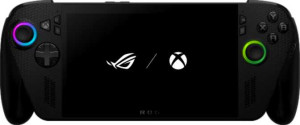
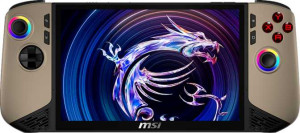
Both devices are full-sized handhelds sharing a surprising number of physical similarities — identical 80 Wh batteries, matching 500 nits brightness, the same IPS LCD panel technology, and 1TB of replaceable NVMe storage. For day-to-day portability fundamentals, they start from a very even baseline. Where things diverge is in display resolution and physical ergonomics.

The MSI Claw 8 AI Plus steps up to a 1200p display versus the Ally X's 1080p, which on a handheld screen translates to noticeably sharper text, finer detail in textures, and a more refined visual experience — particularly relevant for users who also use the device for media consumption or productivity tasks docked to a monitor. However, that upgraded panel comes housed in a larger and notably heavier chassis: the MSI weighs 795g compared to the Ally X's 715g, an 80g difference that becomes very tangible during extended handheld sessions. The MSI is also wider and taller, though its 24mm thickness does undercut the Ally X's 27mm, giving it a slimmer profile despite the larger footprint.

The winner here depends entirely on the user's priority. For long gaming sessions held in-hand, the Asus ROG Ally X has a meaningful ergonomic advantage thanks to its lighter weight. Those who prioritize display sharpness and don't mind the extra bulk will find the MSI Claw's higher-resolution screen worth the trade-off. On shared specs like battery capacity and brightness, neither device holds any edge.

Connectivity:
has a socket for a 3.5 mm audio jack
supports Wi-Fi
Wi-Fi version Wi-Fi 6E (802.11ax), Wi-Fi 6 (802.11ax), Wi-Fi 5 (802.11ac), Wi-Fi 4 (802.11n) Wi-Fi 7 (802.11be), Wi-Fi 6E (802.11ax), Wi-Fi 6 (802.11ax), Wi-Fi 5 (802.11ac), Wi-Fi 4 (802.11n)
is DLNA-certified
USB ports 2 2
has an HDMI output
Bluetooth version 5.2 5.4
has an external memory slot
Supports connectivity between home and portable devices
Has USB Type-C
has a cellular module
has NFC
RJ45 ports 0 0

Wireless connectivity is where the MSI Claw 8 AI Plus pulls ahead most decisively. Its support for Wi-Fi 7 (802.11be) is a meaningful generational leap over the Ally X's top-tier Wi-Fi 6E — Wi-Fi 7 delivers significantly higher theoretical throughput, lower latency, and better multi-link operation, which in practice means more stable online gaming, faster game downloads, and improved performance in congested wireless environments. The MSI's Bluetooth 5.4 also edges past the Ally X's 5.2, bringing minor improvements in connection reliability and power efficiency for wireless peripherals like headsets and controllers.

The more immediately practical differentiator, however, is the MSI's inclusion of a dedicated HDMI output — something the Ally X entirely lacks. For users who want to quickly connect to a TV or monitor without relying on a USB-C adapter or dock, this is a genuine quality-of-life advantage. Both devices offer the same USB port count and include USB Type-C, external memory slots, and 3.5mm audio jacks, so the remaining wired connectivity is evenly matched.

Taken together, the MSI Claw 8 AI Plus holds a clear edge in connectivity. The combination of next-generation Wi-Fi 7, a newer Bluetooth version, and a built-in HDMI port gives it more flexibility for both wireless and wired use cases. The Ally X's connectivity suite is solid but represents the previous generation across every point of difference.

Features:
has voice commands
pixel density 314 ppi 283 ppi
Can play games while they download
supports quick resume
supports Discord voice chat
Supports 3D audio
supports Dolby Vision
supports VR
Has a 4K Blu-ray drive
screen size 7" 8"
number of channels of sound output 2 2
has a touch screen
Has optical tracking
Has an autostereoscopic display
Has a secondary screen
Can play Blu-ray Discs
has two sensors
Access high scores and achievements
has stereo speakers
Supports 3D
has a front camera
Uses flash storage
has a child lock

Across the features category, these two handhelds are remarkably well-matched — both support quick resume, Discord voice chat, touch screens, VR, achievements, stereo speakers, and flash storage. The functional gaming experience on paper is essentially identical, which makes the few points of divergence all the more worth examining closely.

The most consequential trade-off sits between screen size and sharpness. The MSI Claw 8 AI Plus offers a larger 8-inch display, while the Asus ROG Ally X counters with a smaller but denser 7-inch panel at 314 ppi versus the MSI's 283 ppi. In practice, the Ally X's higher pixel density means crisper text and finer image detail, whereas the MSI's extra screen real estate makes gameplay feel more immersive and reduces the need to squint during UI-heavy or strategy titles. Neither is objectively superior — it comes down to whether a user values visual acuity or viewing comfort. The MSI also adds voice commands, a feature absent on the Ally X, though its practical utility in a handheld gaming context is situational.

This group is effectively a tie with a stylistic split: the Ally X appeals to users who prioritize display sharpness, while the MSI Claw edges ahead for those who want a larger screen and the added convenience of voice control. No single product dominates here — the right choice depends entirely on personal preference.

Controllers:
number of controllers 4 4
has adaptive triggers
Compatible with a motion-sensing controller(s)
Has a wireless controller
number of analog sticks 2 2
has an integrated touchpad
Has dual force feedback
number of buttons 16 16

Controller specs are nearly identical between these two handhelds — both pack the same button count, dual analog sticks, motion-sensing compatibility, and no adaptive triggers. For most users, the day-to-day input experience will feel comparable. The one spec that separates them, however, carries real weight for immersion-focused gamers.

The Asus ROG Ally X includes dual force feedback (rumble), while the MSI Claw 8 AI Plus does not. This may sound minor, but haptic feedback is a foundational part of how modern games communicate in-game events — weapon recoil, terrain texture, collision impacts, and environmental cues all become tactile with rumble enabled. Its absence on the MSI means players miss a layer of feedback that most console and handheld gamers have come to expect as standard.

Given that this is the sole differentiator in an otherwise evenly matched category, the Asus ROG Ally X takes a clear edge here. Dual force feedback meaningfully enriches the gaming experience in a way that affects a wide range of titles, making this omission on the MSI Claw a notable gap rather than a trivial one.

Comparison Summary & Verdict

After examining every specification, a clear picture emerges for each device. The Asus ROG Xbox Ally X stands out with its higher pixel density of 314 ppi, lighter weight of 715g, and dual force feedback support, making it an appealing choice for gamers who value portability and tactile controller feedback. The MSI Claw 8 AI Plus, on the other hand, pulls ahead with a significantly faster CPU speed of 8 x 4.8 GHz, more RAM at 32GB, a larger 8″ screen at 1200p resolution, Wi-Fi 7 connectivity, Bluetooth 5.4, a built-in HDMI output, and voice command support. If raw performance and cutting-edge connectivity are your priorities, the MSI Claw 8 AI Plus is the stronger pick. If you prefer a lighter, more compact device with a sharper display and haptic feedback, the Asus ROG Xbox Ally X remains a compelling option.

Asus ROG Xbox Ally X
Buy Asus ROG Xbox Ally X if...

Buy the Asus ROG Xbox Ally X if you prioritize a lighter, more compact handheld with a sharper 314 ppi display and dual force feedback controller support.

MSI Claw 8 AI Plus A2VM Intel Core Ultra 7 258V / 32GB RAM / 1TB SSD
Buy MSI Claw 8 AI Plus A2VM Intel Core Ultra 7 258V / 32GB RAM / 1TB SSD if...

Buy the MSI Claw 8 AI Plus A2VM Intel Core Ultra 7 258V / 32GB RAM / 1TB SSD if you want maximum performance with a faster CPU, 32GB of RAM, a larger 8″ screen, Wi-Fi 7, HDMI output, and voice command support.