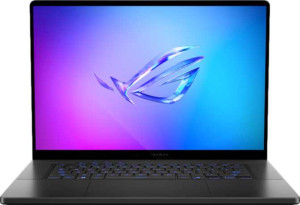
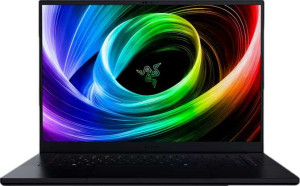
Both the Asus ROG Zephyrus G16 (2025) and the Razer Blade 16 (2025) are firmly in the gaming laptop category, and they share the same broad footprint — their width and height differ by just 1 mm and 4 mm respectively. In everyday use, both will occupy nearly the same amount of desk space and fit into the same laptop bags. Neither offers a fanless design, weather sealing, or a rugged build, which is expected for performance-focused gaming machines where thermal headroom and cost allocation matter more than durability certifications.
Where the two diverge meaningfully is in thickness and overall volume. The Zephyrus G16 measures just 14 mm thick versus the Blade 16's 17 mm — a 3 mm gap that sounds modest but translates to a noticeably sleeker profile in hand and in a bag. This carries through to total volume: the Zephyrus displaces 1,219 cm³ compared to the Blade 16's 1,509 cm³, making it roughly 19% more compact by volume. That kind of chassis engineering at gaming-class performance levels is a real industrial design achievement.
Weight tells a similar story: the Zephyrus G16 comes in at 1,950 g versus the Blade 16's 2,140 g — a 190 g difference, roughly equivalent to a large smartphone. For users who commute, travel, or work from multiple locations, that margin is perceptible over a full day. On design alone, the Asus ROG Zephyrus G16 holds a clear advantage: it is lighter, thinner, and meaningfully more compact, without sacrificing the standard gaming-laptop feature set it shares with the Razer Blade 16.