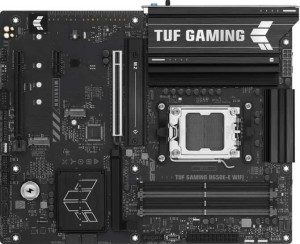
Asus TUF Gaming B650E-E Wi-Fi
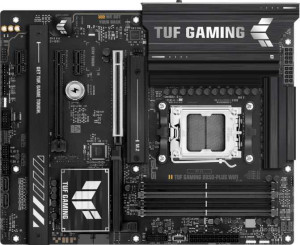
Asus TUF Gaming B850-Plus WiFi

Asus TUF Gaming B650E-E Wi-Fi Asus TUF Gaming B850-Plus WiFi

Overview

Welcome to our detailed spec comparison between the Asus TUF Gaming B650E-E Wi-Fi and the Asus TUF Gaming B850-Plus WiFi. Both boards share the AM5 socket and ATX form factor, but they diverge in meaningful ways across connectivity, USB port selection, and platform features. Whether you are building a future-ready system or maximizing value on a proven platform, understanding these distinctions will help you make the right choice for your build.

Common Features

  • Both products use the AM5 CPU socket.
  • Both products have an ATX form factor.
  • Wi-Fi connectivity is available on both products.
  • Bluetooth is available on both products.
  • Both products support HDMI 2.1.
  • Overclocking support is available on both products.
  • RGB lighting is present on both products.
  • Easy BIOS reset is not available on either product.
  • Both products support DDR5 memory.
  • Both products have 4 memory slots and 2 memory channels.
  • The maximum overclocked RAM speed is 8000 MHz on both products.
  • ECC memory support is not available on either product.
  • Neither product has USB-C ports in the USB 3.2 Gen 1 category.
  • Neither product has USB 4 or Thunderbolt ports.
  • Both products have one HDMI output and one DisplayPort output.
  • Both products have one RJ45 port.
  • Both products provide 2 USB 3.2 Gen 1 ports and 4 USB 2.0 ports through expansion.
  • Both products have 4 SATA 3 connectors, 3 M.2 sockets, 6 fan headers, and no U.2 sockets.
  • A TPM connector is not present on either product.
  • Both products have one PCIe 5.0 x16 slot, one PCIe 4.0 x16 slot, and no PCIe 3.0, 2.0, x8, or PCI slots.
  • Both products support 7.1 audio channels.
  • S/PDIF Out port is not available on either product.
  • Both products support RAID 0, RAID 1, RAID 5, and RAID 10, but neither supports RAID 0+1.

Main Differences

  • The chipset is B650 on Asus TUF Gaming B650E-E Wi-Fi and B850 on Asus TUF Gaming B850-Plus WiFi.
  • Wi-Fi 7 (802.11be) support is present on Asus TUF Gaming B850-Plus WiFi but not available on Asus TUF Gaming B650E-E Wi-Fi.
  • Bluetooth version is 5.3 on Asus TUF Gaming B650E-E Wi-Fi and 5.4 on Asus TUF Gaming B850-Plus WiFi.
  • Dual BIOS is present on Asus TUF Gaming B850-Plus WiFi but not available on Asus TUF Gaming B650E-E Wi-Fi.
  • Maximum memory amount is 256GB on Asus TUF Gaming B650E-E Wi-Fi and 192GB on Asus TUF Gaming B850-Plus WiFi.
  • USB 3.2 Gen 2 ports (USB-A) count is 1 on Asus TUF Gaming B650E-E Wi-Fi and 3 on Asus TUF Gaming B850-Plus WiFi.
  • USB 3.2 Gen 1 ports (USB-A) count is 3 on Asus TUF Gaming B650E-E Wi-Fi and 4 on Asus TUF Gaming B850-Plus WiFi.
  • USB 3.2 Gen 2 port (USB-C) is present on Asus TUF Gaming B650E-E Wi-Fi but not available on Asus TUF Gaming B850-Plus WiFi.
  • USB 2.0 ports count is 3 on Asus TUF Gaming B650E-E Wi-Fi and 2 on Asus TUF Gaming B850-Plus WiFi.
  • A USB 3.2 Gen 2x2 port is present on Asus TUF Gaming B850-Plus WiFi but not available on Asus TUF Gaming B650E-E Wi-Fi.
  • PCIe x1 slots count is 1 on Asus TUF Gaming B650E-E Wi-Fi and 2 on Asus TUF Gaming B850-Plus WiFi.
  • Audio connectors count is 3 on Asus TUF Gaming B650E-E Wi-Fi and 5 on Asus TUF Gaming B850-Plus WiFi.
Specs Comparison
Asus TUF Gaming B650E-E Wi-Fi

Asus TUF Gaming B650E-E Wi-Fi

Asus TUF Gaming B850-Plus WiFi

Asus TUF Gaming B850-Plus WiFi

General info:
CPU socket AM5 AM5
chipset B650 B850
form factor ATX ATX
release date June 2025 January 2025
supports Wi-Fi
Wi-Fi version Wi-Fi 4 (802.11n), Wi-Fi 5 (802.11ac), Wi-Fi 6 (802.11ax), Wi-Fi 6E (802.11ax) Wi-Fi 4 (802.11n), Wi-Fi 5 (802.11ac), Wi-Fi 6 (802.11ax), Wi-Fi 6E (802.11ax), Wi-Fi 7 (802.11be)
Has Bluetooth
Bluetooth version 5.3 5.4
HDMI version HDMI 2.1 HDMI 2.1
Easy to overclock
has RGB lighting
Easy to reset BIOS
Has dual BIOS
has aptX
CPU sockets 1 1
Has integrated graphics
warranty period 3 years 3 years
height 244 mm 244 mm
width 305 mm 305 mm
Has integrated CPU

Both the Asus TUF Gaming B650E-E Wi-Fi and the Asus TUF Gaming B850-Plus WiFi share a strong common foundation: the AM5 socket, standard ATX form factor, identical physical dimensions (244 × 305 mm), HDMI 2.1 output, overclocking support, RGB lighting, and a 3-year warranty. For a user evaluating platform compatibility or case fit, these boards are effectively interchangeable on paper.

The meaningful differences emerge in connectivity and reliability features. The B850-Plus steps up to Wi-Fi 7 (802.11be), which offers significantly higher throughput and lower latency over Wi-Fi 6E — a real-world advantage for users on a compatible router doing high-bandwidth tasks like game streaming or large file transfers. Its Bluetooth 5.4 also improves slightly on the B650E-E's 5.3 in terms of connection stability and power efficiency. More notably, the B850-Plus includes dual BIOS, a hardware-level safety net that lets the board automatically recover from a failed firmware flash — a feature the B650E-E lacks entirely, making risky BIOS updates on the older board a potential single point of failure.

Overall, the B850-Plus WiFi holds a clear edge in this group. The addition of Wi-Fi 7, a newer Bluetooth version, and especially dual BIOS make it the more future-proof and resilient choice. The B650E-E is not deficient by any absolute standard, but on every spec where the two boards diverge, the B850-Plus comes out ahead.
Memory:
maximum memory amount 256GB 192GB
overclocked RAM speed 8000 MHz 8000 MHz
memory slots 4 4
DDR memory version 5 5
memory channels 2 2
Supports ECC memory

On the memory front, these two boards are largely aligned: both run DDR5, offer 4 slots in a dual-channel configuration, top out at 8000 MHz overclocked speed, and lack ECC support. For the vast majority of gaming and content creation workloads, this shared foundation means identical day-to-day memory performance.

The one standout difference is maximum capacity. The B650E-E supports up to 256 GB of RAM, while the B850-Plus caps at 192 GB — a 25% reduction. In practice, this gap is irrelevant for most users, since even memory-intensive tasks like video editing or virtualization rarely push beyond 128 GB on a consumer desktop. However, for professional or prosumer workloads that genuinely saturate large memory pools — think extensive virtual machine stacks or large in-memory datasets — the B650E-E's higher ceiling is a concrete advantage.

This is an unusual reversal from the General Info group, where the B850-Plus held the edge. Here, the B650E-E takes a narrow win on paper due to its higher memory ceiling, though for the overwhelming majority of users the two boards are functionally tied in this category.

Ports:
USB 3.2 Gen 2 ports (USB-A) 1 3
USB 3.2 Gen 1 ports (USB-A) 3 4
USB 3.2 Gen 2 ports (USB-C) 1 0
USB 3.2 Gen 1 ports (USB-C) 0 0
USB 2.0 ports 3 2
USB 3.2 Gen 2x2 ports 0 1
USB 4 40Gbps ports 0 0
USB 4 20Gbps ports 0 0
Thunderbolt 4 ports 0 0
Thunderbolt 3 ports 0 0
has an HDMI output
DisplayPort outputs 1 1
RJ45 ports 1 1
Has USB Type-C
eSATA ports 0 0
DVI outputs 0 0
has a VGA connector
PS/2 ports 0 0

The rear I/O panel tells quite different stories for these two boards. The B850-Plus offers a more generous USB-A layout — 3× USB 3.2 Gen 2 (10 Gbps) and 4× USB 3.2 Gen 1 (5 Gbps) ports — compared to the B650E-E's single Gen 2 and three Gen 1 USB-A ports. In practical terms, users with multiple high-speed peripherals like external SSDs, capture cards, or fast hubs will find the B850-Plus considerably less constrained without needing a separate hub.

The more significant differentiator is the B850-Plus's USB 3.2 Gen 2x2 port, which delivers 20 Gbps of bandwidth — double that of a standard Gen 2 port. This is the fastest USB connection available on either board and makes a tangible difference when transferring large files to a compatible NVMe enclosure. The B650E-E counters with a USB 3.2 Gen 2 Type-C rear port, which the B850-Plus lacks entirely in its Type-C rear offerings. So the trade-off is raw peak speed (B850-Plus) versus a rear USB-C option for Type-C devices (B650E-E). Video output parity is complete — both carry HDMI and a single DisplayPort.

On balance, the B850-Plus holds the clear edge in this group. Its higher USB-A port count, greater number of Gen 2 connections, and the exclusive Gen 2x2 port give it a meaningfully more capable rear panel for a port-intensive desktop setup. The B650E-E's sole advantage — its rear USB-C Gen 2 port — is useful but narrow in scope.

Connectors:
USB 3.2 Gen 1 ports (through expansion) 2 2
USB 2.0 ports (through expansion) 4 4
SATA 3 connectors 4 4
fan headers 6 6
USB 3.0 ports (through expansion) 2 2
M.2 sockets 3 3
Has TPM connector
U.2 sockets 0 0
Has mSATA connector
SATA 2 connectors 0 0

The internal connectors specification is a rare case of a perfect tie. Every single data point — 3× M.2 sockets, 4× SATA 3 ports, 6 fan headers, and identical internal USB expansion headers — is shared between the B650E-E and the B850-Plus without exception.

The practical implications of this parity are worth noting. Three M.2 slots provide ample room for a primary NVMe boot drive alongside dedicated storage for games or a secondary OS, while four SATA 3 ports keep legacy HDDs and SSDs well accommodated. Six fan headers is a solid count for a mid-to-full tower build with thorough airflow management, removing the need for a fan hub in most configurations.

This group is a complete draw — no advantage can be awarded to either board based solely on the provided data. A buyer's decision here should rest entirely on the differentiators found in other specification groups.

Expansion slots:
PCIe 4.0 x16 slots 1 1
PCIe 5.0 x16 slots 1 1
PCIe 3.0 x16 slots 0 0
PCIe x1 slots 1 2
PCI slots 0 0
PCIe 2.0 x16 slots 0 0
PCIe x8 slots 0 0

Expansion slot layouts are nearly identical across these two boards. Both feature the same high-bandwidth foundation: one PCIe 5.0 x16 slot for a primary GPU and one PCIe 4.0 x16 slot for a secondary card or high-speed add-in device. This configuration is well-suited to modern discrete graphics cards and keeps both boards current-generation ready.

The only divergence is a single extra PCIe x1 slot on the B850-Plus, giving it 2 versus the B650E-E's 1. While x1 slots are narrow in bandwidth, they serve a practical role for add-in cards like sound cards, Wi-Fi cards, capture cards, or USB expansion controllers. Having two instead of one simply provides more flexibility without consuming a full x16 slot.

The B850-Plus edges ahead in this group, though narrowly. The extra x1 slot is a modest but real advantage for builders who plan to populate their system with multiple add-in cards. For users unlikely to use more than one such card, the two boards are functionally equivalent here.

Audio:
audio channels 7.1 7.1
Has S/PDIF Out port
audio connectors 3 5

Audio capabilities are closely matched in one key respect: both boards deliver 7.1 surround sound and neither includes an S/PDIF optical output, so users who rely on digital optical passthrough to an external receiver or DAC will need an add-in solution regardless of which board they choose.

Where they diverge is in the number of analog audio connectors — 5 on the B850-Plus versus 3 on the B650E-E. This is a meaningful practical difference for multi-channel analog audio setups. A full 7.1 analog configuration requires multiple 3.5 mm jacks to carry all speaker channels; fewer physical connectors can limit the ability to wire up a complete surround speaker system directly from the rear panel without additional hardware. The B850-Plus's five connectors are better positioned to support that use case out of the box.

For users running a simple stereo headset or a pair of bookshelf speakers, the distinction is irrelevant — two connectors (input and output) are all that's ever used. But for those building a dedicated surround sound desktop setup, the B850-Plus holds a clear advantage in this group with its more complete analog audio panel.

Storage:
Supports RAID 1
Supports RAID 10 (1+0)
Supports RAID 5
Supports RAID 0
Supports RAID 0+1

RAID support is identical across both boards. The B650E-E and B850-Plus each support RAID 0 (striping for performance), RAID 1 (mirroring for redundancy), RAID 5 (distributed parity for a balance of speed and fault tolerance), and RAID 10 (a combined stripe-and-mirror configuration) — while neither supports RAID 0+1.

This is another complete tie. The supported RAID modes cover the configurations most relevant to consumer and prosumer desktop use cases, so neither board has a meaningful advantage over the other in how it handles multi-drive storage arrays. Any decision between these two boards should be made based on the differentiators identified in other specification groups.

Comparison Summary & Verdict

Both boards are strong contenders in the AM5 ecosystem, sharing DDR5 support, PCIe 5.0, Wi-Fi, and robust RAID options. However, they cater to slightly different builder profiles. The Asus TUF Gaming B650E-E Wi-Fi stands out with a higher maximum memory capacity of 256GB and includes a USB 3.2 Gen 2 USB-C rear port, making it appealing for power users with high-capacity memory needs. On the other hand, the Asus TUF Gaming B850-Plus WiFi brings Wi-Fi 7, Bluetooth 5.4, a dual BIOS safety net, more USB-A ports, a USB 3.2 Gen 2x2 port, and additional audio connectors, positioning it as the more future-proof and feature-rich option for enthusiasts who want the latest wireless standards and greater connectivity flexibility.

Asus TUF Gaming B650E-E Wi-Fi
Buy Asus TUF Gaming B650E-E Wi-Fi if...

Buy the Asus TUF Gaming B650E-E Wi-Fi if you need a maximum memory capacity of 256GB or want a rear USB 3.2 Gen 2 USB-C port on a proven AM5 platform.

Asus TUF Gaming B850-Plus WiFi
Buy Asus TUF Gaming B850-Plus WiFi if...

Buy the Asus TUF Gaming B850-Plus WiFi if you want the latest Wi-Fi 7, Bluetooth 5.4, dual BIOS protection, and a richer selection of USB-A and audio ports for a more future-ready build.