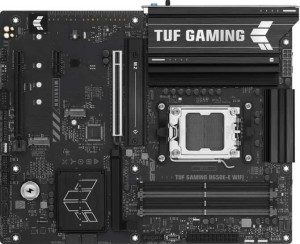
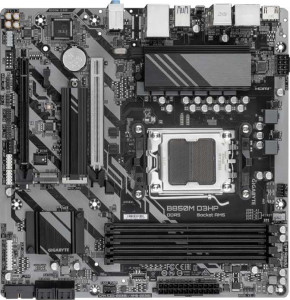
Both boards share the same AM5 socket and core fundamentals — single CPU socket, no integrated CPU or graphics, HDMI 2.1 output, overclocking support, and a 3-year warranty — so neither has a baseline advantage there. The most structurally significant difference is form factor: the Asus TUF Gaming B650E-E is a full ATX board (305 × 244 mm), while the Gigabyte B850M D3HP is Micro-ATX (244 × 244 mm). This means the Asus physically requires a mid- or full-tower case, whereas the Gigabyte fits in more compact builds — a real constraint to check before buying either.
Connectivity is where the Asus pulls ahead for most users: it includes built-in Wi-Fi and Bluetooth, while the Gigabyte has neither, meaning wireless users would need a separate adapter on the Gigabyte build. On the other hand, the Gigabyte counters with a dual BIOS — a second backup chip that can recover a corrupted firmware automatically, something the Asus lacks. Neither board offers an easy one-button BIOS reset, so that's a shared limitation. The Asus also includes RGB lighting; the Gigabyte does not, which is purely aesthetic but worth noting for case-window builds.
The chipset difference — B650 on the Asus vs. B850 on the Gigabyte — is also worth flagging: the B850 is a newer platform generation, which can imply improved power delivery and feature support depending on implementation, though the provided specs don't detail PCIe lane counts or USB configurations here. Overall, the Asus TUF B650E-E has a clear connectivity edge (Wi-Fi + Bluetooth out of the box), while the Gigabyte B850M D3HP edges ahead on firmware resilience (dual BIOS) and fits smaller cases. The right choice depends on whether wireless connectivity or build size is the bigger priority.