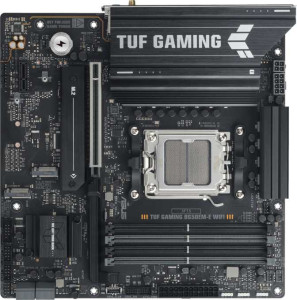
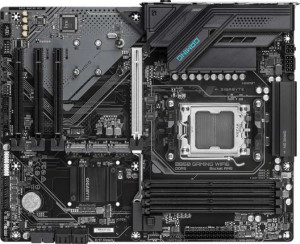
Both boards share the same AM5 socket, support overclocking, include Wi-Fi 6 and Bluetooth, and carry a 3-year warranty — so on paper they target a similar audience. The most consequential platform difference is the chipset: the Asus uses a B650 while the Gigabyte steps up to a B850, which is a newer generation and generally offers improved I/O capabilities and PCIe lane allocation, meaning the Gigabyte has a slight forward-looking edge for storage and peripheral expansion without paying for a premium X-series board.
Form factor is a real-world dividing line here. The Asus is Micro-ATX (244 × 244 mm), making it the right pick for compact or space-constrained builds, while the Gigabyte is a full ATX (244 × 305 mm), providing more room for additional slots, VRM cooling headroom, and better cable management. The Gigabyte also includes dual BIOS — a meaningful reliability feature that lets the board recover from a failed firmware flash automatically — something the Asus lacks. Conversely, the Asus ships with RGB lighting, which the Gigabyte omits entirely; a minor but visible aesthetic difference for builders who care about case aesthetics. Bluetooth is nearly identical at 5.2 vs 5.3, with 5.3 offering marginally better connection stability and slightly lower power draw in practice.
Overall, the Gigabyte B850 Gaming WiFi6 holds a clear general-info advantage for most builders: it pairs a newer chipset with a full ATX layout and the added safety net of dual BIOS. The Asus TUF B650EM-E earns its place specifically for small-form-factor builds or budget-conscious setups where its Micro-ATX footprint and RGB aesthetics matter more than platform longevity.