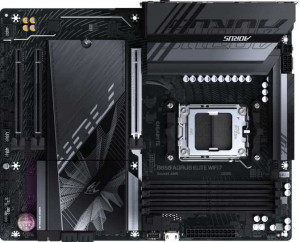
At a foundational level, the Asus TUF Gaming B850-BTF Wi-Fi W and the Gigabyte B850 Aorus Elite WiFi7 are near-identical twins. Both are full-size ATX boards sharing the same 305 × 244 mm footprint, built around the AMD B850 chipset for the AM5 platform. Wireless connectivity is equally matched: both support the full Wi-Fi generational stack up to Wi-Fi 7 (802.11be) and Bluetooth 5.4, which delivers the latest low-energy and multi-stream audio improvements. Both boards also carry a 3-year warranty, support overclocking, include RGB lighting, and feature dual BIOS — a critical safety net that lets the board recover from a failed firmware flash by switching to a backup chip automatically.
The only meaningful differentiator in this group is easy BIOS reset: the TUF Gaming B850-BTF Wi-Fi W offers it, while the Aorus Elite WiFi7 does not. In practice, a dedicated BIOS reset mechanism — typically a physical button on the rear I/O panel or board edge — allows users to clear CMOS and restore default settings without opening the case, removing the battery, or shorting jumper pins. This is particularly valuable during overclocking sessions gone wrong or after a misconfigured memory profile prevents the system from posting. The Aorus relies on dual BIOS as its primary recovery tool, which handles firmware corruption but does not replace the convenience of a one-press CMOS clear for configuration-level issues.
Overall, this group is essentially a tie with one nuanced edge: the TUF Gaming B850-BTF Wi-Fi W has a slight practical advantage for builders and overclockers who value quick BIOS recovery, thanks to its easy reset feature. For users who never push settings to the edge, the two boards are functionally equivalent on every spec covered here.