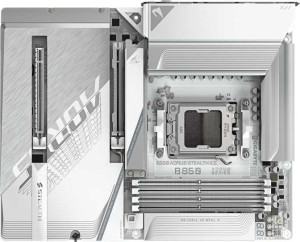
Asus TUF Gaming B850-BTF Wi-Fi W
Gigabyte B850 Aorus Stealth Ice

Asus TUF Gaming B850-BTF Wi-Fi W Gigabyte B850 Aorus Stealth Ice

Overview

Welcome to our in-depth specification comparison between the Asus TUF Gaming B850-BTF Wi-Fi W and the Gigabyte B850 Aorus Stealth Ice. Both motherboards share the same AM5 socket, B850 chipset, and ATX form factor, making this a fascinating head-to-head between two capable platforms. The key battlegrounds include storage and expansion options, USB connectivity, fan header count, and overclocking headroom — areas where each board carves out its own identity.

Common Features

  • Both motherboards use the AM5 CPU socket.
  • Both motherboards feature the B850 chipset.
  • Both motherboards have an ATX form factor.
  • Wi-Fi is supported on both motherboards, covering Wi-Fi 4, Wi-Fi 5, Wi-Fi 6, Wi-Fi 6E, and Wi-Fi 7.
  • Bluetooth 5.4 is available on both motherboards.
  • Both motherboards support a maximum memory amount of 256GB.
  • Both motherboards have 4 memory slots.
  • Both motherboards use DDR5 memory.
  • Both motherboards have 2 memory channels.
  • ECC memory is not supported on either motherboard.
  • Both motherboards have 4 USB 3.2 Gen 1 Type-A ports.
  • Neither motherboard has any USB 3.2 Gen 1 Type-C ports.
  • Neither motherboard has any USB 4 40Gbps or USB 4 20Gbps ports.
  • Neither motherboard has any Thunderbolt 3 or Thunderbolt 4 ports.
  • An HDMI 2.1 output is present on both motherboards.
  • Both motherboards have 1 RJ45 port.
  • Both motherboards provide 2 USB 3.2 Gen 1 ports through expansion.
  • Both motherboards provide 4 USB 2.0 ports through expansion.
  • Both motherboards provide 2 USB 3.0 ports through expansion.
  • Neither motherboard has any U.2 sockets or mSATA connectors.
  • Neither motherboard has any SATA 2 connectors.
  • Both motherboards have 1 PCIe 5.0 x16 slot.
  • Neither motherboard has any PCIe 3.0 x16, PCIe 2.0 x16, PCIe x8, or PCI slots.
  • Both motherboards have a signal-to-noise ratio of 120 dB on the DAC.
  • Both motherboards support 7.1 audio channels.
  • An S/PDIF Out port is present on both motherboards.
  • RAID 0, RAID 1, RAID 5, and RAID 10 are supported on both motherboards.
  • RAID 0+1 is not supported on either motherboard.

Main Differences

  • Easy BIOS reset is available on Asus TUF Gaming B850-BTF Wi-Fi W but not on Gigabyte B850 Aorus Stealth Ice.
  • Maximum overclocked RAM speed is 8000 MHz on Asus TUF Gaming B850-BTF Wi-Fi W and 8200 MHz on Gigabyte B850 Aorus Stealth Ice.
  • USB 3.2 Gen 2 Type-A ports number 3 on Asus TUF Gaming B850-BTF Wi-Fi W and 2 on Gigabyte B850 Aorus Stealth Ice.
  • USB 3.2 Gen 2 Type-C ports number 0 on Asus TUF Gaming B850-BTF Wi-Fi W and 1 on Gigabyte B850 Aorus Stealth Ice.
  • USB 2.0 ports number 2 on Asus TUF Gaming B850-BTF Wi-Fi W and 4 on Gigabyte B850 Aorus Stealth Ice.
  • A USB 3.2 Gen 2x2 port is present on Asus TUF Gaming B850-BTF Wi-Fi W but not available on Gigabyte B850 Aorus Stealth Ice.
  • A DisplayPort output is present on Asus TUF Gaming B850-BTF Wi-Fi W but not available on Gigabyte B850 Aorus Stealth Ice.
  • SATA 3 connectors number 4 on Asus TUF Gaming B850-BTF Wi-Fi W and 2 on Gigabyte B850 Aorus Stealth Ice.
  • Fan headers number 6 on Asus TUF Gaming B850-BTF Wi-Fi W and 8 on Gigabyte B850 Aorus Stealth Ice.
  • M.2 sockets number 3 on Asus TUF Gaming B850-BTF Wi-Fi W and 4 on Gigabyte B850 Aorus Stealth Ice.
  • A TPM connector is present on Gigabyte B850 Aorus Stealth Ice but not available on Asus TUF Gaming B850-BTF Wi-Fi W.
  • A PCIe 4.0 x16 slot is present on Asus TUF Gaming B850-BTF Wi-Fi W but not available on Gigabyte B850 Aorus Stealth Ice.
  • A PCIe x1 slot is present on Asus TUF Gaming B850-BTF Wi-Fi W but not available on Gigabyte B850 Aorus Stealth Ice.
  • A PCIe x4 slot is present on Gigabyte B850 Aorus Stealth Ice but not available on Asus TUF Gaming B850-BTF Wi-Fi W.
  • Audio connectors number 5 on Asus TUF Gaming B850-BTF Wi-Fi W and 2 on Gigabyte B850 Aorus Stealth Ice.
Specs Comparison
Asus TUF Gaming B850-BTF Wi-Fi W

Asus TUF Gaming B850-BTF Wi-Fi W

Gigabyte B850 Aorus Stealth Ice

Gigabyte B850 Aorus Stealth Ice

General info:
CPU socket AM5 AM5
chipset B850 B850
form factor ATX ATX
release date May 2025 May 2025
supports Wi-Fi
Wi-Fi version Wi-Fi 4 (802.11n), Wi-Fi 5 (802.11ac), Wi-Fi 6 (802.11ax), Wi-Fi 6E (802.11ax), Wi-Fi 7 (802.11be) Wi-Fi 4 (802.11n), Wi-Fi 5 (802.11ac), Wi-Fi 6 (802.11ax), Wi-Fi 6E (802.11ax), Wi-Fi 7 (802.11be)
Has Bluetooth
Bluetooth version 5.4 5.4
HDMI version HDMI 2.1 HDMI 2.1
Easy to overclock
has RGB lighting
Easy to reset BIOS
Has dual BIOS
has aptX
CPU sockets 1 1
Has integrated graphics
warranty period 3 years 3 years
height 244 mm 244 mm
width 305 mm 305 mm
Has integrated CPU

At the general level, the Asus TUF Gaming B850-BTF Wi-Fi W and the Gigabyte B850 Aorus Stealth Ice are built on the same foundation: both use the AM5 socket with a B850 chipset, share the standard ATX form factor (305 × 244 mm), and offer identical wireless connectivity with Wi-Fi 7 and Bluetooth 5.4 — the latest generations available, ensuring future-proof wireless performance and low-latency device pairing. Both also output video via HDMI 2.1, support overclocking, include RGB lighting, carry a dual BIOS for firmware redundancy, and are backed by a 3-year warranty.

The only meaningful differentiator in this group is BIOS recovery ergonomics: the TUF Gaming B850-BTF Wi-Fi W supports easy BIOS reset, while the Aorus Stealth Ice does not. In practice, this matters most during aggressive overclocking sessions or failed firmware updates — a dedicated clear-CMOS button or similar mechanism lets users recover without opening the case or shorting jumper pins, which is a genuine convenience advantage.

Overall, these two boards are nearly identical in general specifications. The Asus TUF Gaming B850-BTF Wi-Fi W holds a narrow but practical edge in this group solely due to its easier BIOS reset capability — a small but real quality-of-life benefit for enthusiasts who push their system settings frequently.

Memory:
maximum memory amount 256GB 256GB
overclocked RAM speed 8000 MHz 8200 MHz
memory slots 4 4
DDR memory version 5 5
memory channels 2 2
Supports ECC memory

Both boards share the same core memory architecture: DDR5 with 4 slots, dual-channel configuration, and a 256 GB maximum capacity. That ceiling is more than sufficient for any current workstation or gaming workload, and dual-channel DDR5 delivers the bandwidth needed to keep a modern AM5 processor well-fed.

The sole differentiator here is the maximum overclocked RAM speed. The Gigabyte B850 Aorus Stealth Ice tops out at 8200 MHz, versus 8000 MHz on the Asus TUF Gaming B850-BTF Wi-Fi W. In absolute terms the gap is modest — 200 MHz represents roughly a 2.5% headroom increase — but for enthusiasts chasing peak memory performance or running memory-sensitive workloads like content creation and simulation, that extra ceiling can matter when pushing XMP/EXPO profiles to their limits.

For the vast majority of users, this difference will be imperceptible in day-to-day use. However, on a strictly spec-by-spec basis for this group, the Aorus Stealth Ice holds a narrow edge in memory overclocking potential, making it the marginally more appealing choice for users who intend to run high-frequency RAM kits at their rated or beyond-rated speeds.

Ports:
USB 3.2 Gen 2 ports (USB-A) 3 2
USB 3.2 Gen 1 ports (USB-A) 4 4
USB 3.2 Gen 2 ports (USB-C) 0 1
USB 3.2 Gen 1 ports (USB-C) 0 0
USB 2.0 ports 2 4
USB 3.2 Gen 2x2 ports 1 0
USB 4 40Gbps ports 0 0
USB 4 20Gbps ports 0 0
Thunderbolt 4 ports 0 0
Thunderbolt 3 ports 0 0
has an HDMI output
DisplayPort outputs 1 0
RJ45 ports 1 1
Has USB Type-C
eSATA ports 0 0
DVI outputs 0 0
has a VGA connector
PS/2 ports 0 0

The rear I/O port selection is where these two boards diverge most clearly. The Asus TUF Gaming B850-BTF Wi-Fi W counters with a USB 3.2 Gen 2x2 port delivering 20 Gbps — double the throughput of a standard Gen 2 port — making it a strong choice for users with fast external NVMe enclosures or high-speed storage accessories. It also includes a DisplayPort 1 output alongside HDMI, giving it two video-out options on the rear panel. The Gigabyte B850 Aorus Stealth Ice, by contrast, skips both of those but adds a USB 3.2 Gen 2 Type-C port — useful for connecting modern peripherals or displays that favor the USB-C connector form factor — and doubles the USB 2.0 count to 4, which helps with legacy devices like wireless dongles and audio interfaces.

In terms of raw high-speed connectivity, the Asus edges ahead: the Gen 2x2 port is a meaningful upgrade for anyone transferring large files to fast external drives, and having both HDMI and DisplayPort outputs without needing an adapter adds genuine flexibility for multi-monitor setups using integrated or discrete graphics simultaneously.

On balance, the Asus TUF Gaming B850-BTF Wi-Fi W holds a clearer advantage in this group for performance-oriented users, thanks to its 20 Gbps USB port and dual video outputs. The Aorus Stealth Ice is the more practical pick only if a rear-panel USB-C connector is a priority — otherwise, the Asus offers a more capable port layout overall.

Connectors:
USB 3.2 Gen 1 ports (through expansion) 2 2
USB 2.0 ports (through expansion) 4 4
SATA 3 connectors 4 2
fan headers 6 8
USB 3.0 ports (through expansion) 2 2
M.2 sockets 3 4
Has TPM connector
U.2 sockets 0 0
Has mSATA connector
SATA 2 connectors 0 0

Internal storage expansion tells an interesting story here. The Gigabyte B850 Aorus Stealth Ice offers 4 M.2 sockets versus 3 on the Asus TUF Gaming B850-BTF Wi-Fi W, making it the stronger pick for NVMe-centric builds that prioritize fast solid-state storage. The Asus counters with 4 SATA 3 connectors compared to just 2 on the Gigabyte — a meaningful difference for users who still rely on SATA SSDs or HDDs for bulk storage, as running out of SATA ports on a high-capacity NAS-style or media server build is a real constraint.

Thermal management is another area where the boards diverge. The Aorus Stealth Ice provides 8 fan headers to the TUF's 6, which gives builders with large tower cases, custom water-cooling loops, or elaborate multi-fan configurations more native control points without resorting to external fan hubs. The Gigabyte also includes a TPM connector, which the Asus lacks — relevant for enterprise users or anyone requiring hardware-level security features such as BitLocker or secure boot attestation.

The Gigabyte B850 Aorus Stealth Ice takes the edge in this group. Its additional M.2 slot, extra fan headers, and TPM support collectively make it the more expandable and feature-rich option internally — particularly for builders planning dense NVMe arrays, complex cooling setups, or security-conscious deployments. The Asus remains competitive for SATA-heavy configurations, but that use case is increasingly niche.

Expansion slots:
PCIe 4.0 x16 slots 1 0
PCIe 5.0 x16 slots 1 1
PCIe 3.0 x16 slots 0 0
PCIe x1 slots 1 0
PCI slots 0 0
PCIe 2.0 x16 slots 0 0
PCIe x4 slots 0 1
PCIe x8 slots 0 0

When it comes to expansion slots, both boards anchor their layout around a single PCIe 5.0 x16 slot — the right choice for pairing with current and next-generation discrete GPUs, where the extra bandwidth headroom future-proofs the platform. That shared foundation means neither board compromises on primary graphics performance.

Beyond the main GPU slot, the two boards take noticeably different approaches. The Asus TUF Gaming B850-BTF Wi-Fi W includes an additional PCIe 4.0 x16 slot alongside a PCIe x1 slot, giving builders two extra expansion options — useful for a secondary GPU, a capture card, a 10GbE NIC, or other full-size add-in cards. The Gigabyte B850 Aorus Stealth Ice offers only a single secondary slot at PCIe x4, which suits NVMe expansion cards or lower-bandwidth peripherals but provides less overall flexibility than the Asus configuration.

The Asus TUF Gaming B850-BTF Wi-Fi W holds a clear advantage in this group. With three total expansion slots versus the Gigabyte's two, and a full-bandwidth PCIe 4.0 x16 secondary slot that opens the door to multi-card or high-throughput add-in scenarios, it is the more versatile choice for builders who expect to populate more than just a GPU.

Audio:
Signal-to-Noise ratio (DAC) 120 dB 120 dB
audio channels 7.1 7.1
Has S/PDIF Out port
audio connectors 5 2

On the qualitative side of audio, these boards are perfectly matched: both deliver a 120 dB signal-to-noise ratio from their onboard DAC, support 7.1 surround sound, and include an S/PDIF optical output for routing audio to an external receiver or DAC. A 120 dB SNR is a strong figure for integrated audio, meaning the noise floor is low enough to satisfy most enthusiast headphone and speaker setups without requiring a discrete sound card.

Where they part ways is the physical rear-panel audio jack count. The Asus TUF Gaming B850-BTF Wi-Fi W provides 5 audio connectors, while the Gigabyte B850 Aorus Stealth Ice offers just 2. In practice, this is a significant gap for anyone running a multi-channel analog speaker system — a full 7.1 analog setup requires multiple 3.5mm jacks, and with only 2, the Gigabyte effectively pushes multi-channel users toward the S/PDIF output or an external audio solution. The Asus, with its 5-jack layout, can accommodate a proper analog surround configuration directly from the motherboard.

The Asus TUF Gaming B850-BTF Wi-Fi W wins this group on the strength of its 5 audio connectors. For users who rely on analog multi-channel audio — whether for surround sound gaming headsets, speaker systems, or simultaneous front/rear output — the Gigabyte's 2-jack rear panel is a notable limitation that the Asus avoids entirely.

Storage:
Supports RAID 1
Supports RAID 10 (1+0)
Supports RAID 5
Supports RAID 0
Supports RAID 0+1

Storage redundancy and performance configurations are identical across both boards. Each supports RAID 0 (striping for speed), RAID 1 (mirroring for redundancy), RAID 5 (distributed parity for a balance of performance and fault tolerance), and RAID 10 (a stripe of mirrors combining both speed and redundancy). Neither supports RAID 0+1, though this omission is the same for both and inconsequential given that RAID 10 achieves comparable outcomes with better fault tolerance in most practical scenarios.

This is a clean tie. There is no differentiator in this group — both boards give builders the same range of RAID options, covering everything from home media arrays to small workstation setups requiring drive redundancy. The choice between these two boards will not be influenced by storage configuration capabilities.

Comparison Summary & Verdict

After reviewing all specifications, both boards are strong AM5 contenders, but they cater to slightly different builders. The Asus TUF Gaming B850-BTF Wi-Fi W stands out with its easy BIOS reset, more SATA 3 connectors, a USB 3.2 Gen 2x2 port, a dedicated DisplayPort output, more audio connectors, and a PCIe 4.0 x16 slot — making it the more practical choice for users who value versatile connectivity and ease of maintenance. The Gigabyte B850 Aorus Stealth Ice, on the other hand, appeals to enthusiasts who demand more, offering 4 M.2 sockets, 8 fan headers, a higher overclocked RAM speed of 8200 MHz, a TPM connector, and a USB 3.2 Gen 2 Type-C port — positioning it as the stronger option for high-storage and thermally demanding builds.

Asus TUF Gaming B850-BTF Wi-Fi W
Buy Asus TUF Gaming B850-BTF Wi-Fi W if...

Buy the Asus TUF Gaming B850-BTF Wi-Fi W if you want easy BIOS reset functionality, more SATA 3 connectors, a DisplayPort output, and broader expansion slots for a versatile and user-friendly build.

Gigabyte B850 Aorus Stealth Ice
Buy Gigabyte B850 Aorus Stealth Ice if...

Buy the Gigabyte B850 Aorus Stealth Ice if you need more M.2 sockets, additional fan headers, a higher overclocked RAM speed, and a TPM connector for a storage-rich and thermally optimized system.