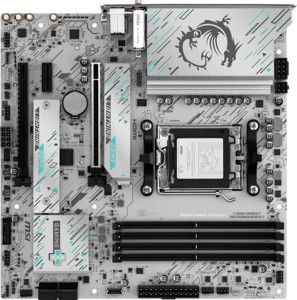
Asus TUF Gaming B850-BTF Wi-Fi W
MSI B850M Gaming Plus Wi-Fi

Asus TUF Gaming B850-BTF Wi-Fi W MSI B850M Gaming Plus Wi-Fi

Overview

Welcome to our detailed spec comparison between the Asus TUF Gaming B850-BTF Wi-Fi W and the MSI B850M Gaming Plus Wi-Fi — two B850 chipset motherboards targeting AMD AM5 builds. Both share a strong foundation with DDR5 memory support, Wi-Fi 7, and PCIe 5.0, yet they diverge notably in form factor, expansion capabilities, and port configuration. Read on to discover which board best suits your next build.

Common Features

  • Both boards use the AM5 CPU socket.
  • Both boards feature the B850 chipset.
  • Wi-Fi is supported on both products, covering Wi-Fi 4, Wi-Fi 5, Wi-Fi 6, Wi-Fi 6E, and Wi-Fi 7.
  • Bluetooth 5.4 is available on both products.
  • Both boards support HDMI 2.1 output.
  • Overclocking is supported on both products.
  • Both boards support a maximum of 256 GB of memory.
  • Both boards have 4 memory slots.
  • Both boards use DDR5 memory.
  • Both boards have 2 memory channels.
  • ECC memory is not supported on either product.
  • Both boards include 3 USB 3.2 Gen 1 ports via rear I/O (USB-A).
  • Neither board has USB 3.2 Gen 1 ports (USB-C) on the rear I/O.
  • Neither board includes USB 4 40 Gbps, USB 4 20 Gbps, Thunderbolt 4, or Thunderbolt 3 ports.
  • Both boards have a DisplayPort output.
  • Both boards provide 2 USB 3.2 Gen 1 ports through expansion headers.
  • Both boards provide 1 USB-C 3.2 Gen 2 port through expansion headers.
  • Both boards provide 4 USB 2.0 ports through expansion headers.
  • Both boards have 4 SATA 3 connectors and no SATA 2 connectors.
  • Neither board includes a U.2 socket or mSATA connector.
  • Both boards have 1 PCIe 5.0 x16 slot, 1 PCIe x1 slot, and no PCI, PCIe 2.0 x16, PCIe 3.0 x16, or PCIe x8 slots.
  • Both boards support 7.1 audio channels.
  • RAID 0, RAID 1, and RAID 10 are supported on both products.
  • RAID 0+1 is not supported on either product.

Main Differences

  • The form factor is ATX on Asus TUF Gaming B850-BTF Wi-Fi W and Micro-ATX on MSI B850M Gaming Plus Wi-Fi.
  • The board height is 244 mm on Asus TUF Gaming B850-BTF Wi-Fi W and 243.8 mm on MSI B850M Gaming Plus Wi-Fi.
  • The board width is 305 mm on Asus TUF Gaming B850-BTF Wi-Fi W and 243.8 mm on MSI B850M Gaming Plus Wi-Fi.
  • The maximum overclocked RAM speed is 8000 MHz on Asus TUF Gaming B850-BTF Wi-Fi W and 8200 MHz on MSI B850M Gaming Plus Wi-Fi.
  • USB 3.2 Gen 1 ports (USB-A) on the rear I/O number 4 on Asus TUF Gaming B850-BTF Wi-Fi W and 3 on MSI B850M Gaming Plus Wi-Fi.
  • USB 3.2 Gen 2 ports (USB-C) on the rear I/O are absent on Asus TUF Gaming B850-BTF Wi-Fi W but number 2 on MSI B850M Gaming Plus Wi-Fi.
  • USB 2.0 rear I/O ports number 2 on Asus TUF Gaming B850-BTF Wi-Fi W but are absent on MSI B850M Gaming Plus Wi-Fi.
  • A USB 3.2 Gen 2x2 port is present on Asus TUF Gaming B850-BTF Wi-Fi W but absent on MSI B850M Gaming Plus Wi-Fi.
  • Fan headers number 6 on Asus TUF Gaming B850-BTF Wi-Fi W and 5 on MSI B850M Gaming Plus Wi-Fi.
  • M.2 sockets number 3 on Asus TUF Gaming B850-BTF Wi-Fi W and 2 on MSI B850M Gaming Plus Wi-Fi.
  • A TPM connector is absent on Asus TUF Gaming B850-BTF Wi-Fi W but present on MSI B850M Gaming Plus Wi-Fi.
  • A PCIe 4.0 x16 slot is present on Asus TUF Gaming B850-BTF Wi-Fi W but absent on MSI B850M Gaming Plus Wi-Fi.
  • A PCIe x4 slot is absent on Asus TUF Gaming B850-BTF Wi-Fi W but present on MSI B850M Gaming Plus Wi-Fi.
  • An S/PDIF Out port is present on Asus TUF Gaming B850-BTF Wi-Fi W but absent on MSI B850M Gaming Plus Wi-Fi.
  • Audio connectors number 5 on Asus TUF Gaming B850-BTF Wi-Fi W and 3 on MSI B850M Gaming Plus Wi-Fi.
  • RAID 5 support is available on Asus TUF Gaming B850-BTF Wi-Fi W but not on MSI B850M Gaming Plus Wi-Fi.
Specs Comparison
Asus TUF Gaming B850-BTF Wi-Fi W

Asus TUF Gaming B850-BTF Wi-Fi W

MSI B850M Gaming Plus Wi-Fi

MSI B850M Gaming Plus Wi-Fi

General info:
CPU socket AM5 AM5
chipset B850 B850
form factor ATX Micro-ATX
release date May 2025 January 2025
supports Wi-Fi
Wi-Fi version Wi-Fi 4 (802.11n), Wi-Fi 5 (802.11ac), Wi-Fi 6 (802.11ax), Wi-Fi 6E (802.11ax), Wi-Fi 7 (802.11be) Wi-Fi 4 (802.11n), Wi-Fi 5 (802.11ac), Wi-Fi 6 (802.11ax), Wi-Fi 6E (802.11ax), Wi-Fi 7 (802.11be)
Has Bluetooth
Bluetooth version 5.4 5.4
HDMI version HDMI 2.1 HDMI 2.1
Easy to overclock
has RGB lighting
Easy to reset BIOS
Has dual BIOS
has aptX
CPU sockets 1 1
Has integrated graphics
warranty period 3 years 3 years
height 244 mm 243.8 mm
width 305 mm 243.8 mm
Has integrated CPU

Both the Asus TUF Gaming B850-BTF Wi-Fi W and the MSI B850M Gaming Plus Wi-Fi share the same foundational platform: the AM5 socket with a B850 chipset, making them equally capable of supporting the same generation of processors. They also match on connectivity, both offering Wi-Fi 7 (backwards-compatible down to Wi-Fi 4), Bluetooth 5.4, and HDMI 2.1, so neither board has an edge in wireless or display output. Quality-of-life features like dual BIOS, easy BIOS reset, overclocking support, and RGB lighting are present on both, as is a 3-year warranty.

The single meaningful differentiator in this group is form factor. The Asus ships as a full ATX board (305 × 244 mm), while the MSI is a Micro-ATX (243.8 × 243.8 mm). In practice, ATX gives more physical room for additional PCIe slots, M.2 connectors, and power circuitry spread across a larger PCB, and it requires a mid-tower or full-tower case. Micro-ATX fits in smaller enclosures, making it the better choice for compact builds, though it may offer fewer expansion slots by design.

For this spec group, neither board is objectively superior in features or capabilities — they are essentially tied on every shared specification. The decision comes down entirely to build size: choose the Asus TUF if you want an ATX chassis with more expansion headroom, or the MSI B850M if a smaller, space-efficient Micro-ATX build is the priority.

Memory:
maximum memory amount 256GB 256GB
overclocked RAM speed 8000 MHz 8200 MHz
memory slots 4 4
DDR memory version 5 5
memory channels 2 2
Supports ECC memory

On paper, the memory specifications of these two boards are nearly identical: both support DDR5 RAM across 4 slots in a dual-channel configuration, with a ceiling of 256GB total capacity. For the vast majority of users — even demanding workstation or gaming builds — 256GB is far beyond what will ever be populated, so this shared ceiling is essentially a non-factor in purchase decisions.

The only differentiator here is maximum overclocked RAM speed. The MSI B850M Gaming Plus Wi-Fi supports memory overclocking up to 8200 MHz, edging out the Asus TUF B850-BTF's ceiling of 8000 MHz. In practice, the gap of 200 MHz is marginal — at these frequencies, real-world performance differences in gaming or general productivity are negligible, and reaching either ceiling requires carefully selected, high-binned DDR5 kits that most users won't be running anyway.

For this spec group, the two boards are effectively tied. The MSI holds a narrow technical edge on peak overclocked frequency, but it is unlikely to translate into a perceptible advantage in any real-world workload. Neither board supports ECC memory, so users with error-correction requirements should look elsewhere regardless of which model they consider.

Ports:
USB 3.2 Gen 2 ports (USB-A) 3 3
USB 3.2 Gen 1 ports (USB-A) 4 3
USB 3.2 Gen 2 ports (USB-C) 0 2
USB 3.2 Gen 1 ports (USB-C) 0 0
USB 2.0 ports 2 0
USB 3.2 Gen 2x2 ports 1 0
USB 4 40Gbps ports 0 0
USB 4 20Gbps ports 0 0
Thunderbolt 4 ports 0 0
Thunderbolt 3 ports 0 0
has an HDMI output
DisplayPort outputs 1 1
RJ45 ports 1 1
Has USB Type-C
eSATA ports 0 0
DVI outputs 0 0
has a VGA connector
PS/2 ports 0 0

Video and networking outputs are a wash between these two boards — both offer HDMI, a DisplayPort, and a single RJ45 ethernet port. The real divergence lies in USB configuration. The Asus TUF B850-BTF leans heavily on USB-A, delivering a total of 7 Type-A ports across Gen 1 and Gen 2 speeds, plus a standout USB 3.2 Gen 2x2 port capable of 20 Gbps — useful for high-speed external SSDs or fast docking stations. However, it offers zero rear USB-C ports, which is a notable omission for a modern board.

The MSI B850M Gaming Plus Wi-Fi takes the opposite approach. It trades the Gen 2x2 port and some USB-A quantity for 2 USB 3.2 Gen 2 Type-C ports at 10 Gbps each, and drops legacy USB 2.0 entirely. This reflects a more forward-looking I/O philosophy — USB-C is increasingly the connector of choice for modern peripherals, external displays, and smartphones, making the MSI's rear panel feel more contemporary out of the box.

Which board has the edge depends on the user's peripheral ecosystem. The Asus wins for raw throughput thanks to its Gen 2x2 port, and offers more total USB-A connectivity for users with legacy devices. The MSI is the stronger pick for anyone whose workflow revolves around USB-C peripherals, given it provides two such ports where the Asus provides none. Neither board is strictly superior overall — they simply prioritize different connectivity profiles.

Connectors:
USB 3.2 Gen 1 ports (through expansion) 2 2
USB-C 3.2 Gen 2 ports (through expansion) 1 1
USB 2.0 ports (through expansion) 4 4
SATA 3 connectors 4 4
fan headers 6 5
USB 3.0 ports (through expansion) 2 2
M.2 sockets 3 2
Has TPM connector
U.2 sockets 0 0
Has mSATA connector
SATA 2 connectors 0 0

Internal expansion connectivity is largely consistent across both boards — identical SATA 3 counts (4 connectors), matching USB 2.0, USB 3.0, and USB-C internal headers, and no U.2 or mSATA sockets on either. For most mainstream builds, this shared foundation covers all the basics without compromise.

The two meaningful differences are M.2 sockets and fan headers. The Asus TUF B850-BTF offers 3 M.2 sockets versus the MSI's 2, which is a tangible advantage for storage-heavy builds — a third M.2 slot means room for an additional NVMe SSD without resorting to SATA drives or a PCIe adapter. The Asus also provides 6 fan headers to the MSI's 5, giving slightly more flexibility for complex cooling setups with multiple fans or pump headers in a larger ATX case. On the flip side, the MSI B850M Gaming Plus Wi-Fi includes a TPM connector, which the Asus lacks — relevant for users deploying hardware-based security, BitLocker encryption, or enterprise environments that require a discrete TPM module.

The Asus holds a clearer edge in this group for most users, thanks to the extra M.2 slot and additional fan header — both practically useful advantages in a gaming or content-creation build. The MSI's TPM connector is a meaningful differentiator only for a specific subset of users with security or compliance requirements; for everyone else, the Asus offers more internal expandability.

Expansion slots:
PCIe 4.0 x16 slots 1 0
PCIe 5.0 x16 slots 1 1
PCIe 3.0 x16 slots 0 0
PCIe x1 slots 1 1
PCI slots 0 0
PCIe 2.0 x16 slots 0 0
PCIe x4 slots 0 1
PCIe x8 slots 0 0

Both boards lead with a single PCIe 5.0 x16 slot — the primary GPU slot — ensuring neither compromises on bandwidth for a discrete graphics card. Beyond that shared anchor, their expansion philosophies diverge in a way that reflects their form factor differences. The Asus TUF B850-BTF adds a second full-bandwidth slot in the form of a PCIe 4.0 x16, which is well-suited for a second GPU, a high-end capture card, or a PCIe 4.0 NVMe add-in card. This makes the Asus a more versatile platform for multi-card or multi-device builds.

The MSI B850M Gaming Plus Wi-Fi, constrained by its Micro-ATX footprint, replaces that second x16 slot with a PCIe x4 slot instead. An x4 slot carries less bandwidth than a full x16 lane, but it remains perfectly adequate for storage expansion cards, 10GbE NICs, or USB expansion controllers — tasks where x4 bandwidth is not a bottleneck. Both boards also share a single PCIe x1 slot for low-bandwidth add-in cards.

The Asus holds a clear edge here for users who want maximum expansion flexibility — a second x16-width slot opens more high-bandwidth upgrade paths. The MSI's x4 slot is a practical solution within the Micro-ATX size constraints, but it cannot match the versatility of a full PCIe 4.0 x16 lane for demanding secondary cards.

Audio:
audio channels 7.1 7.1
Has S/PDIF Out port
audio connectors 5 3

Surround sound support is identical on paper — both boards deliver 7.1-channel audio, which is the standard ceiling for onboard audio solutions and sufficient for immersive gaming headsets or multi-speaker setups. Where they part ways is in how completely that capability is accessible at the rear I/O.

The Asus TUF B850-BTF provides 5 analog audio connectors, which is the full complement needed to physically drive a 7.1 surround speaker system through separate analog channels. It also includes an S/PDIF optical output, enabling a lossless digital audio signal to be passed directly to an external receiver, soundbar, or DAC — a valued feature for home theater integrations and audiophile setups. The MSI B850M Gaming Plus Wi-Fi, by contrast, offers only 3 analog connectors and no S/PDIF output. Three jacks cover the basics (line-in, line-out, mic) but are insufficient to run a full analog 7.1 speaker arrangement without an external audio device.

The Asus has a meaningful advantage in this group. Its richer analog connectivity and S/PDIF output make its 7.1 audio capability practically usable in more scenarios, while the MSI's 7.1 specification is effectively limited by fewer physical outputs. Users who rely solely on USB headsets or external DACs may not notice the difference, but for anyone routing audio through analog speakers or an optical-connected receiver, the Asus is the stronger choice.

Storage:
Supports RAID 1
Supports RAID 10 (1+0)
Supports RAID 5
Supports RAID 0
Supports RAID 0+1

RAID support is rarely a headline feature for consumer motherboards, but it matters significantly for users building NAS-adjacent workstations or redundant storage arrays. Both boards cover the most common configurations: RAID 0 for pure performance striping, RAID 1 for mirroring and data redundancy, and RAID 10 for a combination of both. For the majority of home and gaming users, these three modes represent everything they would realistically deploy.

The single differentiator is RAID 5 support, which the Asus TUF B850-BTF offers and the MSI B850M Gaming Plus Wi-Fi does not. RAID 5 distributes parity data across three or more drives, allowing the array to survive a single drive failure while using storage capacity more efficiently than RAID 1. It is a popular choice in prosumer and small business environments where balancing redundancy, read performance, and usable capacity across multiple drives is a priority.

For mainstream gaming or general-purpose builds, this distinction is largely academic — most users will never configure RAID 5. But for anyone planning a multi-drive storage array with fault tolerance beyond simple mirroring, the Asus holds a clear edge in this group by offering a broader and more flexible set of RAID options.

Comparison Summary & Verdict

Both boards deliver a solid AM5 platform with B850 chipset, Wi-Fi 7, DDR5 support up to 256 GB, and PCIe 5.0 — making either a capable foundation for a modern AMD build. However, their differences reveal distinct audiences. The Asus TUF Gaming B850-BTF Wi-Fi W stands out with its full ATX form factor, three M.2 sockets, an extra PCIe 4.0 x16 slot, more fan headers, a USB 3.2 Gen 2x2 port, S/PDIF audio output, and RAID 5 support — making it the stronger choice for enthusiasts who need maximum expandability and storage flexibility. The MSI B850M Gaming Plus Wi-Fi counters with a compact Micro-ATX footprint, a higher overclocked RAM ceiling of 8200 MHz, two rear USB-C Gen 2 ports, and a TPM connector, appealing to builders who prioritize a smaller chassis, better USB-C rear connectivity, and slightly faster memory tuning headroom.

Asus TUF Gaming B850-BTF Wi-Fi W
Buy Asus TUF Gaming B850-BTF Wi-Fi W if...

Buy the Asus TUF Gaming B850-BTF Wi-Fi W if you need a full ATX board with maximum storage and expansion options, including three M.2 sockets, an extra PCIe 4.0 x16 slot, S/PDIF audio output, and RAID 5 support.

MSI B850M Gaming Plus Wi-Fi
Buy MSI B850M Gaming Plus Wi-Fi if...

Buy the MSI B850M Gaming Plus Wi-Fi if you are building in a compact Micro-ATX case and want two rear USB-C Gen 2 ports, a TPM connector, and a slightly higher overclocked RAM speed ceiling of 8200 MHz.