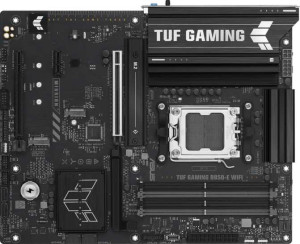
Asus TUF Gaming B850-E Wi-Fi
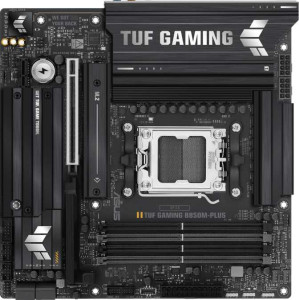
Asus TUF Gaming B850M-Plus

Asus TUF Gaming B850-E Wi-Fi Asus TUF Gaming B850M-Plus

Overview

When choosing between the Asus TUF Gaming B850-E Wi-Fi and the Asus TUF Gaming B850M-Plus, builders face a compelling decision shaped by form factor, connectivity, and expandability. Both boards share the AM5 socket and B850 chipset, yet they diverge meaningfully in areas like wireless connectivity, memory capacity, and rear-panel USB configuration. This comparison breaks down every key specification to help you find the board that best fits your build.

Common Features

  • Both products use the AM5 CPU socket.
  • Both products feature the B850 chipset.
  • Both products support HDMI 2.1.
  • Overclocking is supported on both products.
  • RGB lighting is present on both products.
  • Dual BIOS is available on both products.
  • Neither product has integrated graphics.
  • Both products have a single CPU socket.
  • Both products support DDR5 memory with 4 memory slots across 2 memory channels.
  • The maximum overclocked RAM speed is 8000 MHz on both products.
  • Neither product supports ECC memory.
  • Neither product has USB 3.2 Gen 1 USB-C ports on the rear panel.
  • Neither product has USB 4 40Gbps or USB 4 20Gbps ports.
  • Neither product has Thunderbolt 3 or Thunderbolt 4 ports.
  • Both products include one HDMI output and one DisplayPort output.
  • Both products have one RJ45 port.
  • Both products provide 2 USB 3.2 Gen 1 ports, 1 USB 3.2 Gen 2x2 port, and 4 USB 2.0 ports through expansion.
  • Both products include 4 SATA 3 connectors and 3 M.2 sockets.
  • Neither product has a TPM connector or any U.2 sockets.
  • Both products have 1 PCIe 5.0 x16 slot, 1 PCIe x1 slot, and no PCI, PCIe 2.0 x16, PCIe 3.0 x16, PCIe x4, or PCIe x8 slots.
  • Both products support 7.1 audio channels.
  • Both products support RAID 0, RAID 1, RAID 5, and RAID 10 (1+0), but neither supports RAID 0+1.

Main Differences

  • The form factor is ATX on Asus TUF Gaming B850-E Wi-Fi and Micro-ATX on Asus TUF Gaming B850M-Plus.
  • The width is 305 mm on Asus TUF Gaming B850-E Wi-Fi and 244 mm on Asus TUF Gaming B850M-Plus.
  • Wi-Fi support is present on Asus TUF Gaming B850-E Wi-Fi but not available on Asus TUF Gaming B850M-Plus.
  • Bluetooth support is present on Asus TUF Gaming B850-E Wi-Fi but not available on Asus TUF Gaming B850M-Plus.
  • Easy BIOS reset is available on Asus TUF Gaming B850-E Wi-Fi but not available on Asus TUF Gaming B850M-Plus.
  • The maximum memory amount is 256 GB on Asus TUF Gaming B850-E Wi-Fi and 192 GB on Asus TUF Gaming B850M-Plus.
  • USB 3.2 Gen 2 USB-A ports number 1 on Asus TUF Gaming B850-E Wi-Fi and 3 on Asus TUF Gaming B850M-Plus.
  • USB 3.2 Gen 1 USB-A ports number 3 on Asus TUF Gaming B850-E Wi-Fi and 4 on Asus TUF Gaming B850M-Plus.
  • A USB 3.2 Gen 2 USB-C port is present on Asus TUF Gaming B850-E Wi-Fi but not available on Asus TUF Gaming B850M-Plus.
  • USB 2.0 ports number 3 on Asus TUF Gaming B850-E Wi-Fi and 4 on Asus TUF Gaming B850M-Plus.
  • A USB 3.2 Gen 2x2 port is present on Asus TUF Gaming B850M-Plus but not available on Asus TUF Gaming B850-E Wi-Fi.
  • Fan headers number 6 on Asus TUF Gaming B850-E Wi-Fi and 5 on Asus TUF Gaming B850M-Plus.
  • A PCIe 4.0 x16 slot is present on Asus TUF Gaming B850-E Wi-Fi but not available on Asus TUF Gaming B850M-Plus.
  • An S/PDIF Out port is present on Asus TUF Gaming B850M-Plus but not available on Asus TUF Gaming B850-E Wi-Fi.
  • Audio connectors number 3 on Asus TUF Gaming B850-E Wi-Fi and 5 on Asus TUF Gaming B850M-Plus.
Specs Comparison
Asus TUF Gaming B850-E Wi-Fi

Asus TUF Gaming B850-E Wi-Fi

Asus TUF Gaming B850M-Plus

Asus TUF Gaming B850M-Plus

General info:
CPU socket AM5 AM5
chipset B850 B850
form factor ATX Micro-ATX
release date April 2025 January 2025
supports Wi-Fi
Has Bluetooth
HDMI version HDMI 2.1 HDMI 2.1
Easy to overclock
has RGB lighting
Easy to reset BIOS
Has dual BIOS
CPU sockets 1 1
Has integrated graphics
warranty period 3 years 3 years
height 244 mm 244 mm
width 305 mm 244 mm
Has integrated CPU

Both boards share the same AM5 socket, B850 chipset, and HDMI 2.1 output, meaning they target the same CPU generation and offer identical core platform capabilities. They also match on warranty length, dual BIOS support, RGB lighting, and overclocking accessibility — so neither board holds an advantage on those fronts.

The most significant divergence is form factor: the TUF Gaming B850-E Wi-Fi is a full ATX (305 × 244 mm), while the TUF Gaming B850M-Plus is Micro-ATX (244 × 244 mm). The smaller footprint of the B850M-Plus suits compact builds but typically means fewer expansion slots and less routing space. The B850-E also includes built-in Wi-Fi and Bluetooth, whereas the B850M-Plus has neither — a meaningful gap if wireless connectivity is needed, since adding it later requires a PCIe adapter or USB dongle. Additionally, the B850-E offers an easy BIOS reset mechanism that the B850M-Plus lacks, a convenience that matters during overclocking or recovery scenarios.

For users building a standard mid-tower or full-tower system who want wireless connectivity and more upgrade headroom, the B850-E Wi-Fi has a clear edge. The B850M-Plus is the rational choice only when a smaller chassis is the priority and wireless is handled externally — otherwise it concedes notable built-in features for no performance gain.

Memory:
maximum memory amount 256GB 192GB
overclocked RAM speed 8000 MHz 8000 MHz
memory slots 4 4
DDR memory version 5 5
memory channels 2 2
Supports ECC memory

On the fundamentals, these two boards are virtually identical: both run DDR5 memory across 4 slots in a dual-channel configuration, and both top out at the same overclocked speed of 8000 MHz. That means neither board has an edge in raw memory bandwidth or tuning ceiling for typical builds.

Where they diverge is maximum capacity. The B850-E Wi-Fi supports up to 256 GB of RAM, while the B850M-Plus caps at 192 GB. In practice, most gaming and consumer workloads will never approach either limit — but for users running memory-intensive workloads like large virtual machines, video editing with heavy proxy files, or professional simulation software, that 64 GB gap could eventually matter. It signals that the B850-E is engineered with more headroom for demanding use cases.

The verdict here leans toward the B850-E Wi-Fi, strictly on the strength of its higher memory ceiling. For everyday users the difference is academic, but anyone planning to maximize RAM capacity down the line will find the B850M-Plus hits a wall sooner.

Ports:
USB 3.2 Gen 2 ports (USB-A) 1 3
USB 3.2 Gen 1 ports (USB-A) 3 4
USB 3.2 Gen 2 ports (USB-C) 1 0
USB 3.2 Gen 1 ports (USB-C) 0 0
USB 2.0 ports 3 4
USB 3.2 Gen 2x2 ports 0 1
USB 4 40Gbps ports 0 0
USB 4 20Gbps ports 0 0
Thunderbolt 4 ports 0 0
Thunderbolt 3 ports 0 0
has an HDMI output
DisplayPort outputs 1 1
RJ45 ports 1 1
Has USB Type-C
eSATA ports 0 0
DVI outputs 0 0
has a VGA connector
PS/2 ports 0 0

Video and network connectivity is a draw — both boards offer HDMI, a DisplayPort output, and a single RJ45 ethernet port, so neither pulls ahead on display or wired networking capability. The real story is in the USB rear I/O, where the two boards take noticeably different approaches.

The B850M-Plus comes out ahead on sheer port count, offering more USB-A positions across both Gen 2 and Gen 1 speeds, plus a USB 3.2 Gen 2x2 port — the only one between the two — which doubles the bandwidth ceiling to 20 Gbps. That makes it particularly well-suited for high-speed external SSDs or fast docking stations. The B850-E Wi-Fi, by contrast, trades some of that USB-A density for a rear USB-C Gen 2 port, which is absent on the B850M-Plus. That single Type-C rear port matters for users with modern peripherals, smartphones, or accessories that expect it at the back panel rather than via a front-panel header.

Neither board dominates cleanly. Users who prioritize peak transfer speed and more rear USB-A ports will prefer the B850M-Plus, while those who need a rear USB-C connector for modern devices will find the B850-E Wi-Fi better equipped. It comes down to peripheral habits more than any objective performance gap.

Connectors:
USB 3.2 Gen 1 ports (through expansion) 2 2
USB 3.2 Gen 2x2 ports (through expansion) 1 1
USB 2.0 ports (through expansion) 4 4
SATA 3 connectors 4 4
fan headers 6 5
USB 3.0 ports (through expansion) 2 2
M.2 sockets 3 3
Has TPM connector
U.2 sockets 0 0
Has mSATA connector
SATA 2 connectors 0 0

Internal connectivity is remarkably consistent across these two boards. Both provide 3 M.2 sockets and 4 SATA 3 connectors, meaning storage expansion potential is identical — enough to satisfy even multi-drive builds combining fast NVMe SSDs with traditional storage. Header options for USB expansion are also a perfect match, so front-panel connectivity won't differ between the two.

The only tangible difference in this group is fan headers: the B850-E Wi-Fi offers 6 fan headers versus 5 on the B850M-Plus. That extra header is a genuine convenience for builders running larger cooling setups — think multi-radiator AIOs, additional case fans, or complex air-cooling configurations — eliminating the need for a fan splitter or hub in many scenarios.

Overall this group is nearly a tie, but the B850-E Wi-Fi holds a slim edge purely on thermal management flexibility. For compact Micro-ATX builds where the B850M-Plus lives, five headers will rarely feel limiting. In a larger ATX chassis, however, that sixth header on the B850-E is a practical quality-of-life advantage.

Expansion slots:
PCIe 4.0 x16 slots 1 0
PCIe 5.0 x16 slots 1 1
PCIe 3.0 x16 slots 0 0
PCIe x1 slots 1 1
PCI slots 0 0
PCIe 2.0 x16 slots 0 0
PCIe x4 slots 0 0
PCIe x8 slots 0 0

Both boards share a PCIe 5.0 x16 primary slot and a single PCIe x1 slot, so for the vast majority of users installing a single GPU and perhaps a small add-in card, the two platforms are functionally equivalent. PCIe 5.0 x16 ensures neither board will bottleneck current or near-future discrete graphics cards.

The meaningful differentiator is the B850-E Wi-Fi's additional PCIe 4.0 x16 slot — an advantage that stems directly from its larger ATX footprint. In practice this opens the door to a second GPU, a high-bandwidth capture card, a 10GbE network card, or other full-length PCIe devices without sacrificing the primary GPU slot. The B850M-Plus, with only one x16 slot, offers no such flexibility.

For single-GPU builds the two boards are tied on expansion slot capability. But anyone anticipating a multi-card or high-expansion setup will find the B850-E Wi-Fi holds a clear advantage here, simply by virtue of having that extra x16 lane available.

Audio:
audio channels 7.1 7.1
Has S/PDIF Out port
audio connectors 3 5

Surround sound support is identical — both boards deliver 7.1 channel audio, so neither has an edge in terms of the audio experience ceiling for home theater or gaming setups. The differences, however, lie in how that audio is accessed and routed.

The B850M-Plus offers 5 analog audio connectors versus just 3 on the B850-E Wi-Fi. More jacks mean more simultaneous analog connections — useful for users running a full 7.1 speaker array directly from the rear panel without an external interface. It also includes an S/PDIF optical output, which the B850-E Wi-Fi lacks entirely. S/PDIF matters for users routing audio to a dedicated AV receiver, soundbar, or DAC via optical cable — a lossless digital path that bypasses the motherboard's analog circuitry altogether.

Audio is a category where the B850M-Plus has a clear advantage, despite being the smaller board. Its combination of more analog jacks and an optical output gives it meaningfully broader compatibility with both analog speaker setups and digital home theater equipment — a somewhat unexpected win for the Micro-ATX option.

Storage:
Supports RAID 1
Supports RAID 10 (1+0)
Supports RAID 5
Supports RAID 0
Supports RAID 0+1

Storage redundancy and performance configurations are a perfect match between these two boards. Both support RAID 0, 1, 5, and 10, covering the full practical range of consumer and prosumer RAID needs — from pure striping for maximum throughput to mirroring and parity-based redundancy for data protection. Neither supports RAID 0+1, but that omission is identical and inconsequential given that RAID 10 achieves comparable results more efficiently.

This is a straightforward tie. No decision should be influenced by storage configuration capability, as both boards offer exactly the same options and the same limitations. Users building NAS-adjacent workstations, content creation rigs with redundant drives, or performance-tuned multi-drive arrays will find identical support on either platform.

Comparison Summary & Verdict

The Asus TUF Gaming B850-E Wi-Fi is the stronger choice for enthusiasts building a full-sized ATX system who need built-in Wi-Fi and Bluetooth, a higher memory ceiling of 256 GB, an extra PCIe 4.0 x16 slot for additional expansion cards, and an easy BIOS reset feature. The Asus TUF Gaming B850M-Plus, on the other hand, suits builders working within a compact Micro-ATX case who can live without wireless connectivity but want more USB-A ports on the rear panel, a USB 3.2 Gen 2x2 port, richer audio output with 5 connectors and an S/PDIF Out port, and a slightly lower cost footprint in a smaller chassis. Both boards are solid foundations for an AM5 DDR5 build with identical RAID, storage, and PCIe 5.0 support.

Asus TUF Gaming B850-E Wi-Fi
Buy Asus TUF Gaming B850-E Wi-Fi if...

Buy the Asus TUF Gaming B850-E Wi-Fi if you want built-in Wi-Fi and Bluetooth, a larger 256 GB memory ceiling, and the extra expandability of an ATX board with an additional PCIe 4.0 x16 slot.

Asus TUF Gaming B850M-Plus
Buy Asus TUF Gaming B850M-Plus if...

Buy the Asus TUF Gaming B850M-Plus if you are building in a compact Micro-ATX case and prioritize more rear USB-A ports, a USB 3.2 Gen 2x2 port, and richer onboard audio with an S/PDIF Out port over wireless connectivity.