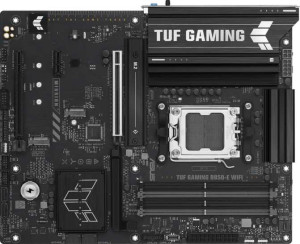
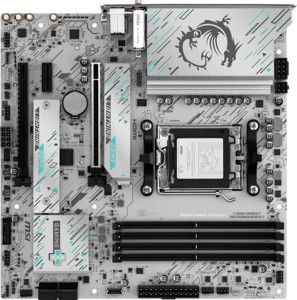
Both the Asus TUF Gaming B850-E Wi-Fi and the MSI B850M Gaming Plus Wi-Fi share the same foundational platform: the AM5 socket with a B850 chipset, making them equally capable as a base for current AMD builds. They also match on several convenience and quality-of-life features — both offer dual BIOS, easy BIOS reset, RGB lighting, and overclocking support, along with identical HDMI 2.1 output and a 3-year warranty. For a buyer comparing these two on paper fundamentals alone, the shared feature set is strong on both sides.
The most meaningful divergence lies in form factor and wireless connectivity. The Asus ships as a full ATX board (305 × 244 mm), while the MSI is a compact Micro-ATX (243.8 × 243.8 mm) — a significant size difference that dictates case compatibility and available expansion slots. If you need a smaller build or a tighter chassis, the MSI is the only option here. On wireless, the MSI edges ahead with support for Wi-Fi 7 (802.11be), whereas the Asus tops out at Wi-Fi 6E. Wi-Fi 7 delivers substantially higher theoretical throughput and lower latency — real-world benefits that matter most if you have a Wi-Fi 7 router or plan to upgrade to one. The MSI also carries a slightly newer Bluetooth 5.4 versus the Asus's 5.3, a minor but forward-looking improvement in connection stability and direction-finding.
On general specs for this group, the MSI B850M Gaming Plus Wi-Fi holds a clear edge: it offers more advanced wireless with Wi-Fi 7 and Bluetooth 5.4 in a compact footprint, making it the stronger pick for small-form-factor builds or anyone who values cutting-edge connectivity. The Asus TUF Gaming B850-E Wi-Fi is the right choice only if you specifically need the larger ATX layout for additional expansion room — its wireless stack, while capable, is one generation behind.