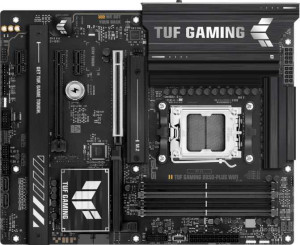
Asus TUF Gaming B850-Plus WiFi
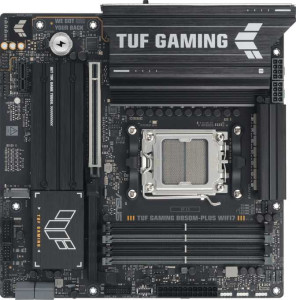
Asus TUF Gaming B850M-Plus Wi-Fi7

Asus TUF Gaming B850-Plus WiFi Asus TUF Gaming B850M-Plus Wi-Fi7

Overview

Welcome to our in-depth specification comparison between the Asus TUF Gaming B850-Plus WiFi and the Asus TUF Gaming B850M-Plus Wi-Fi7. Both motherboards share the same AM5 socket and B850 chipset, yet they diverge in meaningful ways across form factor, memory capacity, expansion slots, and board-level convenience features. Whether you are planning a compact build or a full-sized gaming rig, understanding these distinctions will help you make the right choice for your setup.

Common Features

  • Both products use the AM5 CPU socket.
  • Both products feature the B850 chipset.
  • Wi-Fi is supported on both products.
  • Both products support Wi-Fi 4 (802.11n), Wi-Fi 5 (802.11ac), Wi-Fi 6 (802.11ax), Wi-Fi 6E (802.11ax), and Wi-Fi 7 (802.11be).
  • Bluetooth is available on both products, with version 5.4.
  • Both products include an HDMI 2.1 port.
  • Overclocking is supported on both products.
  • Both products support overclocked RAM speeds up to 8000 MHz.
  • Both products have 4 memory slots.
  • Both products use DDR5 memory.
  • Both products support 2 memory channels.
  • ECC memory is not supported on either product.
  • Both products have 3 USB 3.2 Gen 2 ports (USB-A), 4 USB 3.2 Gen 1 ports (USB-A), and 1 USB 3.2 Gen 2x2 port.
  • USB 3.2 Gen 2 (USB-C), USB 3.2 Gen 1 (USB-C), USB 4 40Gbps, USB 4 20Gbps, and Thunderbolt 4 ports are not available on either product.
  • Both products provide 2 USB 3.2 Gen 1 ports and 1 USB-C 3.2 Gen 2 port through expansion.
  • Both products have 4 SATA 3 connectors and 3 M.2 sockets.
  • A TPM connector is not present on either product.
  • mSATA and U.2 connectors are not available on either product.
  • Both products feature 1 PCIe 5.0 x16 slot, with no PCIe 3.0 x16, PCIe 2.0 x16, PCIe x4, PCIe x8, or PCI slots.
  • Both products have a 120 dB signal-to-noise ratio (DAC) and support 7.1 audio channels.
  • An S/PDIF Out port is not present on either product.
  • Both products support RAID 0, RAID 1, RAID 5, and RAID 10 (1+0), but neither supports RAID 0+1.

Main Differences

  • The form factor is ATX on Asus TUF Gaming B850-Plus WiFi and Micro-ATX on Asus TUF Gaming B850M-Plus Wi-Fi7.
  • The width is 305 mm on Asus TUF Gaming B850-Plus WiFi and 244 mm on Asus TUF Gaming B850M-Plus Wi-Fi7.
  • Easy BIOS reset is available on Asus TUF Gaming B850M-Plus Wi-Fi7 but not on Asus TUF Gaming B850-Plus WiFi.
  • The maximum memory amount is 192 GB on Asus TUF Gaming B850-Plus WiFi and 256 GB on Asus TUF Gaming B850M-Plus Wi-Fi7.
  • USB 2.0 ports (rear I/O) total 2 on Asus TUF Gaming B850-Plus WiFi and 4 on Asus TUF Gaming B850M-Plus Wi-Fi7.
  • USB 2.0 ports through expansion total 4 on Asus TUF Gaming B850-Plus WiFi and 3 on Asus TUF Gaming B850M-Plus Wi-Fi7.
  • Fan headers total 6 on Asus TUF Gaming B850-Plus WiFi and 5 on Asus TUF Gaming B850M-Plus Wi-Fi7.
  • PCIe 4.0 x16 slots total 1 on Asus TUF Gaming B850-Plus WiFi and 0 on Asus TUF Gaming B850M-Plus Wi-Fi7.
  • PCIe x1 slots total 2 on Asus TUF Gaming B850-Plus WiFi and 1 on Asus TUF Gaming B850M-Plus Wi-Fi7.
  • Audio connectors total 5 on Asus TUF Gaming B850-Plus WiFi and 3 on Asus TUF Gaming B850M-Plus Wi-Fi7.
Specs Comparison
Asus TUF Gaming B850-Plus WiFi

Asus TUF Gaming B850-Plus WiFi

Asus TUF Gaming B850M-Plus Wi-Fi7

Asus TUF Gaming B850M-Plus Wi-Fi7

General info:
CPU socket AM5 AM5
chipset B850 B850
form factor ATX Micro-ATX
release date January 2025 July 2025
supports Wi-Fi
Wi-Fi version Wi-Fi 4 (802.11n), Wi-Fi 5 (802.11ac), Wi-Fi 6 (802.11ax), Wi-Fi 6E (802.11ax), Wi-Fi 7 (802.11be) Wi-Fi 4 (802.11n), Wi-Fi 5 (802.11ac), Wi-Fi 6 (802.11ax), Wi-Fi 6E (802.11ax), Wi-Fi 7 (802.11be)
Has Bluetooth
Bluetooth version 5.4 5.4
HDMI version HDMI 2.1 HDMI 2.1
Easy to overclock
has RGB lighting
Easy to reset BIOS
Has dual BIOS
has aptX
CPU sockets 1 1
Has integrated graphics
warranty period 3 years 3 years
height 244 mm 244 mm
width 305 mm 244 mm
Has integrated CPU

At their core, both boards share the same AM5 socket and B850 chipset, meaning they target identical CPU compatibility and deliver the same overclocking headroom. Connectivity is also a wash: both include Wi-Fi 7 (802.11be) with full backwards compatibility, Bluetooth 5.4, and HDMI 2.1, so neither board holds an edge in wireless or display output.

The defining difference between these two boards is form factor. The TUF Gaming B850-Plus WiFi is a full ATX board at 305 mm wide, while the B850M-Plus Wi-Fi 7 is a Micro-ATX at 244 mm wide — identical in height but significantly narrower. In practice, this means the ATX variant fits only in mid-tower or larger cases and typically offers more PCIe and RAM slots, while the Micro-ATX suits compact or budget builds where case space is limited. A secondary but meaningful difference is BIOS recovery: the B850M-Plus supports easy BIOS reset, while the B850-Plus does not — a genuine convenience advantage for builders who tinker with settings frequently and want a quick fallback. Both share dual BIOS, which provides a hardware-level safety net either way.

For the general info group, the two boards are broadly matched in platform and connectivity fundamentals. If your build demands a larger chassis with room to expand, the ATX B850-Plus WiFi is the natural pick. If you are working with a compact case or simply want the added convenience of easy BIOS reset, the Micro-ATX B850M-Plus Wi-Fi 7 has a slight practical edge — with no penalty in wireless capability or overclocking support.

Memory:
maximum memory amount 192GB 256GB
overclocked RAM speed 8000 MHz 8000 MHz
memory slots 4 4
DDR memory version 5 5
memory channels 2 2
Supports ECC memory

On paper, the memory specifications of these two boards look nearly identical — both run DDR5 across 4 slots in a dual-channel configuration, and both top out at the same overclocked speed of 8000 MHz. That shared ceiling matters: it means neither board constrains enthusiasts chasing high-frequency kits, and real-world bandwidth and latency performance will be equivalent given the same RAM installed.

The one meaningful divergence is maximum supported capacity. The B850-Plus WiFi caps at 192 GB, while the B850M-Plus Wi-Fi 7 supports up to 256 GB. For most gaming and mainstream workstation builds, 192 GB is a non-issue — few consumer workloads approach even a fraction of that. However, for users running memory-hungry professional applications such as large virtual machines, video editing with heavy caching, or in-memory databases, that extra 64 GB headroom on the Micro-ATX board is a genuine long-term advantage that is worth noting.

The B850M-Plus Wi-Fi 7 holds a clear edge in this group purely on capacity ceiling. What makes it notable is the context: a Micro-ATX board outpacing its larger ATX sibling in maximum RAM support is unusual, and for workloads that can actually exploit that headroom, the compact board becomes the more future-proof choice. For everyone else, the two boards are functionally tied on memory.

Ports:
USB 3.2 Gen 2 ports (USB-A) 3 3
USB 3.2 Gen 1 ports (USB-A) 4 4
USB 3.2 Gen 2 ports (USB-C) 0 0
USB 3.2 Gen 1 ports (USB-C) 0 0
USB 2.0 ports 2 4
USB 3.2 Gen 2x2 ports 1 1
USB 4 40Gbps ports 0 0
USB 4 20Gbps ports 0 0
Thunderbolt 4 ports 0 0
Thunderbolt 3 ports 0 0
has an HDMI output
DisplayPort outputs 1 1
RJ45 ports 1 1
Has USB Type-C
eSATA ports 0 0
DVI outputs 0 0
has a VGA connector
PS/2 ports 0 0

Across the high-speed USB lineup, these two boards are essentially mirrors of each other: both offer 3x USB 3.2 Gen 2 (10 Gbps) Type-A ports, 4x USB 3.2 Gen 1 (5 Gbps) Type-A ports, and a single USB 3.2 Gen 2x2 (20 Gbps) port — the latter being particularly useful for fast external SSDs. Display output is also identical, with one HDMI and one DisplayPort, and both include a single RJ45 ethernet jack.

The only differentiator in this group is the USB 2.0 port count. The B850M-Plus Wi-Fi 7 provides 4 USB 2.0 ports versus just 2 on the B850-Plus WiFi. While USB 2.0 is not relevant for storage or high-bandwidth peripherals, it remains the standard connection for keyboards, mice, headset dongles, and other low-speed devices that occupy ports permanently. Having twice as many of these on the Micro-ATX board reduces the likelihood of running out of slots for everyday peripherals — a practical advantage, especially in builds where front-panel headers may also compete for USB allocation.

Neither board features USB 4 or Thunderbolt, so both sit at the same ceiling for ultra-high-speed connectivity. Overall, the B850M-Plus Wi-Fi 7 claims a narrow edge here by offering more USB 2.0 ports, which has genuine day-to-day relevance. For users with few legacy peripherals, however, this distinction is minor enough that the two boards are effectively tied in real-world port usability.

Connectors:
USB 3.2 Gen 1 ports (through expansion) 2 2
USB-C 3.2 Gen 2 ports (through expansion) 1 1
USB 2.0 ports (through expansion) 4 3
SATA 3 connectors 4 4
fan headers 6 5
USB 3.0 ports (through expansion) 2 2
M.2 sockets 3 3
Has TPM connector
U.2 sockets 0 0
Has mSATA connector
SATA 2 connectors 0 0

Internal connectors tell a lot about how a board handles expansion and thermal management, and here the two boards are largely in lockstep. Both provide 3 M.2 sockets for NVMe storage, 4 SATA 3 connectors for traditional drives, and identical internal USB expansion headers including a USB-C 3.2 Gen 2 front-panel connector — a feature increasingly important for modern cases with front USB-C ports.

Two small but practical differences emerge on closer inspection. The B850-Plus WiFi includes 6 fan headers versus 5 on the B850M-Plus Wi-Fi 7, and also offers one additional internal USB 2.0 expansion port (4 vs 3). The fan header gap is the more consequential of the two: in a full ATX build where users are more likely to run complex cooling setups — multiple case fans, a CPU cooler, and potentially additional radiator fans — that extra header removes the need for a fan hub. On the compact Micro-ATX board, five headers will still satisfy the majority of builds given typical case sizes.

The B850-Plus WiFi takes a clear, if modest, edge in this group. The additional fan header is a genuine convenience for builders prioritizing thermal control in larger chassis, which aligns naturally with its ATX form factor. Neither board is lacking in storage connectivity, so for users whose cooling setup stays within five fans, the two boards are functionally equivalent here.

Expansion slots:
PCIe 4.0 x16 slots 1 0
PCIe 5.0 x16 slots 1 1
PCIe 3.0 x16 slots 0 0
PCIe x1 slots 2 1
PCI slots 0 0
PCIe 2.0 x16 slots 0 0
PCIe x4 slots 0 0
PCIe x8 slots 0 0

Both boards lead with a PCIe 5.0 x16 slot for the primary GPU, which is the right call for a platform targeting current and next-generation graphics cards. At this level, GPU bandwidth is not a bottleneck, and users on either board will see identical graphics performance from the same card.

Where the ATX board pulls ahead is in secondary expansion. The B850-Plus WiFi adds a PCIe 4.0 x16 slot — a meaningful slot for a second GPU, a high-bandwidth capture card, or a PCIe RAID controller — plus 2 PCIe x1 slots for smaller add-in cards like sound cards or network adapters. The B850M-Plus Wi-Fi 7, constrained by its Micro-ATX footprint, offers only 1 PCIe x1 slot and no secondary x16 slot. This is a direct consequence of the smaller PCB: there is simply less physical space to accommodate additional slot routing.

The B850-Plus WiFi has a clear advantage here, and it matters most for builders who plan to populate their system beyond a single GPU — whether that means multi-card compute workloads, dedicated audio hardware, or future expansion. For single-GPU gaming builds, however, both boards are functionally equivalent, since the primary PCIe 5.0 x16 slot is all that gets used.

Audio:
Signal-to-Noise ratio (DAC) 120 dB 120 dB
audio channels 7.1 7.1
Has S/PDIF Out port
audio connectors 5 3

Audio quality is a tie between these two boards. Both deliver a 120 dB signal-to-noise ratio on the DAC and support 7.1 surround sound — a solid specification for onboard audio that will satisfy most gamers and casual listeners without requiring a dedicated sound card.

The practical divergence comes down to analog output flexibility. The B850-Plus WiFi provides 5 audio connectors, while the B850M-Plus Wi-Fi 7 offers only 3. More rear panel audio jacks means the ATX board can simultaneously accommodate a fuller analog speaker setup — running front, rear, side, and center/subwoofer channels through dedicated plugs — which is directly relevant to users with multi-speaker desktop surround systems. With just 3 jacks, the Micro-ATX board covers the essentials (typically line-out, mic-in, and a shared line) but limits true analog multi-channel configurations.

Neither board includes S/PDIF output, so users dependent on optical digital audio for an external receiver or DAC will need to look elsewhere regardless of which board they choose. Within the provided specs, the B850-Plus WiFi holds a clear edge for users with analog surround setups, while for anyone using headphones or a simple stereo configuration, both boards are equivalent in what actually matters — the 120 dB SNR audio quality itself.

Storage:
Supports RAID 1
Supports RAID 10 (1+0)
Supports RAID 5
Supports RAID 0
Supports RAID 0+1

Storage redundancy support is identical across both boards. Each one covers the most widely used RAID configurations: RAID 0 for striped performance, RAID 1 for mirroring and data protection, RAID 5 for distributed parity across three or more drives, and RAID 10 for the combined benefits of striping and redundancy. Neither board supports RAID 0+1, though this omission is inconsequential in practice — RAID 10 achieves a functionally equivalent result and is the more commonly recommended configuration anyway.

This is a clean tie. Users planning a redundant NAS-style setup, a performance-oriented striped array, or a fault-tolerant multi-drive configuration will find no reason to choose one board over the other based on storage spec alone. The decision remains entirely in the hands of the other spec groups already analyzed.

Comparison Summary & Verdict

After examining the full specification set, both boards are strong contenders built on the same B850 foundation with identical Wi-Fi 7, Bluetooth 5.4, DDR5, and PCIe 5.0 support. The Asus TUF Gaming B850-Plus WiFi stands out with its ATX form factor, an additional PCIe 4.0 x16 slot, more PCIe x1 slots, 6 fan headers, and 5 audio connectors, making it the better fit for users who want maximum expandability and a richer audio setup. The Asus TUF Gaming B850M-Plus Wi-Fi7, on the other hand, offers a higher maximum memory capacity of 256 GB, a convenient easy BIOS reset feature, and a compact Micro-ATX footprint, appealing to builders who prioritize a smaller chassis, more RAM headroom, and greater ease of maintenance. Neither board is objectively superior; the right choice depends entirely on your case size, expansion needs, and workflow priorities.

Asus TUF Gaming B850-Plus WiFi
Buy Asus TUF Gaming B850-Plus WiFi if...

Buy the Asus TUF Gaming B850-Plus WiFi if you need an ATX board with more PCIe expansion slots, additional fan headers, and a richer set of audio connectors for a fully-featured full-tower build.

Asus TUF Gaming B850M-Plus Wi-Fi7
Buy Asus TUF Gaming B850M-Plus Wi-Fi7 if...

Buy the Asus TUF Gaming B850M-Plus Wi-Fi7 if you want a compact Micro-ATX board that supports up to 256 GB of RAM and includes an easy BIOS reset feature for added convenience.