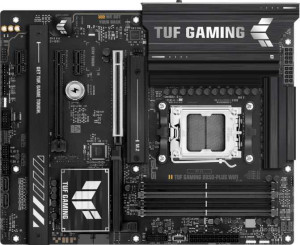
Asus TUF Gaming B850-Plus WiFi
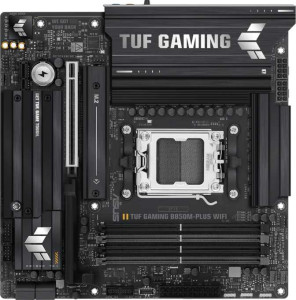
Asus TUF Gaming B850M-Plus WiFi

Asus TUF Gaming B850-Plus WiFi Asus TUF Gaming B850M-Plus WiFi

Overview

Choosing between the Asus TUF Gaming B850-Plus WiFi and the Asus TUF Gaming B850M-Plus WiFi means weighing more than just size. Both motherboards are built around the AM5 socket and B850 chipset, sharing strong foundations in DDR5 memory support, robust RAID configurations, and solid connectivity. Yet they diverge meaningfully on form factor, wireless standards, expansion slot availability, and audio output — key battlegrounds that could define which board fits your next build perfectly.

Common Features

  • Both products use the AM5 CPU socket.
  • Both products feature the B850 chipset.
  • Wi-Fi support is available on both products.
  • Bluetooth is present on both products.
  • Both products include HDMI 2.1.
  • Both products support overclocking.
  • RGB lighting is present on both products.
  • Easy BIOS reset is not available on either product.
  • Both products support a maximum memory amount of 192GB.
  • Both products support an overclocked RAM speed of up to 8000 MHz.
  • Both products have 4 memory slots and 2 memory channels.
  • Both products use DDR5 memory.
  • ECC memory is not supported on either product.
  • Both products have 3 USB 3.2 Gen 2 USB-A ports and 4 USB 3.2 Gen 1 USB-A ports.
  • Both products feature 1 USB 3.2 Gen 2x2 port.
  • Thunderbolt 4 is not available on either product.
  • Both products have 4 SATA 3 connectors and 3 M.2 sockets.
  • Both products feature 1 PCIe 5.0 x16 slot.
  • Both products deliver 7.1 audio channels with a 120 dB signal-to-noise ratio and 5 audio connectors.
  • Both products support RAID 0, RAID 1, RAID 5, and RAID 10, but neither supports RAID 0+1.

Main Differences

  • The form factor is ATX on Asus TUF Gaming B850-Plus WiFi and Micro-ATX on Asus TUF Gaming B850M-Plus WiFi.
  • Wi-Fi 7 (802.11be) support is present on Asus TUF Gaming B850-Plus WiFi but not available on Asus TUF Gaming B850M-Plus WiFi.
  • The Bluetooth version is 5.4 on Asus TUF Gaming B850-Plus WiFi and 5.3 on Asus TUF Gaming B850M-Plus WiFi.
  • The board width is 305 mm on Asus TUF Gaming B850-Plus WiFi and 244 mm on Asus TUF Gaming B850M-Plus WiFi.
  • There are 2 USB 2.0 ports on Asus TUF Gaming B850-Plus WiFi and 4 USB 2.0 ports on Asus TUF Gaming B850M-Plus WiFi.
  • There are 6 fan headers on Asus TUF Gaming B850-Plus WiFi and 5 fan headers on Asus TUF Gaming B850M-Plus WiFi.
  • There is 1 PCIe 4.0 x16 slot on Asus TUF Gaming B850-Plus WiFi and no PCIe 4.0 x16 slot on Asus TUF Gaming B850M-Plus WiFi.
  • There are 2 PCIe x1 slots on Asus TUF Gaming B850-Plus WiFi and 1 PCIe x1 slot on Asus TUF Gaming B850M-Plus WiFi.
  • An S/PDIF Out port is present on Asus TUF Gaming B850M-Plus WiFi but not available on Asus TUF Gaming B850-Plus WiFi.
Specs Comparison
Asus TUF Gaming B850-Plus WiFi

Asus TUF Gaming B850-Plus WiFi

Asus TUF Gaming B850M-Plus WiFi

Asus TUF Gaming B850M-Plus WiFi

General info:
CPU socket AM5 AM5
chipset B850 B850
form factor ATX Micro-ATX
release date January 2025 January 2025
supports Wi-Fi
Wi-Fi version Wi-Fi 4 (802.11n), Wi-Fi 5 (802.11ac), Wi-Fi 6 (802.11ax), Wi-Fi 6E (802.11ax), Wi-Fi 7 (802.11be) Wi-Fi 4 (802.11n), Wi-Fi 5 (802.11ac), Wi-Fi 6 (802.11ax), Wi-Fi 6E (802.11ax)
Has Bluetooth
Bluetooth version 5.4 5.3
HDMI version HDMI 2.1 HDMI 2.1
Easy to overclock
has RGB lighting
Easy to reset BIOS
Has dual BIOS
has aptX
CPU sockets 1 1
Has integrated graphics
warranty period 3 years 3 years
height 244 mm 244 mm
width 305 mm 244 mm
Has integrated CPU

Both the Asus TUF Gaming B850-Plus WiFi and the Asus TUF Gaming B850M-Plus WiFi share the same foundation: an AM5 socket with a B850 chipset, dual BIOS, RGB lighting, HDMI 2.1, and a 3-year warranty. For day-to-day use, this means both boards are equally capable as a platform base, support the same CPU lineup, and offer the same video output quality and reliability features.

The most decisive split between the two is form factor. The B850-Plus is a full ATX board (305 mm wide), while the B850M-Plus is Micro-ATX (244 mm wide), despite sharing the same 244 mm height. In practice, the ATX board fits only in mid-tower or full-tower cases, while the Micro-ATX opens up smaller, more compact builds. If case size is a constraint, the B850M-Plus is the only viable option here. The wireless stack also diverges: the B850-Plus supports Wi-Fi 7 (802.11be) and Bluetooth 5.4, whereas the B850M-Plus tops out at Wi-Fi 6E and Bluetooth 5.3. Wi-Fi 7 delivers significantly higher theoretical throughput and lower latency on compatible routers, and Bluetooth 5.4 brings minor stability and energy efficiency improvements over 5.3.

The B850-Plus WiFi has a clear edge in wireless connectivity thanks to Wi-Fi 7 and the newer Bluetooth version — meaningful for users with a modern router or many wireless peripherals. However, if you are building in a compact case or do not yet own a Wi-Fi 7 router, the B850M-Plus WiFi is the more practical pick, sacrificing only future-proofing on the wireless side in exchange for a smaller footprint.
Memory:
maximum memory amount 192GB 192GB
overclocked RAM speed 8000 MHz 8000 MHz
memory slots 4 4
DDR memory version 5 5
memory channels 2 2
Supports ECC memory

The memory specifications for the Asus TUF Gaming B850-Plus WiFi and the Asus TUF Gaming B850M-Plus WiFi are identical. Both motherboards support a maximum memory amount of 192GB and have 4 memory slots. They both also support DDR5 memory with a maximum overclocked RAM speed of 8000 MHz and feature dual memory channels. Neither model supports ECC memory.

With matching memory capabilities, users can expect similar performance when it comes to memory configuration and capacity on both motherboards.

Ports:
USB 3.2 Gen 2 ports (USB-A) 3 3
USB 3.2 Gen 1 ports (USB-A) 4 4
USB 3.2 Gen 2 ports (USB-C) 0 0
USB 3.2 Gen 1 ports (USB-C) 0 0
USB 2.0 ports 2 4
USB 3.2 Gen 2x2 ports 1 1
USB 4 40Gbps ports 0 0
USB 4 20Gbps ports 0 0
Thunderbolt 4 ports 0 0
Thunderbolt 3 ports 0 0
has an HDMI output
DisplayPort outputs 1 1
RJ45 ports 1 1
Has USB Type-C
eSATA ports 0 0
DVI outputs 0 0
has a VGA connector
PS/2 ports 0 0

The Asus TUF Gaming B850-Plus WiFi and the Asus TUF Gaming B850M-Plus WiFi share many similarities when it comes to their port configurations, though there are a few small differences. Both motherboards offer 3 USB 3.2 Gen 2 (USB-A) ports, 4 USB 3.2 Gen 1 (USB-A) ports, 1 USB 3.2 Gen 2x2 port, and 1 DisplayPort output. They also both feature HDMI output, 1 RJ45 port, and a USB Type-C port. Neither motherboard includes any USB 4 or Thunderbolt ports, nor do they offer eSATA, DVI, or VGA connectors.

The main difference between the two products is in the number of USB 2.0 ports. The B850-Plus WiFi has 2 USB 2.0 ports, while the B850M-Plus WiFi has 4 USB 2.0 ports. Otherwise, the port configurations are identical, including the absence of PS/2 ports and the lack of VGA connectors on both models.

In summary, both motherboards offer the same range of modern connectivity options, with the B850M-Plus WiFi having a slight edge in the number of USB 2.0 ports.

Connectors:
USB 3.2 Gen 1 ports (through expansion) 2 2
USB 2.0 ports (through expansion) 4 4
SATA 3 connectors 4 4
fan headers 6 5
USB 3.0 ports (through expansion) 2 2
M.2 sockets 3 3
Has TPM connector
U.2 sockets 0 0
Has mSATA connector
SATA 2 connectors 0 0

The Asus TUF Gaming B850-Plus WiFi and the Asus TUF Gaming B850M-Plus WiFi are quite similar in terms of connectors, with only a small difference between them. Both motherboards offer 2 USB 3.2 Gen 1 ports (through expansion), 4 USB 2.0 ports (through expansion), and 2 USB 3.0 ports (through expansion). They also feature 4 SATA 3 connectors and 3 M.2 sockets, with no U.2 or mSATA connectors available on either model.

The key distinction is in the number of fan headers: the B850-Plus WiFi has 6 fan headers, while the B850M-Plus WiFi has 5 fan headers. Additionally, neither motherboard includes a TPM connector.

In conclusion, the main difference between these two models lies in the number of fan headers, with the B850-Plus WiFi providing one additional header for greater cooling expansion.

Expansion slots:
PCIe 4.0 x16 slots 1 0
PCIe 5.0 x16 slots 1 1
PCIe 3.0 x16 slots 0 0
PCIe x1 slots 2 1
PCI slots 0 0
PCIe 2.0 x16 slots 0 0
PCIe x4 slots 0 0
PCIe x8 slots 0 0

The expansion slot configurations of the Asus TUF Gaming B850-Plus WiFi and the Asus TUF Gaming B850M-Plus WiFi show some key differences in the types of PCIe slots available. The B850-Plus WiFi has 1 PCIe 4.0 x16 slot and 1 PCIe 5.0 x16 slot, along with 2 PCIe x1 slots. In contrast, the B850M-Plus WiFi has 1 PCIe 5.0 x16 slot but no PCIe 4.0 x16 slot, and it includes only 1 PCIe x1 slot.

Neither motherboard features any PCI slots, PCIe 2.0 x16 slots, PCIe x4 slots, or PCIe x8 slots, and both models have no PCIe 3.0 x16 slots. The B850-Plus WiFi stands out with its additional PCIe 4.0 x16 slot, offering a bit more flexibility for expansion.

In summary, the main difference between these two motherboards is the extra PCIe 4.0 x16 slot available on the B850-Plus WiFi, which provides more options for users who need additional high-speed expansion slots.

Audio:
Signal-to-Noise ratio (DAC) 120 dB 120 dB
audio channels 7.1 7.1
Has S/PDIF Out port
audio connectors 5 5

Both the Asus TUF Gaming B850-Plus WiFi and the Asus TUF Gaming B850M-Plus WiFi have the same high-quality audio specifications, with both offering a signal-to-noise ratio (DAC) of 120 dB and supporting 7.1 audio channels. They also each have 5 audio connectors, providing a solid range of options for audio setups.

The key difference lies in the presence of an S/PDIF Out port: the B850M-Plus WiFi includes this feature, while the B850-Plus WiFi does not.

In summary, the main difference between the two models is the inclusion of an S/PDIF Out port on the B850M-Plus WiFi, which can be useful for digital audio output to external devices.

Storage:
Supports RAID 1
Supports RAID 10 (1+0)
Supports RAID 5
Supports RAID 0
Supports RAID 0+1

The Asus TUF Gaming B850-Plus WiFi and the Asus TUF Gaming B850M-Plus WiFi offer identical storage RAID support options. Both motherboards support RAID 1, RAID 10 (1+0), and RAID 5, providing flexibility for various storage configurations. Neither model supports RAID 0+1.

With the same RAID capabilities, both motherboards offer equivalent storage options for users looking to set up redundant or high-performance disk arrays.

Comparison Summary & Verdict

Both the Asus TUF Gaming B850-Plus WiFi and Asus TUF Gaming B850M-Plus WiFi deliver an impressive shared core: AM5 compatibility, DDR5 memory up to 192GB at 8000 MHz, and comprehensive RAID and storage options. The differences, however, are meaningful. The Asus TUF Gaming B850-Plus WiFi suits builders who demand maximum expandability — its ATX footprint, additional PCIe 4.0 x16 slot, extra PCIe x1 slot, six fan headers, and cutting-edge Wi-Fi 7 with Bluetooth 5.4 make it ideal for large, future-oriented rigs. The Asus TUF Gaming B850M-Plus WiFi is the smarter pick for compact builds, offering the same processing and memory foundation in a space-saving Micro-ATX form, plus an S/PDIF Out port for digital audio enthusiasts and more USB 2.0 rear ports for legacy device support.

Asus TUF Gaming B850-Plus WiFi
Buy Asus TUF Gaming B850-Plus WiFi if...

Buy the Asus TUF Gaming B850-Plus WiFi if you want a full ATX build with Wi-Fi 7, Bluetooth 5.4, an extra PCIe 4.0 x16 slot, and six fan headers for advanced cooling configurations.

Asus TUF Gaming B850M-Plus WiFi
Buy Asus TUF Gaming B850M-Plus WiFi if...

Choose the Asus TUF Gaming B850M-Plus WiFi if you need a compact Micro-ATX system and value an S/PDIF Out port for digital audio output or require more USB 2.0 rear ports for legacy peripherals.