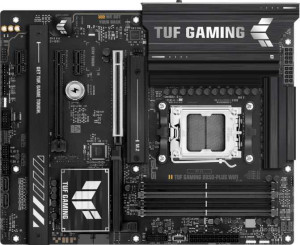
Asus TUF Gaming B850-Plus WiFi
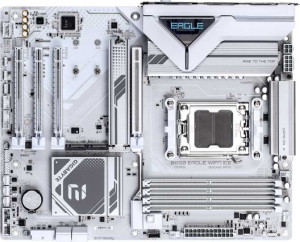
Gigabyte B850 Eagle Wi-Fi7 Ice

Asus TUF Gaming B850-Plus WiFi Gigabyte B850 Eagle Wi-Fi7 Ice

Overview

Welcome to our in-depth specification face-off between the Asus TUF Gaming B850-Plus WiFi and the Gigabyte B850 Eagle Wi-Fi7 Ice. Both boards share the AM5 socket, B850 chipset, and ATX form factor, making them natural rivals for AMD platform builders. The real questions lie in their memory capacity and speed headroom, rear I/O port selection, and expansion slot configurations — areas where the two boards take notably different approaches. Read on to find out which one best fits your build.

Common Features

  • Both boards use the AM5 CPU socket.
  • Both boards feature the B850 chipset.
  • Both boards use the ATX form factor.
  • Wi-Fi is available on both products, supporting Wi-Fi 4, Wi-Fi 5, Wi-Fi 6, Wi-Fi 6E, and Wi-Fi 7.
  • Bluetooth 5.4 is present on both products.
  • Both boards output video via HDMI 2.1.
  • Both boards have 4 memory slots supporting DDR5 in a dual-channel configuration.
  • ECC memory is not supported on either product.
  • Neither product includes a USB-C port at USB 3.2 Gen 2 speeds on the rear panel.
  • Neither product offers USB 4 (40Gbps or 20Gbps), Thunderbolt 3, or Thunderbolt 4 ports.
  • Both boards include one DisplayPort output and one RJ45 ethernet port.
  • Both boards provide HDMI output.
  • Both boards include 2 USB 3.2 Gen 1 ports through expansion, 4 USB 2.0 ports through expansion, and 2 USB 3.0 ports through expansion.
  • Both boards have 4 SATA 3 connectors, 3 M.2 sockets, and no U.2 sockets.
  • Both boards feature 6 fan headers.
  • An mSATA connector is not present on either product.
  • Both boards include 1 PCIe 5.0 x16 slot, 2 PCIe x1 slots, and no PCI or PCIe 2.0 x16 slots.
  • Both boards support 7.1 audio channels.
  • An S/PDIF Out port is not available on either product.
  • Both boards support RAID 0, RAID 1, RAID 5, and RAID 10, but neither supports RAID 0+1.

Main Differences

  • Dual BIOS is present on the Asus TUF Gaming B850-Plus WiFi but not available on the Gigabyte B850 Eagle Wi-Fi7 Ice.
  • Maximum memory capacity is 192GB on the Asus TUF Gaming B850-Plus WiFi and 256GB on the Gigabyte B850 Eagle Wi-Fi7 Ice.
  • Maximum RAM speed is 4000 MHz on the Asus TUF Gaming B850-Plus WiFi and 5200 MHz on the Gigabyte B850 Eagle Wi-Fi7 Ice.
  • Maximum overclocked RAM speed is 8000 MHz on the Asus TUF Gaming B850-Plus WiFi and 8200 MHz on the Gigabyte B850 Eagle Wi-Fi7 Ice.
  • USB 3.2 Gen 2 Type-A ports number 3 on the Asus TUF Gaming B850-Plus WiFi and 2 on the Gigabyte B850 Eagle Wi-Fi7 Ice.
  • USB 3.2 Gen 1 Type-A ports number 4 on the Asus TUF Gaming B850-Plus WiFi and 2 on the Gigabyte B850 Eagle Wi-Fi7 Ice.
  • A USB 3.2 Gen 1 Type-C port is not present on the Asus TUF Gaming B850-Plus WiFi but is available on the Gigabyte B850 Eagle Wi-Fi7 Ice.
  • USB 2.0 ports number 2 on the Asus TUF Gaming B850-Plus WiFi and 4 on the Gigabyte B850 Eagle Wi-Fi7 Ice.
  • A USB 3.2 Gen 2x2 port is present on the Asus TUF Gaming B850-Plus WiFi but not available on the Gigabyte B850 Eagle Wi-Fi7 Ice.
  • A PS/2 port is not present on the Asus TUF Gaming B850-Plus WiFi but is available on the Gigabyte B850 Eagle Wi-Fi7 Ice.
  • A TPM connector is not present on the Asus TUF Gaming B850-Plus WiFi but is available on the Gigabyte B850 Eagle Wi-Fi7 Ice.
  • A PCIe 4.0 x16 slot is present on the Asus TUF Gaming B850-Plus WiFi but not on the Gigabyte B850 Eagle Wi-Fi7 Ice.
  • A PCIe x4 slot is not present on the Asus TUF Gaming B850-Plus WiFi but is available on the Gigabyte B850 Eagle Wi-Fi7 Ice.
  • Audio connectors number 5 on the Asus TUF Gaming B850-Plus WiFi and 3 on the Gigabyte B850 Eagle Wi-Fi7 Ice.
Specs Comparison
Asus TUF Gaming B850-Plus WiFi

Asus TUF Gaming B850-Plus WiFi

Gigabyte B850 Eagle Wi-Fi7 Ice

Gigabyte B850 Eagle Wi-Fi7 Ice

General info:
CPU socket AM5 AM5
chipset B850 B850
form factor ATX ATX
release date January 2025 April 2025
supports Wi-Fi
Wi-Fi version Wi-Fi 4 (802.11n), Wi-Fi 5 (802.11ac), Wi-Fi 6 (802.11ax), Wi-Fi 6E (802.11ax), Wi-Fi 7 (802.11be) Wi-Fi 4 (802.11n), Wi-Fi 5 (802.11ac), Wi-Fi 6 (802.11ax), Wi-Fi 6E (802.11ax), Wi-Fi 7 (802.11be)
Has Bluetooth
Bluetooth version 5.4 5.4
HDMI version HDMI 2.1 HDMI 2.1
Easy to overclock
has RGB lighting
Easy to reset BIOS
Has dual BIOS
has aptX
CPU sockets 1 1
Has integrated graphics
warranty period 3 years 3 years
height 244 mm 244 mm
width 305 mm 305 mm
Has integrated CPU

At their core, the Asus TUF Gaming B850-Plus WiFi and the Gigabyte B850 Eagle Wi-Fi7 Ice are built on the same fundamental blueprint: both use the AM5 socket with the B850 chipset, adopt the standard ATX form factor (244 × 305 mm), and offer identical connectivity credentials — Wi-Fi 7 (802.11be) with backwards compatibility down to Wi-Fi 4, Bluetooth 5.4, and HDMI 2.1. Both also support overclocking, include RGB lighting, and carry a 3-year warranty. For the vast majority of build considerations in the general category, these two boards are effectively equivalent.

The one meaningful differentiator in this group is that the Asus TUF features dual BIOS, while the Gigabyte Eagle does not. A dual BIOS chip is a practical safety net: if a firmware update goes wrong or the primary BIOS becomes corrupted, the board can automatically fall back to the backup chip, avoiding a potentially unbootable system. For users who regularly update firmware or plan to push the platform with BIOS-level tweaks, this is a genuine reliability advantage — not a marketing checkbox.

Overall, the Asus TUF Gaming B850-Plus WiFi holds a clear edge in this group strictly due to its dual BIOS implementation. It adds a layer of resilience that the Gigabyte board simply cannot match here. If BIOS redundancy matters to you — and for enthusiasts and overclockers it often does — the Asus is the safer long-term choice based on these general specs alone.

Memory:
maximum memory amount 192GB 256GB
RAM speed (max) 4000 MHz 5200 MHz
overclocked RAM speed 8000 MHz 8200 MHz
memory slots 4 4
DDR memory version 5 5
memory channels 2 2
Supports ECC memory

Both boards share the same DDR5 foundation — 4 slots, dual-channel architecture, and no ECC support — but the Gigabyte B850 Eagle Wi-Fi7 Ice pulls ahead on every performance and capacity metric in this group. Its native RAM support tops out at 5200 MHz versus the Asus TUF's 4000 MHz, a gap that matters in latency-sensitive workloads like video editing, large dataset processing, and high-framerate gaming where memory bandwidth is a bottleneck.

The overclocking headroom tells a similar story: the Gigabyte reaches 8200 MHz with XMP/EXPO profiles engaged, compared to 8000 MHz on the Asus — a modest but consistent advantage. More significantly, the Gigabyte supports up to 256 GB of total RAM versus the Asus's 192 GB ceiling. While 192 GB already exceeds the needs of virtually all consumer use cases today, the higher cap on the Gigabyte makes it a more future-proof choice for power users running memory-hungry virtualization environments or professional creative workloads that scale aggressively with available RAM.

The Gigabyte B850 Eagle Wi-Fi7 Ice holds a clear advantage in this group across maximum capacity, native speed, and overclocked speed. None of these gaps are dramatic in isolation, but taken together they consistently position the Gigabyte as the stronger memory platform — particularly for users who intend to push their kits hard or anticipate heavier RAM demands over the board's lifespan.

Ports:
USB 3.2 Gen 2 ports (USB-A) 3 2
USB 3.2 Gen 1 ports (USB-A) 4 2
USB 3.2 Gen 2 ports (USB-C) 0 0
USB 3.2 Gen 1 ports (USB-C) 0 1
USB 2.0 ports 2 4
USB 3.2 Gen 2x2 ports 1 0
USB 4 40Gbps ports 0 0
USB 4 20Gbps ports 0 0
Thunderbolt 4 ports 0 0
Thunderbolt 3 ports 0 0
has an HDMI output
DisplayPort outputs 1 1
RJ45 ports 1 1
Has USB Type-C
eSATA ports 0 0
DVI outputs 0 0
has a VGA connector
PS/2 ports 0 1

When it comes to rear I/O, the Asus TUF Gaming B850-Plus WiFi is meaningfully more generous for modern peripherals. It offers 7 USB-A ports rated at Gen 1 or faster, compared to just 4 on the Gigabyte Eagle — and critically, the Asus includes a USB 3.2 Gen 2x2 port running at 20 Gbps, which the Gigabyte lacks entirely. That single port is particularly valuable for users with high-speed external NVMe enclosures or fast docking stations that can saturate a standard 10 Gbps Gen 2 connection.

The Gigabyte counters with a USB 3.2 Gen 1 Type-C port on the rear panel, which the Asus does not offer at that speed tier — making it marginally more accommodating for USB-C peripherals out of the box. The Gigabyte also includes a PS/2 port, a legacy connector that appeals to a narrow audience (primarily users with older mechanical keyboards or those requiring BIOS-level input without USB driver support). For most builders in 2024 and beyond, this carries little practical weight. Video output and networking are identical on both boards: each provides HDMI, a single DisplayPort, and one RJ45 ethernet jack.

The Asus TUF Gaming B850-Plus WiFi takes a clear lead in this group. Its higher total USB-A port count and the inclusion of a Gen 2x2 interface give it a stronger I/O profile for high-bandwidth peripherals, while the Gigabyte's only real distinction — its rear Type-C port and PS/2 — serves a narrower set of use cases.

Connectors:
USB 3.2 Gen 1 ports (through expansion) 2 2
USB 2.0 ports (through expansion) 4 4
SATA 3 connectors 4 4
fan headers 6 6
USB 3.0 ports (through expansion) 2 2
M.2 sockets 3 3
Has TPM connector
U.2 sockets 0 0
Has mSATA connector
SATA 2 connectors 0 0

Strip away the one differentiator here and these two boards are carbon copies of each other internally: both provide 3 M.2 sockets, 4 SATA 3 connectors, 6 fan headers, and identical expansion USB headers. For storage builders and cooling enthusiasts, neither board offers an inherent advantage — the M.2 count supports a capable all-NVMe setup, and six fan headers is sufficient to manage airflow in most mid-to-high-end cases without needing a separate fan hub.

The sole distinction is the TPM header present on the Gigabyte B850 Eagle Wi-Fi7 Ice and absent on the Asus TUF. A TPM (Trusted Platform Module) connector allows a discrete TPM module to be added to the board, enabling hardware-level encryption, secure boot attestation, and compliance with security frameworks that mandate TPM 2.0. While many modern CPUs include a firmware-based TPM that satisfies Windows 11 requirements, a dedicated hardware TPM is preferred in enterprise, government, or high-security environments where software TPM implementations are not considered sufficient. For the average consumer builder, this distinction is unlikely to matter — but for IT-managed deployments or security-conscious setups, it is a tangible gap.

The Gigabyte B850 Eagle Wi-Fi7 Ice takes a narrow edge in this group solely due to its TPM connector. For most home users the two boards are functionally identical here, but anyone building for a security-hardened or enterprise-adjacent environment will find the Gigabyte the more accommodating platform.
Expansion slots:
PCIe 4.0 x16 slots 1 0
PCIe 5.0 x16 slots 1 1
PCIe 3.0 x16 slots 0 0
PCIe x1 slots 2 2
PCI slots 0 0
PCIe 2.0 x16 slots 0 0
PCIe x4 slots 0 1
PCIe x8 slots 0 0

Both boards lead with a PCIe 5.0 x16 slot for the primary GPU — the current standard for top-tier discrete graphics cards and NVMe add-in cards — and each includes 2 PCIe x1 slots for smaller expansion cards like capture cards or network adapters. That shared baseline is solid for a single-GPU gaming or workstation build. The divergence comes in how each board handles secondary expansion.

The Asus TUF Gaming B850-Plus WiFi adds a PCIe 4.0 x16 slot as its secondary large slot, which is a meaningful bonus: it can accommodate a second GPU for compute workloads, a high-bandwidth NVMe expansion card, or a professional capture/encoding card that requires x16 physical bandwidth. The Gigabyte B850 Eagle Wi-Fi7 Ice instead offers a PCIe x4 slot in that position — usable for NVMe adapters or similarly bandwidth-modest cards, but unable to seat full x16 cards at their intended electrical width. For users who know they will only ever run one GPU and a couple of x1 peripherals, this difference is academic. For anyone planning a more expandable or multi-card configuration, it is a real constraint on the Gigabyte.

The Asus TUF Gaming B850-Plus WiFi has a clear advantage here. The second PCIe 4.0 x16 slot opens up expansion scenarios that the Gigabyte's x4 slot simply cannot support, giving the Asus a more versatile and future-accommodating PCIe layout.

Audio:
audio channels 7.1 7.1
Has S/PDIF Out port
audio connectors 5 3

Both the Asus TUF Gaming B850-Plus WiFi and Gigabyte B850 Eagle Wi-Fi7 Ice support 7.1 audio channels, providing high-quality surround sound capabilities. Neither motherboard includes an S/PDIF Out port, which means neither offers a dedicated digital audio output for connecting to external audio equipment such as home theater systems.

In terms of audio connectors, the Asus TUF Gaming B850-Plus WiFi has 5 connectors, while the Gigabyte B850 Eagle Wi-Fi7 Ice has 3. This difference suggests that the Asus board offers more flexibility for connecting various audio devices, such as speakers, headphones, and microphones, compared to the Gigabyte model.

In summary, while both motherboards provide similar audio channel support and lack an S/PDIF Out port, the Asus TUF Gaming B850-Plus WiFi offers more audio connectors, providing potentially more options for audio setups than the Gigabyte B850 Eagle Wi-Fi7 Ice.

Storage:
Supports RAID 1
Supports RAID 10 (1+0)
Supports RAID 5
Supports RAID 0
Supports RAID 0+1

Both the Asus TUF Gaming B850-Plus WiFi and Gigabyte B850 Eagle Wi-Fi7 Ice motherboards support the same RAID configurations, including RAID 1, RAID 10 (1+0), RAID 5, and RAID 0. Neither board supports RAID 0+1, which is absent in both products.

Overall, the storage capabilities in terms of RAID support are identical between the two motherboards, with both offering the same range of RAID levels, excluding RAID 0+1.

In summary, there are no differences between the Asus TUF Gaming B850-Plus WiFi and Gigabyte B850 Eagle Wi-Fi7 Ice when it comes to supported RAID configurations, as both models offer the same RAID options.

Comparison Summary & Verdict

After examining every specification, these two B850 boards serve overlapping but distinct audiences. The Asus TUF Gaming B850-Plus WiFi stands out with its dual BIOS safety net, a richer rear USB layout including a USB 3.2 Gen 2x2 port, more analog audio connectors, and a PCIe 4.0 x16 slot for added expansion flexibility — making it a strong pick for enthusiasts who value reliability and versatile connectivity. The Gigabyte B850 Eagle Wi-Fi7 Ice, on the other hand, pulls ahead with a higher maximum memory capacity of 256GB, a faster supported RAM ceiling of 5200 MHz, and a TPM connector for security-conscious users, while also offering a USB-C Gen 1 rear port and a PS/2 connector for legacy peripherals. Neither board is a clear-cut winner — your ideal choice depends on whether you prioritize platform resilience and I/O depth, or maximum memory headroom and security features.

Asus TUF Gaming B850-Plus WiFi
Buy Asus TUF Gaming B850-Plus WiFi if...

Buy the Asus TUF Gaming B850-Plus WiFi if you want the added peace of mind of a dual BIOS, a more versatile rear USB layout with a USB 3.2 Gen 2x2 port, and more analog audio connectors for a feature-rich build.

Gigabyte B850 Eagle Wi-Fi7 Ice
Buy Gigabyte B850 Eagle Wi-Fi7 Ice if...

Buy the Gigabyte B850 Eagle Wi-Fi7 Ice if you need maximum memory capacity up to 256GB, higher native RAM speeds of 5200 MHz, or a TPM connector for enhanced platform security.