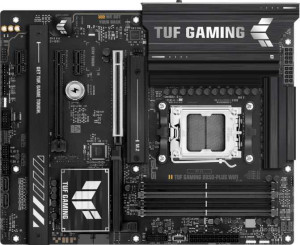
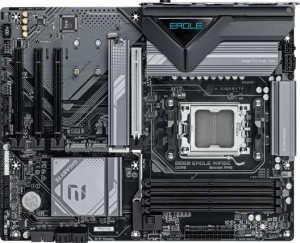
Both the Asus TUF Gaming B850-Plus WiFi and the Gigabyte B850 Eagle WiFi6E share the same fundamental platform: the AM5 socket with a B850 chipset, standard ATX form factor, identical 244 × 305 mm dimensions, and a 3-year warranty. Both support overclocking, carry dual BIOS for recovery safety, and output video via HDMI 2.1. For builders deciding between these two at the platform level, there is no meaningful difference in the foundation itself.
The most consequential differentiator in this group is wireless connectivity. The Asus TUF includes Wi-Fi 7 (802.11be), while the Gigabyte tops out at Wi-Fi 6E (802.11ax). In practice, Wi-Fi 7 delivers significantly higher theoretical throughput, lower latency via Multi-Link Operation (MLO), and better performance in congested environments — a tangible advantage for users with a Wi-Fi 7 router or those planning to upgrade. The Asus also edges ahead on Bluetooth 5.4 versus the Gigabyte's Bluetooth 5.3, bringing marginally improved connection stability and power efficiency, though this gap is minor in daily use. The Gigabyte's product name explicitly references Wi-Fi 6E, which accurately reflects its ceiling.
A secondary but visible difference is that the Asus TUF includes RGB lighting, which the Gigabyte Eagle lacks entirely. This is purely aesthetic and irrelevant to performance, but relevant for builders who want an illuminated build without adding separate components. Overall, the Asus TUF Gaming B850-Plus WiFi holds a clear edge in this group, driven by its superior Wi-Fi 7 support — a forward-looking advantage that the Gigabyte simply does not offer.