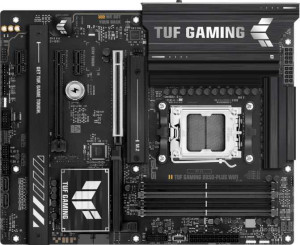
Both boards share a strong common foundation: the AM5 socket, B850 chipset, single CPU socket, no integrated graphics or CPU, 3-year warranty, dual BIOS, RGB lighting, Bluetooth, Wi-Fi, and overclocking support. For a user scanning the headline specs, these two boards look nearly identical on paper — but the differences that do exist carry real practical weight.
The most consequential difference is form factor. The Asus TUF Gaming B850-Plus WiFi is a full ATX board (305 × 244 mm), while the Gigabyte B850M Aorus Elite WiFi6E Ice is Micro-ATX (244 × 244 mm). ATX means more PCIe slots, more headers, and greater expansion headroom, but it also demands a larger case. Micro-ATX is the better pick for compact or mid-size builds where physical footprint matters. The second meaningful gap is wireless connectivity: the Asus extends to Wi-Fi 7 (802.11be), which delivers significantly higher throughput and lower latency than Wi-Fi 6E — a genuine future-proofing advantage as Wi-Fi 7 routers become mainstream. The Gigabyte tops out at Wi-Fi 6E. Bluetooth follows the same pattern: Asus offers Bluetooth 5.4 versus the Gigabyte′s 5.3, a minor but measurable improvement in connection stability and energy efficiency.
In summary, the Asus TUF Gaming B850-Plus WiFi holds a clear edge for users who want maximum expansion and the latest wireless standards, particularly Wi-Fi 7. The Gigabyte B850M Aorus Elite WiFi6E Ice makes more sense for builders working within a compact case constraint, accepting slightly older wireless tech as a trade-off for a smaller board footprint. Neither board has a meaningful advantage in overclockability, BIOS features, warranty, or audio (neither supports aptX).