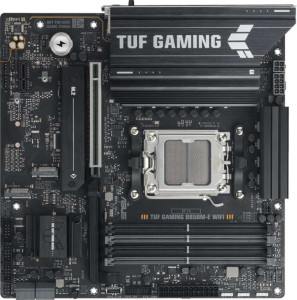
Asus TUF Gaming B850M-E Wi-Fi
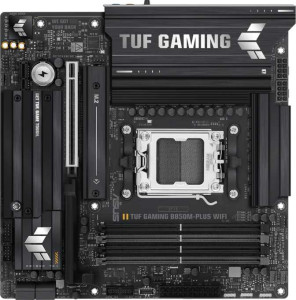
Asus TUF Gaming B850M-Plus WiFi

Asus TUF Gaming B850M-E Wi-Fi Asus TUF Gaming B850M-Plus WiFi

Overview

Welcome to this in-depth specification comparison between the Asus TUF Gaming B850M-E Wi-Fi and the Asus TUF Gaming B850M-Plus WiFi, two Micro-ATX motherboards built on the B850 chipset with AM5 socket support. While both boards share a strong common foundation, key differences emerge across areas such as rear USB connectivity, maximum memory capacity, and audio output options, making the choice between them more nuanced than it first appears.

Common Features

  • Both products use the AM5 CPU socket.
  • Both products feature the B850 chipset.
  • Both products have a Micro-ATX form factor.
  • Both products support Wi-Fi, including Wi-Fi 4 (802.11n), Wi-Fi 5 (802.11ac), Wi-Fi 6 (802.11ax), and Wi-Fi 6E (802.11ax).
  • Both products include Bluetooth 5.3.
  • Both products have an HDMI 2.1 output.
  • Both products support overclocked RAM speeds up to 8000 MHz.
  • Both products have 4 memory slots.
  • Both products use DDR5 memory.
  • Both products support 2 memory channels.
  • ECC memory is not supported on either product.
  • Neither product has USB 3.2 Gen 1 ports via USB-C on the rear panel.
  • Neither product has USB 4 40Gbps or USB 4 20Gbps ports.
  • Neither product has Thunderbolt 3 or Thunderbolt 4 ports.
  • Both products have 1 RJ45 port.
  • Both products include a USB Type-C connector.
  • Both products provide 2 USB 3.2 Gen 1 ports and 2 USB 3.0 ports through expansion headers.
  • Both products provide 4 USB 2.0 ports through expansion headers.
  • Both products have 4 SATA 3 connectors.
  • Both products have 3 M.2 sockets.
  • Neither product has a TPM connector, U.2 socket, or mSATA connector.
  • Both products have 1 PCIe 5.0 x16 slot and 1 PCIe x1 slot.
  • Both products support 7.1 audio channels.
  • Both products support RAID 0, RAID 1, RAID 5, and RAID 10, but neither supports RAID 0+1.

Main Differences

  • Maximum memory capacity is 256 GB on Asus TUF Gaming B850M-E Wi-Fi and 192 GB on Asus TUF Gaming B850M-Plus WiFi.
  • USB 3.2 Gen 2 ports (USB-A) count is 1 on Asus TUF Gaming B850M-E Wi-Fi and 3 on Asus TUF Gaming B850M-Plus WiFi.
  • USB 3.2 Gen 1 ports (USB-A) count is 2 on Asus TUF Gaming B850M-E Wi-Fi and 4 on Asus TUF Gaming B850M-Plus WiFi.
  • USB 3.2 Gen 2 port via USB-C is present on Asus TUF Gaming B850M-E Wi-Fi but not available on Asus TUF Gaming B850M-Plus WiFi.
  • USB 2.0 ports are not present on Asus TUF Gaming B850M-E Wi-Fi, while Asus TUF Gaming B850M-Plus WiFi has 4.
  • A USB 3.2 Gen 2x2 port is present on Asus TUF Gaming B850M-Plus WiFi but not available on Asus TUF Gaming B850M-E Wi-Fi.
  • DisplayPort outputs count is 2 on Asus TUF Gaming B850M-E Wi-Fi and 1 on Asus TUF Gaming B850M-Plus WiFi.
  • A PS/2 port is present on Asus TUF Gaming B850M-E Wi-Fi but not available on Asus TUF Gaming B850M-Plus WiFi.
  • Fan headers count is 4 on Asus TUF Gaming B850M-E Wi-Fi and 5 on Asus TUF Gaming B850M-Plus WiFi.
  • S/PDIF Out port is present on Asus TUF Gaming B850M-Plus WiFi but not available on Asus TUF Gaming B850M-E Wi-Fi.
  • Audio connectors count is 3 on Asus TUF Gaming B850M-E Wi-Fi and 5 on Asus TUF Gaming B850M-Plus WiFi.
Specs Comparison
Asus TUF Gaming B850M-E Wi-Fi

Asus TUF Gaming B850M-E Wi-Fi

Asus TUF Gaming B850M-Plus WiFi

Asus TUF Gaming B850M-Plus WiFi

General info:
CPU socket AM5 AM5
chipset B850 B850
form factor Micro-ATX Micro-ATX
release date September 2025 January 2025
supports Wi-Fi
Wi-Fi version Wi-Fi 4 (802.11n), Wi-Fi 5 (802.11ac), Wi-Fi 6 (802.11ax), Wi-Fi 6E (802.11ax) Wi-Fi 4 (802.11n), Wi-Fi 5 (802.11ac), Wi-Fi 6 (802.11ax), Wi-Fi 6E (802.11ax)
Has Bluetooth
Bluetooth version 5.3 5.3
HDMI version HDMI 2.1 HDMI 2.1
Easy to overclock
has RGB lighting
Easy to reset BIOS
Has dual BIOS
has aptX
CPU sockets 1 1
Has integrated graphics
warranty period 3 years 3 years
height 244 mm 244 mm
width 244 mm 244 mm
Has integrated CPU

In terms of general specifications, the Asus TUF Gaming B850M-E Wi-Fi and the Asus TUF Gaming B850M-Plus WiFi are virtually identical across every tracked attribute in this group. Both boards share the same AM5 socket, B850 chipset, and Micro-ATX form factor at identical dimensions of 244 × 244 mm, meaning they will fit the same cases and support the same current AMD processor lineup without any distinction.

Feature parity extends to connectivity and usability: both offer Wi-Fi 6E support, Bluetooth 5.3, HDMI 2.1 output, RGB lighting, overclocking capability, and dual BIOS — while neither supports easy BIOS reset, aptX audio, integrated graphics, or an integrated CPU. A shared 3-year warranty rounds out an identical ownership proposition on paper.

Based strictly on the general info specs provided, these two boards are a complete tie — there is not a single differentiating data point in this group. A purchasing decision between them cannot be made on general specs alone; buyers should look to other specification groups such as memory support, I/O, or storage connectivity for meaningful differences.

Memory:
maximum memory amount 256GB 192GB
overclocked RAM speed 8000 MHz 8000 MHz
memory slots 4 4
DDR memory version 5 5
memory channels 2 2
Supports ECC memory

The one meaningful split between these two boards in this group comes down to maximum memory capacity. The B850M-E Wi-Fi tops out at 256 GB of DDR5, while the B850M-Plus WiFi caps at 192 GB — a 64 GB gap that, for most gaming or general desktop workloads, will never matter. However, for users running memory-intensive professional applications such as large virtual machines, in-memory databases, or heavy video editing timelines, that extra headroom on the B850M-E Wi-Fi becomes a tangible long-term advantage.

Everything else in this group is identical: both boards provide 4 DIMM slots in a dual-channel DDR5 configuration and support overclocked RAM speeds up to 8000 MHz, which sits at the high end of what current AM5 platforms can realistically sustain. Neither board supports ECC memory, so error-correcting workloads common in server or workstation environments are off the table for both.

The B850M-E Wi-Fi holds a clear edge in this group solely due to its higher maximum memory ceiling. It is the stronger pick for anyone who anticipates pushing memory capacity over time, while the B850M-Plus WiFi remains perfectly sufficient for the vast majority of consumer use cases within its 192 GB limit.

Ports:
USB 3.2 Gen 2 ports (USB-A) 1 3
USB 3.2 Gen 1 ports (USB-A) 2 4
USB 3.2 Gen 2 ports (USB-C) 1 0
USB 3.2 Gen 1 ports (USB-C) 0 0
USB 2.0 ports 0 4
USB 3.2 Gen 2x2 ports 0 1
USB 4 40Gbps ports 0 0
USB 4 20Gbps ports 0 0
Thunderbolt 4 ports 0 0
Thunderbolt 3 ports 0 0
has an HDMI output
DisplayPort outputs 2 1
RJ45 ports 1 1
Has USB Type-C
eSATA ports 0 0
DVI outputs 0 0
has a VGA connector
PS/2 ports 1 0

The port layouts of these two boards reflect distinctly different priorities. The B850M-Plus WiFi is built for sheer USB density — it offers 3 USB 3.2 Gen 2 Type-A ports, 4 USB 3.2 Gen 1 Type-A ports, 4 USB 2.0 ports, and crucially, a USB 3.2 Gen 2x2 port delivering 20 Gbps — the fastest USB connection in this comparison, ideal for high-speed external SSDs. In total, that is 12 rear USB ports, making it a strong fit for users with many peripherals or external storage devices.

The B850M-E Wi-Fi takes a leaner but more modern approach: only 4 rear USB ports in total, but it includes a USB 3.2 Gen 2 Type-C output — a connector type completely absent from the B850M-Plus WiFi's rear panel — alongside 2 DisplayPort outputs versus just one on the Plus. That second DisplayPort is a meaningful advantage for anyone running a multi-monitor setup without relying on a discrete GPU. The B850M-E also adds a legacy PS/2 port, a niche but occasionally useful inclusion for older input devices or KVM switches.

Neither board wins outright in every scenario. The B850M-Plus WiFi has the edge for peripheral-heavy desks thanks to its volume of USB ports and the faster Gen 2x2 connection, while the B850M-E Wi-Fi better serves users who need rear USB-C connectivity or a dual-display output without a dedicated GPU. The right choice here depends entirely on how the board will be used day-to-day.

Connectors:
USB 3.2 Gen 1 ports (through expansion) 2 2
USB 2.0 ports (through expansion) 4 4
SATA 3 connectors 4 4
fan headers 4 5
USB 3.0 ports (through expansion) 2 2
M.2 sockets 3 3
Has TPM connector
U.2 sockets 0 0
Has mSATA connector
SATA 2 connectors 0 0

Strip away the near-identical connector specs and only one difference surfaces: the B850M-Plus WiFi provides 5 fan headers versus 4 on the B850M-E Wi-Fi. That extra header may sound minor, but in a thermally demanding build — one with multiple case fans, a CPU cooler, and an AIO radiator fan — having an additional dedicated header means fewer splitters and cleaner individual fan control through the BIOS. For users who prioritize fine-grained thermal management, it is a genuine convenience advantage.

Everywhere else, the two boards are indistinguishable: both offer 3 M.2 sockets for NVMe storage, 4 SATA 3 connectors for traditional drives, and identical internal USB expansion headers. The 3 M.2 slots in particular is a strong offering for a Micro-ATX board, giving builders ample high-speed storage options without relying on SATA at all if preferred.

The B850M-Plus WiFi holds a narrow edge in this group purely on the strength of that additional fan header. It is a small but practical advantage for anyone planning a multi-fan cooling setup, while the B850M-E Wi-Fi's connector spec is otherwise fully competitive.

Expansion slots:
PCIe 5.0 x16 slots 1 1
PCIe 3.0 x16 slots 0 0
PCIe x1 slots 1 1
PCI slots 0 0
PCIe 2.0 x16 slots 0 0
PCIe x4 slots 0 0
PCIe x8 slots 0 0

Expansion slot configurations are identical on both boards: a single PCIe 5.0 x16 slot and a single PCIe x1 slot, with no additional legacy or alternate-generation slots. The full-bandwidth PCIe 5.0 x16 connection is the headline here — it ensures compatibility with current and next-generation discrete GPUs at maximum throughput, making either board a solid foundation for a high-performance gaming or workstation build.

The solitary PCIe x1 slot offers room for one low-profile expansion card, such as a sound card or network adapter, which is a typical allocation for the Micro-ATX form factor. Neither board offers additional PCIe lanes for multi-GPU or heavy expansion scenarios, but that is consistent with the B850 chipset class and the platform's intended audience.

This group is a complete tie — there is no basis for preferring one board over the other on expansion slot grounds alone. Both deliver the same modern PCIe 5.0 primary slot and the same limited secondary expansion, which is appropriate and expected at this tier.

Audio:
audio channels 7.1 7.1
Has S/PDIF Out port
audio connectors 3 5

Audio is where the B850M-Plus WiFi pulls ahead noticeably. While both boards support 7.1-channel surround sound, the Plus WiFi backs that up with 5 audio connectors compared to just 3 on the B850M-E Wi-Fi. In practice, a full 7.1 analog setup requires multiple jacks to distribute front, rear, side, and center/subwoofer channels — having only 3 connectors on the B850M-E Wi-Fi limits its ability to drive a complete analog multi-speaker arrangement, making its 7.1 support more theoretical than practical without additional hardware.

The more significant differentiator is the S/PDIF optical output present on the B850M-Plus WiFi and entirely absent from the B850M-E Wi-Fi. S/PDIF allows a lossless digital audio signal to be passed directly to an external DAC, AV receiver, or a surround sound system — bypassing the motherboard's onboard audio circuitry entirely. For users with dedicated audio equipment or home theater setups, this is a meaningful connectivity option that the B850M-E Wi-Fi simply cannot offer.

The B850M-Plus WiFi wins this group clearly. Its combination of more analog connectors and the addition of S/PDIF output gives it a materially broader range of audio configurations, benefiting both multi-speaker desktop users and those feeding audio into external processing hardware.

Storage:
Supports RAID 1
Supports RAID 10 (1+0)
Supports RAID 5
Supports RAID 0
Supports RAID 0+1

Both boards support the same set of RAID configurations: RAID 0, RAID 1, RAID 5, and RAID 10, with neither supporting RAID 0+1. This covers the practical needs of most users — RAID 0 for striped performance gains, RAID 1 for straightforward mirroring and redundancy, RAID 5 for a balance of performance and fault tolerance across three or more drives, and RAID 10 for those wanting both speed and redundancy simultaneously.

This group is a complete tie. Every supported and unsupported RAID mode is identical across the two boards, meaning storage redundancy and array configuration capability offer no basis for choosing one over the other.

Comparison Summary & Verdict

Both the Asus TUF Gaming B850M-E Wi-Fi and the Asus TUF Gaming B850M-Plus WiFi are well-matched Micro-ATX boards sharing DDR5 support, Wi-Fi 6E, Bluetooth 5.3, and three M.2 sockets. However, distinct differences define their ideal users. The Asus TUF Gaming B850M-E Wi-Fi stands out with a higher maximum memory capacity of 256 GB, two DisplayPort outputs, a USB 3.2 Gen 2 Type-C rear port, and a PS/2 connector, making it a stronger pick for power users and those needing legacy peripheral support. The Asus TUF Gaming B850M-Plus WiFi counters with a richer rear USB-A port selection, an additional fan header, a USB 3.2 Gen 2x2 port, and superior audio connectivity with five audio connectors and an S/PDIF Out port, suiting builders who prioritize peripheral flexibility and audio versatility.

Asus TUF Gaming B850M-E Wi-Fi
Buy Asus TUF Gaming B850M-E Wi-Fi if...

Buy the Asus TUF Gaming B850M-E Wi-Fi if you need a higher maximum memory capacity of 256 GB, multiple DisplayPort outputs, or a rear USB 3.2 Gen 2 Type-C port and PS/2 connector for legacy peripherals.

Asus TUF Gaming B850M-Plus WiFi
Buy Asus TUF Gaming B850M-Plus WiFi if...

Buy the Asus TUF Gaming B850M-Plus WiFi if you want more rear USB-A ports, an extra fan header for better cooling control, or enhanced audio connectivity with five audio connectors and an S/PDIF Out port.