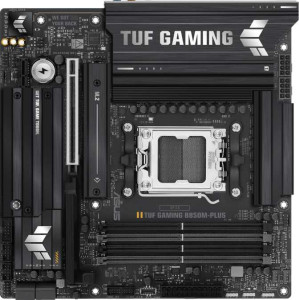
Asus TUF Gaming B850M-Plus
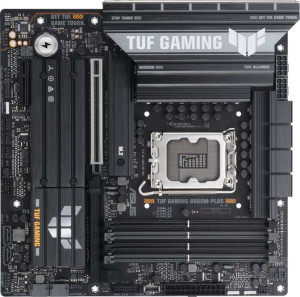
Asus TUF Gaming B860M-Plus

Asus TUF Gaming B850M-Plus Asus TUF Gaming B860M-Plus

Overview

When choosing between the Asus TUF Gaming B850M-Plus and the Asus TUF Gaming B860M-Plus, the decision hinges on more than just a chipset name. Both are Micro-ATX boards sharing a strong common foundation, yet they diverge in critical areas such as CPU platform compatibility, maximum memory capacity, and expansion slot configuration. This detailed comparison will help you identify which board best fits your build requirements and long-term upgrade goals.

Common Features

  • Both boards use the Micro-ATX form factor.
  • Neither board includes Wi-Fi support.
  • Neither board includes Bluetooth support.
  • Both boards feature HDMI 2.1 output.
  • Both boards support easy overclocking.
  • Both boards have RGB lighting.
  • Both boards have dual BIOS.
  • Both boards have a single CPU socket.
  • Both boards have 4 memory slots supporting DDR5.
  • Both boards support dual-channel memory.
  • ECC memory is not supported on either board.
  • Both boards have 4 USB 3.2 Gen 1 Type-A ports.
  • Neither board has USB 3.2 Gen 2 Type-C ports.
  • Neither board has USB 3.2 Gen 1 Type-C ports.
  • Both boards have 1 USB 3.2 Gen 2x2 port.
  • Neither board has USB 4, Thunderbolt 3, or Thunderbolt 4 ports.
  • Both boards have 2 USB 3.2 Gen 1 expansion ports, 4 SATA 3 connectors, 5 fan headers, and 3 M.2 sockets.
  • Neither board has a TPM connector, U.2 socket, or mSATA connector.
  • Both boards have 1 PCIe 5.0 x16 slot and no PCIe 4.0, 3.0, 2.0, or PCI slots.
  • Both boards offer 7.1 audio channels, an S/PDIF Out port, and 5 audio connectors.
  • Both boards support RAID 0, RAID 1, RAID 5, and RAID 10, but neither supports RAID 0+1.

Main Differences

  • The CPU socket is AM5 on the Asus TUF Gaming B850M-Plus and LGA 1851 on the Asus TUF Gaming B860M-Plus.
  • The chipset is B850 on the Asus TUF Gaming B850M-Plus and B860 on the Asus TUF Gaming B860M-Plus.
  • Easy BIOS reset is not available on the Asus TUF Gaming B850M-Plus but is available on the Asus TUF Gaming B860M-Plus.
  • Maximum supported memory is 192GB on the Asus TUF Gaming B850M-Plus and 256GB on the Asus TUF Gaming B860M-Plus.
  • Maximum overclocked RAM speed is 8000 MHz on the Asus TUF Gaming B850M-Plus and 8800 MHz on the Asus TUF Gaming B860M-Plus.
  • USB 3.2 Gen 2 Type-A ports number 3 on the Asus TUF Gaming B850M-Plus and 2 on the Asus TUF Gaming B860M-Plus.
  • USB 2.0 ports number 4 on the Asus TUF Gaming B850M-Plus and 1 on the Asus TUF Gaming B860M-Plus.
  • USB 2.0 expansion ports number 4 on the Asus TUF Gaming B850M-Plus and 2 on the Asus TUF Gaming B860M-Plus.
  • PCIe x1 slots number 1 on the Asus TUF Gaming B850M-Plus and 0 on the Asus TUF Gaming B860M-Plus.
  • PCIe x4 slots number 0 on the Asus TUF Gaming B850M-Plus and 1 on the Asus TUF Gaming B860M-Plus.
Specs Comparison
Asus TUF Gaming B850M-Plus

Asus TUF Gaming B850M-Plus

Asus TUF Gaming B860M-Plus

Asus TUF Gaming B860M-Plus

General info:
CPU socket AM5 LGA 1851
chipset B850 B860
form factor Micro-ATX Micro-ATX
release date January 2025 January 2025
supports Wi-Fi
Has Bluetooth
HDMI version HDMI 2.1 HDMI 2.1
Easy to overclock
has RGB lighting
Easy to reset BIOS
Has dual BIOS
CPU sockets 1 1
Has integrated graphics
warranty period 3 years 3 years
height 244 mm 244 mm
width 244 mm 244 mm
Has integrated CPU

The single most important differentiator in this group is platform compatibility. The Asus TUF Gaming B850M-Plus uses the AM5 socket with an AMD B850 chipset, while the B860M-Plus uses the LGA 1851 socket with an Intel B860 chipset. These two boards serve entirely different CPU ecosystems and are not interchangeable — your choice of processor locks you into one of these boards, not the other. Neither integrates a CPU or onboard graphics, so a discrete GPU or a CPU with its own integrated graphics is required in both builds.

Beyond the platform split, the boards are remarkably similar in their physical and feature profile: both are Micro-ATX at an identical 244 × 244 mm footprint, both carry HDMI 2.1, RGB lighting, dual BIOS, and a 3-year warranty. Neither supports Wi-Fi or Bluetooth out of the box, which is worth noting for builders who expect wireless connectivity — an add-in card or a Wi-Fi-equipped CPU cooler ecosystem will not compensate for this; a dedicated adapter would be needed. Both are also listed as easy to overclock, a slight surprise for B-series Intel given Intel′s historically tighter overclocking restrictions on non-Z chipsets, so buyers should verify the specific headroom available on the B860.

The one functional edge the B860M-Plus holds in this group is its Easy to reset BIOS capability, which the B850M-Plus lacks. In practice this means the B860M-Plus offers a more accessible recovery path if a bad BIOS flash or misconfiguration renders the system unbootable — a meaningful convenience advantage for less experienced builders or those who flash firmware frequently. Aside from that, the two boards are evenly matched on general specifications; the decision between them comes down entirely to AMD versus Intel platform preference.

Memory:
maximum memory amount 192GB 256GB
overclocked RAM speed 8000 MHz 8800 MHz
memory slots 4 4
DDR memory version 5 5
memory channels 2 2
Supports ECC memory

The Asus TUF Gaming B850M-Plus and Asus TUF Gaming B860M-Plus are quite similar in terms of memory specifications, with both featuring 4 memory slots, support for DDR5 memory, and 2 memory channels. However, there are a few key differences. The B850M-Plus supports a maximum memory amount of 192GB, while the B860M-Plus supports a higher maximum of 256GB.

Another difference is in the overclocked RAM speed. The B850M-Plus can handle RAM speeds up to 8000 MHz, whereas the B860M-Plus can go up to 8800 MHz. Both motherboards do not support ECC (Error-Correcting Code) memory, which means neither can provide the error protection that ECC memory offers.

Overall, the main differences between these two products in terms of memory are the maximum supported memory amount and the overclocked RAM speed, with the B860M-Plus having the edge in both areas.

Ports:
USB 3.2 Gen 2 ports (USB-A) 3 2
USB 3.2 Gen 1 ports (USB-A) 4 4
USB 3.2 Gen 2 ports (USB-C) 0 0
USB 3.2 Gen 1 ports (USB-C) 0 0
USB 2.0 ports 4 1
USB 3.2 Gen 2x2 ports 1 1
USB 4 40Gbps ports 0 0
USB 4 20Gbps ports 0 0
Thunderbolt 4 ports 0 0
Thunderbolt 3 ports 0 0
has an HDMI output
DisplayPort outputs 1 1
RJ45 ports 1 1
Has USB Type-C
eSATA ports 0 0
DVI outputs 0 0
has a VGA connector
PS/2 ports 0 0

The Asus TUF Gaming B850M-Plus and Asus TUF Gaming B860M-Plus have several similarities in their port configurations, but there are a few key differences. Both motherboards offer the same types of ports, including HDMI output, DisplayPort, RJ45 Ethernet, and USB Type-C. They also both provide a USB 3.2 Gen 2x2 port, but the number of USB 3.2 Gen 2 (USB-A) and USB 2.0 ports differ.

The B850M-Plus offers 3 USB 3.2 Gen 2 (USB-A) ports and 4 USB 2.0 ports, while the B860M-Plus has only 2 USB 3.2 Gen 2 (USB-A) ports but just 1 USB 2.0 port. The number of USB 3.2 Gen 1 ports (USB-A) is the same for both products, at 4. Both boards have DisplayPort outputs and HDMI output, and neither has any USB 4 or Thunderbolt ports.

In terms of additional connectors, the B850M-Plus has more USB 3.2 Gen 2 (USB-A) and USB 2.0 ports, while the B860M-Plus provides fewer USB 3.2 Gen 2 (USB-A) but fewer USB 2.0 ports, and both share the same set of other ports like RJ45, DisplayPort, and HDMI outputs. Notably, both motherboards lack VGA connectors and eSATA ports.

Connectors:
USB 3.2 Gen 1 ports (through expansion) 2 2
USB 2.0 ports (through expansion) 4 2
SATA 3 connectors 4 4
fan headers 5 5
USB 3.0 ports (through expansion) 2 2
M.2 sockets 3 3
Has TPM connector
U.2 sockets 0 0
Has mSATA connector
SATA 2 connectors 0 0

The Asus TUF Gaming B850M-Plus and Asus TUF Gaming B860M-Plus have a very similar set of connectors, with both featuring 3 M.2 sockets, 4 SATA 3 connectors, and 5 fan headers. Neither motherboard includes U.2 or mSATA connectors, and both do not support a TPM connector. Both also provide 2 USB 3.2 Gen 1 ports through expansion and 2 USB 3.0 ports through expansion. However, there is a difference in the USB 2.0 ports available through expansion: the B850M-Plus has 4, while the B860M-Plus only has 2.

Overall, the differences between the two products in this category are quite minor, with the B850M-Plus offering more USB 2.0 expansion ports than the B860M-Plus. Both motherboards have identical features in terms of SATA, M.2 sockets, and fan headers, and neither supports mSATA or U.2 connectors.

Both boards are equipped with similar expansion and connector options overall, with the main distinction being the USB 2.0 ports available through expansion, where the B850M-Plus has a greater count.

Expansion slots:
PCIe 4.0 x16 slots 0 0
PCIe 5.0 x16 slots 1 1
PCIe 3.0 x16 slots 0 0
PCIe x1 slots 1 0
PCI slots 0 0
PCIe 2.0 x16 slots 0 0
PCIe x4 slots 0 1
PCIe x8 slots 0 0

The Asus TUF Gaming B850M-Plus and Asus TUF Gaming B860M-Plus have a similar set of expansion slots, with both featuring one PCIe 5.0 x16 slot. However, there are some differences in the additional slots available. The B850M-Plus includes one PCIe x1 slot, while the B860M-Plus offers one PCIe x4 slot instead. Neither motherboard has PCIe 4.0 x16, PCIe 3.0 x16, PCIe 2.0 x16, or PCI slots.

In summary, the main difference between the two boards in terms of expansion slots is the type of additional PCIe slot. The B850M-Plus has a PCIe x1 slot, while the B860M-Plus has a PCIe x4 slot. Otherwise, both motherboards share the same PCIe 5.0 x16 slot for high-speed GPU connectivity and lack other traditional PCIe slot types.

Both boards provide solid expansion options with one primary x16 PCIe 5.0 slot, but the B860M-Plus offers a slightly different expansion configuration with the x4 slot.

Audio:
audio channels 7.1 7.1
Has S/PDIF Out port
audio connectors 5 5

The Asus TUF Gaming B850M-Plus and Asus TUF Gaming B860M-Plus have identical audio specifications. Both motherboards support 7.1 audio channels and come with an S/PDIF Out port. They also feature 5 audio connectors, making their audio capabilities virtually the same.

Since both motherboards share the same audio channels, S/PDIF Out port, and the number of audio connectors, there is no difference in terms of their audio performance or connectivity options.

Overall, the audio features are identical between the B850M-Plus and B860M-Plus, offering the same 7.1 surround sound experience with the same number of audio connectors and the presence of an S/PDIF Out port on both boards.

Storage:
Supports RAID 1
Supports RAID 10 (1+0)
Supports RAID 5
Supports RAID 0
Supports RAID 0+1

The Asus TUF Gaming B850M-Plus and Asus TUF Gaming B860M-Plus have identical RAID support. Both motherboards support RAID 1, RAID 10 (1+0), and RAID 5 configurations, providing solid options for data redundancy and performance. Neither motherboard supports RAID 0+1, but they both do support RAID 0 for performance-oriented setups.

In summary, there are no differences between the B850M-Plus and B860M-Plus in terms of their RAID capabilities. Both motherboards offer the same set of RAID configurations, ensuring compatibility with a range of storage setups.

Overall, these two boards offer equivalent RAID functionality, supporting all common RAID configurations except RAID 0+1.

Comparison Summary & Verdict

Both boards deliver a solid Micro-ATX package with PCIe 5.0, DDR5 memory, triple M.2 sockets, and 7.1 audio, making either a capable choice for a mid-range gaming or productivity build. However, the distinctions matter. The Asus TUF Gaming B850M-Plus targets AMD AM5 platform builders and offers more USB 2.0 headers and a PCIe x1 slot for legacy peripherals, making it a practical pick for those already invested in the AMD ecosystem. The Asus TUF Gaming B860M-Plus, built around the Intel LGA 1851 platform, pulls ahead with a higher 256GB memory ceiling, faster 8800 MHz overclocked RAM support, a convenient easy BIOS reset feature, and a PCIe x4 slot for added flexibility. Choose the B850M-Plus for AMD-based builds with broader USB legacy needs; opt for the B860M-Plus if you are building on Intel and want higher memory headroom and smoother BIOS management.

Asus TUF Gaming B850M-Plus
Buy Asus TUF Gaming B850M-Plus if...

Buy the Asus TUF Gaming B850M-Plus if you are building on the AMD AM5 platform and need more USB 2.0 connectivity or a PCIe x1 slot for additional expansion cards.

Asus TUF Gaming B860M-Plus
Buy Asus TUF Gaming B860M-Plus if...

Buy the Asus TUF Gaming B860M-Plus if you prefer the Intel LGA 1851 platform and want a higher memory capacity of 256GB, faster overclocked RAM speeds up to 8800 MHz, and the convenience of easy BIOS reset.