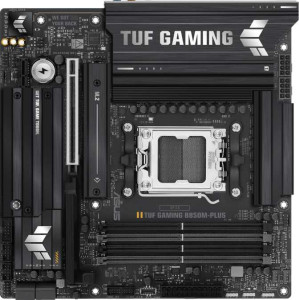
Asus TUF Gaming B850M-Plus
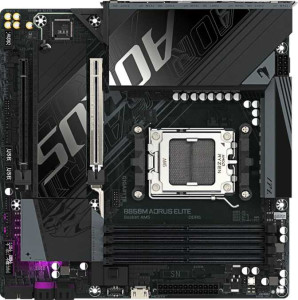
Gigabyte B850M Aorus Elite

Asus TUF Gaming B850M-Plus Gigabyte B850M Aorus Elite

Overview

When choosing between the Asus TUF Gaming B850M-Plus and the Gigabyte B850M Aorus Elite, builders are faced with two capable Micro-ATX motherboards sharing the same AM5 socket and B850 chipset foundation. While they agree on many fundamentals, key battlegrounds emerge around maximum memory capacity, rear USB port configurations, storage expansion options, and a handful of board-level features that could tip the scales depending on your build priorities.

Common Features

  • Both motherboards use the AM5 CPU socket.
  • Both boards feature the B850 chipset.
  • Both are Micro-ATX form factor boards.
  • Neither board includes built-in Wi-Fi.
  • Neither board includes Bluetooth.
  • Both boards support overclocking.
  • Both boards feature RGB lighting.
  • Easy BIOS reset is not available on either board.
  • Both boards have 4 memory slots.
  • Both boards support DDR5 memory.
  • Both boards operate in dual-channel memory mode.
  • ECC memory is not supported on either board.
  • Neither board has USB 3.2 Gen 1 Type-C rear ports.
  • Both boards provide 4 USB 2.0 rear ports.
  • Neither board includes USB 4 40Gbps ports.
  • Neither board includes USB 4 20Gbps ports.
  • Neither board includes Thunderbolt 4 or Thunderbolt 3 ports.
  • Both boards include 1 DisplayPort output.
  • Both boards include 1 RJ45 Ethernet port.
  • Both boards provide 2 USB 3.2 Gen 1 ports through internal expansion.
  • Both boards provide 1 USB 3.2 Gen 2x2 port through internal expansion.
  • Both boards provide 4 USB 2.0 ports through internal expansion.
  • Both boards include 4 SATA 3 connectors.
  • Neither board has an mSATA connector.
  • Neither board includes SATA 2 connectors.
  • Both boards have 1 PCIe 5.0 x16 slot.
  • Neither board includes PCIe 4.0 x16, PCIe 3.0 x16, PCIe 2.0 x16, PCIe x8, or PCI slots.
  • Both boards deliver a 120 dB signal-to-noise ratio on the DAC.
  • Both boards support 7.1 audio channels.
  • Both boards include an S/PDIF optical output.
  • Both boards support RAID 0, RAID 1, RAID 5, and RAID 10 configurations.
  • RAID 0+1 is not supported on either board.

Main Differences

  • Dual BIOS is present on Asus TUF Gaming B850M-Plus but not available on Gigabyte B850M Aorus Elite.
  • Maximum supported memory is 192 GB on Asus TUF Gaming B850M-Plus and 256 GB on Gigabyte B850M Aorus Elite.
  • Maximum overclocked RAM speed is 8000 MHz on Asus TUF Gaming B850M-Plus and 8200 MHz on Gigabyte B850M Aorus Elite.
  • USB 3.2 Gen 2 Type-A rear ports number 3 on Asus TUF Gaming B850M-Plus and 2 on Gigabyte B850M Aorus Elite.
  • USB 3.2 Gen 1 Type-A rear ports number 4 on Asus TUF Gaming B850M-Plus and 5 on Gigabyte B850M Aorus Elite.
  • A USB 3.2 Gen 2 Type-C rear port is present on Gigabyte B850M Aorus Elite but not available on Asus TUF Gaming B850M-Plus.
  • A USB 3.2 Gen 2x2 rear port is present on Asus TUF Gaming B850M-Plus but not available on Gigabyte B850M Aorus Elite.
  • An HDMI output is present on Asus TUF Gaming B850M-Plus but not available on Gigabyte B850M Aorus Elite.
  • Fan headers number 5 on Asus TUF Gaming B850M-Plus and 6 on Gigabyte B850M Aorus Elite.
  • M.2 sockets number 3 on Asus TUF Gaming B850M-Plus and 2 on Gigabyte B850M Aorus Elite.
  • A TPM connector is present on Gigabyte B850M Aorus Elite but not available on Asus TUF Gaming B850M-Plus.
  • PCIe x1 slots number 1 on Asus TUF Gaming B850M-Plus, while Gigabyte B850M Aorus Elite has none.
  • Gigabyte B850M Aorus Elite includes 1 PCIe x4 slot, while Asus TUF Gaming B850M-Plus has none.
  • Audio connectors number 5 on Asus TUF Gaming B850M-Plus and 2 on Gigabyte B850M Aorus Elite.
Specs Comparison
Asus TUF Gaming B850M-Plus

Asus TUF Gaming B850M-Plus

Gigabyte B850M Aorus Elite

Gigabyte B850M Aorus Elite

General info:
CPU socket AM5 AM5
chipset B850 B850
form factor Micro-ATX Micro-ATX
release date January 2025 January 2025
supports Wi-Fi
Has Bluetooth
Easy to overclock
has RGB lighting
Easy to reset BIOS
Has dual BIOS
CPU sockets 1 1
Has integrated graphics
warranty period 3 years 3 years
height 244 mm 244 mm
width 244 mm 244 mm
Has integrated CPU

At the general level, the Asus TUF Gaming B850M-Plus and the Gigabyte B850M Aorus Elite are remarkably similar boards. Both use the AM5 socket with a B850 chipset, share an identical Micro-ATX form factor (244 × 244 mm), and offer the same core feature set: overclocking support, RGB lighting, a 3-year warranty, and no integrated Wi-Fi, Bluetooth, graphics, or CPU.

The only meaningful differentiator in this group is dual BIOS. The TUF Gaming B850M-Plus includes it; the Aorus Elite does not. In practice, dual BIOS means a backup firmware chip that can automatically recover a corrupted or failed BIOS flash — a genuine safety net when overclocking or updating firmware. Its absence on the Aorus Elite is not a dealbreaker for most users, but it does add a layer of risk when experimenting with BIOS updates.

Based solely on the general specs provided, the Asus TUF Gaming B850M-Plus holds a clear edge thanks to its dual BIOS implementation, which meaningfully reduces the risk of a bricked board. Everything else in this category is a dead tie.

Memory:
maximum memory amount 192GB 256GB
overclocked RAM speed 8000 MHz 8200 MHz
memory slots 4 4
DDR memory version 5 5
memory channels 2 2
Supports ECC memory

Both boards share a solid DDR5 foundation: 4 memory slots, dual-channel architecture, and no ECC support — a standard configuration for mainstream B850 platforms. Where they diverge is in their memory ceilings and overclocking headroom.

The Gigabyte B850M Aorus Elite pulls ahead on both fronts. Its maximum supported capacity of 256 GB versus the TUF's 192 GB matters primarily for memory-intensive workloads like large virtual machines, professional content creation, or future-proofing a high-end build. Similarly, its overclocked RAM ceiling of 8200 MHz edges out the TUF's 8000 MHz — a modest gap in absolute terms, but it signals slightly more aggressive XMP/EXPO tuning support, which enthusiasts pushing high-speed kits will appreciate.

For the vast majority of users running 32–64 GB configurations for gaming or everyday productivity, neither advantage will be felt in practice. However, for users who anticipate maxing out RAM capacity or who specifically own high-frequency DDR5 kits rated above 8000 MHz, the Aorus Elite holds a clear edge in this category.

Ports:
USB 3.2 Gen 2 ports (USB-A) 3 2
USB 3.2 Gen 1 ports (USB-A) 4 5
USB 3.2 Gen 2 ports (USB-C) 0 1
USB 3.2 Gen 1 ports (USB-C) 0 0
USB 2.0 ports 4 4
USB 3.2 Gen 2x2 ports 1 0
USB 4 40Gbps ports 0 0
USB 4 20Gbps ports 0 0
Thunderbolt 4 ports 0 0
Thunderbolt 3 ports 0 0
has an HDMI output
DisplayPort outputs 1 1
RJ45 ports 1 1
Has USB Type-C
eSATA ports 0 0
DVI outputs 0 0
has a VGA connector
PS/2 ports 0 0

The rear I/O layouts of these two boards take meaningfully different approaches. The Asus TUF Gaming B850M-Plus skips a USB-C Gen 2 port entirely but compensates with a USB 3.2 Gen 2x2 port — delivering 20 Gbps throughput, double that of standard Gen 2. This makes it the stronger choice for users with high-speed external SSDs or NVMe enclosures that can saturate a 10 Gbps connection. The Gigabyte B850M Aorus Elite, by contrast, omits Gen 2x2 but includes a USB-C Gen 2 port, which is increasingly the connector of choice for modern peripherals, smartphones, and accessories — a more practical day-to-day convenience for many users.

The other standout difference is video output. The TUF includes both an HDMI port and a DisplayPort, while the Aorus Elite offers only a DisplayPort. For users pairing the board with an AMD Ryzen CPU that carries integrated graphics, this matters: the TUF gives flexibility to connect monitors or TVs using whichever cable is at hand, whereas the Aorus Elite forces a DisplayPort-only connection for display output.

Neither board dominates cleanly — the right choice depends on your peripheral ecosystem. Power users with fast external storage will prefer the TUF's Gen 2x2 port, while those with USB-C-heavy setups will gravitate toward the Aorus Elite. The TUF's dual video output options do give it a practical edge for display flexibility, and on balance it edges ahead in this category for general versatility.

Connectors:
USB 3.2 Gen 1 ports (through expansion) 2 2
USB 3.2 Gen 2x2 ports (through expansion) 1 1
USB 2.0 ports (through expansion) 4 4
SATA 3 connectors 4 4
fan headers 5 6
USB 3.0 ports (through expansion) 2 2
M.2 sockets 3 2
Has TPM connector
U.2 sockets 0 0
Has mSATA connector
SATA 2 connectors 0 0

Internal connectivity is where these two boards make their sharpest trade-offs. The Asus TUF Gaming B850M-Plus wins on storage expansion with 3 M.2 sockets versus the Aorus Elite's 2 — a genuine advantage for users building NVMe-heavy systems, whether that means a dedicated OS drive, a fast scratch disk, and a bulk storage drive all running simultaneously without touching the SATA ports. Both boards offer 4 SATA 3 connectors as well, so traditional drive arrays are equally supported on either platform.

Thermal management tells a different story. The Gigabyte B850M Aorus Elite provides 6 fan headers compared to the TUF's 5, giving builders one extra point of control for chassis fans or radiator pumps — a meaningful perk in more elaborate cooling setups where every header counts. The Aorus Elite also includes a TPM connector, which the TUF lacks; this is relevant for enterprise or security-conscious builds where a discrete TPM module is required for hardware-level encryption or compliance.

The verdict here is genuinely split by use case. Storage-focused builders and those running multiple NVMe drives should favor the TUF's extra M.2 slot, while users prioritizing thermal headroom or security infrastructure will find the Aorus Elite's additional fan header and TPM support more compelling. On raw build flexibility, the TUF's third M.2 socket is arguably the higher-impact advantage for the broader audience.

Expansion slots:
PCIe 4.0 x16 slots 0 0
PCIe 5.0 x16 slots 1 1
PCIe 3.0 x16 slots 0 0
PCIe x1 slots 1 0
PCI slots 0 0
PCIe 2.0 x16 slots 0 0
PCIe x4 slots 0 1
PCIe x8 slots 0 0

For the primary GPU slot, both boards are identical: a single PCIe 5.0 x16 slot that ensures full bandwidth compatibility with current and next-generation graphics cards. Neither board is at a disadvantage here for any mainstream discrete GPU available today.

The secondary slot is where they diverge. The Asus TUF Gaming B850M-Plus includes a PCIe x1 slot, while the Gigabyte B850M Aorus Elite opts for a PCIe x4 slot instead. In practical terms, a x1 slot is adequate for low-bandwidth add-in cards like sound cards, USB expansion cards, or network adapters. A x4 slot, however, opens the door to higher-bandwidth cards — such as certain capture cards, NVMe add-in cards, or 10GbE network adapters — that either require or benefit from the additional lanes. For a Micro-ATX board with limited real estate, the Aorus Elite's choice to allocate x4 bandwidth to that secondary slot is the more versatile decision.

On expansion slots, the Aorus Elite holds a modest edge thanks to its higher-bandwidth secondary slot. Users who will only ever populate the primary x16 slot with a GPU will find no practical difference, but anyone planning to add a high-throughput expansion card will benefit from the x4 slot's additional headroom.

Audio:
Signal-to-Noise ratio (DAC) 120 dB 120 dB
audio channels 7.1 7.1
Has S/PDIF Out port
audio connectors 5 2

Three of the four audio specs here are identical: both boards deliver a 120 dB SNR DAC, 7.1-channel output, and an S/PDIF optical output. A 120 dB signal-to-noise ratio is a strong result for onboard audio, meaning clean, low-noise output suitable for quality headphones and speaker setups without an external DAC.

The single differentiator — but a consequential one — is the number of analog audio connectors. The Asus TUF Gaming B850M-Plus provides 5 audio jacks, while the Gigabyte B850M Aorus Elite offers just 2. To actually use the 7.1-channel capability through analog outputs, you typically need at least 3 jacks (front, rear, and center/subwoofer channels). With only 2 connectors, the Aorus Elite cannot deliver a full analog 7.1 surround setup — users wanting multi-channel analog audio would need to rely on S/PDIF or an external solution. The TUF's 5-jack layout, by contrast, fully supports analog 7.1 without any workarounds.

For anyone using a 7.1 analog speaker system or simply wanting a flexible multi-device audio setup at the rear panel, the TUF holds a clear and practical advantage here. The Aorus Elite's 2-jack configuration is adequate for stereo headphone and microphone use, but it significantly limits analog surround options despite the board's stated 7.1 support.

Storage:
Supports RAID 1
Supports RAID 10 (1+0)
Supports RAID 5
Supports RAID 0
Supports RAID 0+1

Storage redundancy support is a complete tie between these two boards. Both the Asus TUF Gaming B850M-Plus and the Gigabyte B850M Aorus Elite support RAID 0, 1, 5, and 10, and neither supports RAID 0+1 — an identical feature set across the board.

The supported modes cover the most practically relevant configurations: RAID 0 for striped performance, RAID 1 for simple mirroring and data redundancy, RAID 5 for a balanced mix of performance and fault tolerance across three or more drives, and RAID 10 for the combined benefits of striping and mirroring. The absence of RAID 0+1 is inconsequential in practice, as RAID 10 is widely considered the superior alternative and is supported by both.

There is no differentiator to call out here — this category is a dead tie, and storage redundancy should carry no weight in the decision between these two boards.

Comparison Summary & Verdict

Both the Asus TUF Gaming B850M-Plus and the Gigabyte B850M Aorus Elite are well-rounded B850 Micro-ATX platforms, but each caters to a subtly different builder. The Asus board stands out with its dual BIOS protection, an additional M.2 socket for storage-hungry builds, a USB 3.2 Gen 2x2 rear port, an HDMI output, and a richer 5-connector audio layout — making it a strong pick for users who want redundancy and versatility. The Gigabyte board counters with a higher maximum memory capacity of 256 GB, a slightly faster 8200 MHz overclocked RAM ceiling, an extra fan header, a USB 3.2 Gen 2 Type-C rear port, and a TPM connector, appealing to power users focused on memory headroom and modern connectivity. Neither includes Wi-Fi or Bluetooth, so both require an add-in solution for wireless.

Asus TUF Gaming B850M-Plus
Buy Asus TUF Gaming B850M-Plus if...

Buy the Asus TUF Gaming B850M-Plus if you want dual BIOS protection, more M.2 storage slots, and a broader set of rear audio and USB options including a Gen 2x2 port and HDMI output.

Gigabyte B850M Aorus Elite
Buy Gigabyte B850M Aorus Elite if...

Buy the Gigabyte B850M Aorus Elite if you need a higher maximum memory capacity of 256 GB, a slightly faster overclocked RAM speed, an extra fan header, or a built-in TPM connector for security requirements.