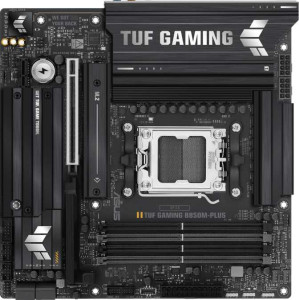
Asus TUF Gaming B850M-Plus
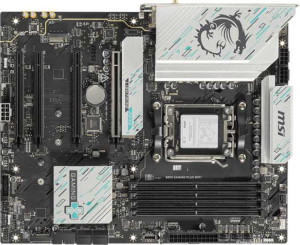
MSI B850 Gaming Plus WiFi

Asus TUF Gaming B850M-Plus MSI B850 Gaming Plus WiFi

Overview

Welcome to our in-depth specification comparison between the Asus TUF Gaming B850M-Plus and the MSI B850 Gaming Plus WiFi. Both boards share the AM5 socket and B850 chipset, but they take meaningfully different approaches to form factor, connectivity, and expandability. Whether you are building a compact rig or a fully-featured desktop workstation, this comparison will help you understand which board best matches your needs.

Common Features

  • Both motherboards use the AM5 CPU socket.
  • Both boards feature the B850 chipset.
  • Both products support overclocking.
  • RGB lighting is present on both boards.
  • Both boards include a dual BIOS feature.
  • Each board has a single CPU socket.
  • Neither board has integrated graphics.
  • Both products carry a 3-year warranty.
  • Both boards have 4 memory slots.
  • Both use DDR5 memory.
  • Both boards support 2 memory channels.
  • ECC memory is not supported on either board.
  • Neither board has USB 3.2 Gen 1 USB-C ports on the rear.
  • Both boards provide 4 USB 2.0 rear ports.
  • Neither board includes USB 4 40Gbps, USB 4 20Gbps, Thunderbolt 3, or Thunderbolt 4 ports.
  • Both boards include 1 DisplayPort output.
  • Both boards have 1 RJ45 Ethernet port.
  • Both boards offer 4 USB 2.0 ports through expansion headers.
  • Both boards include 4 SATA 3 connectors.
  • Both boards feature 3 M.2 sockets.
  • Neither board has an mSATA connector or U.2 sockets.
  • Both boards support 7.1 audio channels.
  • An S/PDIF Out port is available on both boards.
  • Both boards include 1 PCIe 5.0 x16 slot.
  • Neither board has PCIe 3.0 x16, PCIe 2.0 x16, PCI, PCIe x4, or PCIe x8 slots.
  • Both boards support RAID 0 and RAID 1.
  • RAID 0+1 is not supported on either board.

Main Differences

  • The Asus TUF Gaming B850M-Plus has a Micro-ATX form factor, while the MSI B850 Gaming Plus WiFi uses an ATX form factor.
  • Wi-Fi is available on the MSI B850 Gaming Plus WiFi but not on the Asus TUF Gaming B850M-Plus.
  • Bluetooth is present on the MSI B850 Gaming Plus WiFi but not on the Asus TUF Gaming B850M-Plus.
  • Easy BIOS reset is supported on the MSI B850 Gaming Plus WiFi but not on the Asus TUF Gaming B850M-Plus.
  • The Asus TUF Gaming B850M-Plus measures 244 mm wide, while the MSI B850 Gaming Plus WiFi is 304.8 mm wide.
  • The maximum supported memory is 192 GB on the Asus TUF Gaming B850M-Plus and 256 GB on the MSI B850 Gaming Plus WiFi.
  • The maximum overclocked RAM speed is 8000 MHz on the Asus TUF Gaming B850M-Plus and 8200 MHz on the MSI B850 Gaming Plus WiFi.
  • The Asus TUF Gaming B850M-Plus has 3 USB 3.2 Gen 2 Type-A ports, while the MSI B850 Gaming Plus WiFi has 1.
  • The Asus TUF Gaming B850M-Plus has 4 USB 3.2 Gen 1 Type-A ports, while the MSI B850 Gaming Plus WiFi has 1.
  • USB 3.2 Gen 2 Type-C ports are present on the MSI B850 Gaming Plus WiFi (2 ports) but absent on the Asus TUF Gaming B850M-Plus.
  • A USB 3.2 Gen 2x2 port is available on the Asus TUF Gaming B850M-Plus but not on the MSI B850 Gaming Plus WiFi.
  • An HDMI output is available on the Asus TUF Gaming B850M-Plus but not on the MSI B850 Gaming Plus WiFi.
  • USB 3.2 Gen 1 expansion headers support 2 ports on the Asus TUF Gaming B850M-Plus and 4 ports on the MSI B850 Gaming Plus WiFi.
  • The Asus TUF Gaming B850M-Plus has 5 fan headers, while the MSI B850 Gaming Plus WiFi has 6.
  • A TPM connector is present on the MSI B850 Gaming Plus WiFi but not on the Asus TUF Gaming B850M-Plus.
  • The Asus TUF Gaming B850M-Plus has no PCIe 4.0 x16 slot, while the MSI B850 Gaming Plus WiFi includes 1.
  • The Asus TUF Gaming B850M-Plus has 1 PCIe x1 slot, while the MSI B850 Gaming Plus WiFi has 2.
  • The Asus TUF Gaming B850M-Plus has 5 audio connectors, while the MSI B850 Gaming Plus WiFi has 2.
  • RAID 10 (1+0) is supported on the Asus TUF Gaming B850M-Plus but not on the MSI B850 Gaming Plus WiFi.
  • RAID 5 is supported on the Asus TUF Gaming B850M-Plus but not on the MSI B850 Gaming Plus WiFi.
Specs Comparison
Asus TUF Gaming B850M-Plus

Asus TUF Gaming B850M-Plus

MSI B850 Gaming Plus WiFi

MSI B850 Gaming Plus WiFi

General info:
CPU socket AM5 AM5
chipset B850 B850
form factor Micro-ATX ATX
release date January 2025 January 2025
supports Wi-Fi
Has Bluetooth
Easy to overclock
has RGB lighting
Easy to reset BIOS
Has dual BIOS
CPU sockets 1 1
Has integrated graphics
warranty period 3 years 3 years
height 244 mm 243.8 mm
width 244 mm 304.8 mm
Has integrated CPU

Both boards share the same AM5 socket and B850 chipset, meaning they support the same range of Ryzen processors and offer identical overclocking headroom — a notable strength of this chipset tier. They also match on dual BIOS, RGB lighting, and a 3-year warranty, so neither holds an advantage on reliability features or platform fundamentals.

The most consequential differences lie in form factor and connectivity. The MSI is a full ATX board (304.8 mm wide) while the Asus is Micro-ATX (244 mm wide), which directly affects case compatibility, available PCIe slot count, and overall expansion room. Beyond size, the MSI includes built-in Wi-Fi and Bluetooth, features the Asus omits entirely — meaning Asus TUF users who need wireless connectivity must budget for an add-in card or adapter. The MSI also supports easy BIOS reset, a small but practical convenience the Asus lacks.

In this group, the MSI B850 Gaming Plus WiFi holds a clear edge: it offers more physical expansion via ATX, eliminates the need for separate wireless hardware, and adds a friendlier BIOS recovery experience — all without sacrificing any feature the Asus provides. The Asus TUF makes sense only if a compact Micro-ATX build is a hard requirement.

Memory:
maximum memory amount 192GB 256GB
overclocked RAM speed 8000 MHz 8200 MHz
memory slots 4 4
DDR memory version 5 5
memory channels 2 2
Supports ECC memory

The Asus TUF Gaming B850M-Plus and MSI B850 Gaming Plus WiFi are both equipped with four memory slots and support DDR5 memory, with each motherboard having two memory channels. However, the maximum memory capacity differs between the two. The Asus board supports up to 192GB of memory, while the MSI model can accommodate up to 256GB of memory.

In terms of overclocked RAM speed, the MSI B850 Gaming Plus WiFi supports a slightly faster 8200 MHz, compared to the Asus TUF Gaming B850M-Plus, which supports 8000 MHz. Both motherboards do not support ECC memory, making them suitable for gaming and general use but not for enterprise-level applications requiring error correction.

Overall, both products offer similar memory configurations, with the MSI motherboard having a higher maximum memory capacity and slightly faster overclocked RAM speed.

Ports:
USB 3.2 Gen 2 ports (USB-A) 3 1
USB 3.2 Gen 1 ports (USB-A) 4 1
USB 3.2 Gen 2 ports (USB-C) 0 2
USB 3.2 Gen 1 ports (USB-C) 0 0
USB 2.0 ports 4 4
USB 3.2 Gen 2x2 ports 1 0
USB 4 40Gbps ports 0 0
USB 4 20Gbps ports 0 0
Thunderbolt 4 ports 0 0
Thunderbolt 3 ports 0 0
has an HDMI output
DisplayPort outputs 1 1
RJ45 ports 1 1
Has USB Type-C
eSATA ports 0 0
DVI outputs 0 0
has a VGA connector
PS/2 ports 0 0

The Asus TUF Gaming B850M-Plus and MSI B850 Gaming Plus WiFi offer a variety of ports, but they differ in their USB configurations. The Asus board provides more USB 3.2 Gen 2 (USB-A) ports, with a total of 3, compared to the MSI board's 1. However, the MSI motherboard offers more USB 3.2 Gen 2 ports in the USB-C category, with 2 compared to none on the Asus model.

Both motherboards feature 4 USB 2.0 ports and 1 RJ45 Ethernet port, but the Asus model has an additional USB 3.2 Gen 2x2 port, while the MSI board does not. In terms of display outputs, the Asus model has an HDMI output in addition to a DisplayPort, while the MSI model lacks HDMI but also includes a DisplayPort. Neither product offers a VGA connector, eSATA ports, or PS/2 ports.

Both boards have USB Type-C ports, but only the MSI motherboard includes USB 3.2 Gen 2 Type-C ports, while the Asus board provides the standard USB Type-C port without specific mention of speed. Neither product includes Thunderbolt 3 or Thunderbolt 4 ports, or USB 4 40Gbps/20Gbps ports.

Connectors:
USB 3.2 Gen 1 ports (through expansion) 2 4
USB 2.0 ports (through expansion) 4 4
SATA 3 connectors 4 4
fan headers 5 6
USB 3.0 ports (through expansion) 2 4
M.2 sockets 3 3
Has TPM connector
U.2 sockets 0 0
Has mSATA connector
SATA 2 connectors 0 0

The Asus TUF Gaming B850M-Plus and MSI B850 Gaming Plus WiFi offer similar connector options, with both providing 4 SATA 3 connectors and 3 M.2 sockets. The Asus board has 2 USB 3.2 Gen 1 ports and 2 USB 3.0 ports available through expansion, while the MSI model provides 4 USB 3.2 Gen 1 ports and 4 USB 3.0 ports through expansion, offering more expansion options in this category.

In terms of fan headers, the Asus TUF Gaming B850M-Plus has 5, while the MSI B850 Gaming Plus WiFi includes 6 fan headers, giving users one additional header for cooling configurations. Both models include 4 USB 2.0 ports through expansion.

One significant difference is the presence of a TPM connector on the MSI motherboard, which the Asus model lacks. Neither board features U.2 sockets, and neither has an mSATA connector. Both boards also lack SATA 2 connectors.

Expansion slots:
PCIe 4.0 x16 slots 0 1
PCIe 5.0 x16 slots 1 1
PCIe 3.0 x16 slots 0 0
PCIe x1 slots 1 2
PCI slots 0 0
PCIe 2.0 x16 slots 0 0
PCIe x4 slots 0 0
PCIe x8 slots 0 0

The Asus TUF Gaming B850M-Plus and MSI B850 Gaming Plus WiFi differ in their PCIe slot configurations. The Asus motherboard includes one PCIe 5.0 x16 slot but lacks any PCIe 4.0 or PCIe 3.0 x16 slots. In contrast, the MSI board offers both one PCIe 4.0 x16 slot and one PCIe 5.0 x16 slot, giving it a broader range of high-speed expansion options.

Both motherboards feature one PCIe x1 slot, and neither includes PCI slots or PCIe 2.0 x16, PCIe x4, or PCIe x8 slots. The MSI board provides more flexibility in expansion, thanks to its additional PCIe x1 slot compared to the single PCIe x1 slot on the Asus model.

Overall, the MSI B850 Gaming Plus WiFi offers more PCIe 4.0 expansion options, while the Asus TUF Gaming B850M-Plus focuses on PCIe 5.0 x16 for the latest high-speed devices.

Audio:
audio channels 7.1 7.1
Has S/PDIF Out port
audio connectors 5 2

Both the Asus TUF Gaming B850M-Plus and MSI B850 Gaming Plus WiFi support 7.1 audio channels and include an S/PDIF Out port, making them both suitable for high-quality audio setups. However, they differ in the number of audio connectors they provide. The Asus motherboard offers 5 audio connectors, while the MSI motherboard has only 2.

This means the Asus model provides more options for connecting additional audio devices, such as speakers, headphones, or microphones, compared to the MSI model, which has fewer connectors available for such purposes.

Despite these differences in connector count, both motherboards offer similar core audio features, including the same 7.1 channel audio support and S/PDIF Out capability.

Storage:
Supports RAID 1
Supports RAID 10 (1+0)
Supports RAID 5
Supports RAID 0
Supports RAID 0+1

The Asus TUF Gaming B850M-Plus and MSI B850 Gaming Plus WiFi both support some RAID configurations but differ in the specific RAID levels they offer. Both motherboards support RAID 1 for mirroring and RAID 0 for striping, making them suitable for setups requiring redundancy or increased speed. The Asus model additionally supports RAID 10 (1+0) for a balance of redundancy and performance, as well as RAID 5 for fault tolerance with data striping.

On the other hand, the MSI motherboard does not support RAID 10 (1+0) or RAID 5, limiting its options to RAID 1 and RAID 0. Both boards do not support RAID 0+1, a hybrid RAID configuration.

Overall, the Asus motherboard offers a broader range of RAID options, particularly for users who need more advanced configurations like RAID 5 or RAID 10 (1+0), while the MSI model is limited to the more basic RAID 1 and RAID 0 setups.

Comparison Summary & Verdict

After examining every specification, these two B850 motherboards reveal clearly distinct identities. The Asus TUF Gaming B850M-Plus is a strong choice for users who want a compact Micro-ATX build without sacrificing rear USB density, as it delivers more USB 3.2 Gen 2 and Gen 1 Type-A ports, a USB 3.2 Gen 2x2 port, an HDMI output, and broader RAID support including RAID 5 and RAID 10. The MSI B850 Gaming Plus WiFi, on the other hand, is the better fit for builders who need an ATX platform with built-in Wi-Fi and Bluetooth, higher maximum memory capacity of 256 GB, faster overclocked RAM speeds, more fan headers, USB 3.2 Gen 2 Type-C ports, an extra PCIe 4.0 x16 slot, and a TPM connector. Choose the Asus for a dense, compact build; choose the MSI for a feature-rich, wireless-ready full-size platform.

Asus TUF Gaming B850M-Plus
Buy Asus TUF Gaming B850M-Plus if...

Buy the Asus TUF Gaming B850M-Plus if you are building a compact Micro-ATX system and want more rear USB Type-A ports, a USB 3.2 Gen 2x2 port, an HDMI output, and advanced RAID 5 and RAID 10 storage support.

MSI B850 Gaming Plus WiFi
Buy MSI B850 Gaming Plus WiFi if...

Buy the MSI B850 Gaming Plus WiFi if you need a full ATX board with built-in Wi-Fi and Bluetooth, higher maximum memory capacity, faster RAM overclocking, more fan headers, USB 3.2 Gen 2 Type-C ports, and an additional PCIe 4.0 x16 expansion slot.