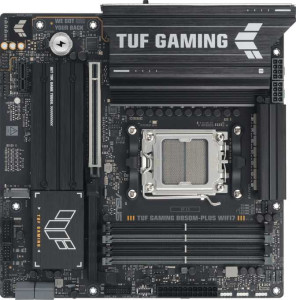
Asus TUF Gaming B850M-Plus Wi-Fi7
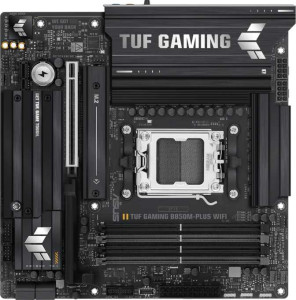
Asus TUF Gaming B850M-Plus WiFi

Asus TUF Gaming B850M-Plus Wi-Fi7 Asus TUF Gaming B850M-Plus WiFi

Overview

Welcome to our in-depth comparison of the Asus TUF Gaming B850M-Plus Wi-Fi7 and the Asus TUF Gaming B850M-Plus WiFi — two Micro-ATX motherboards sharing the same B850 chipset and AM5 socket foundation. While these boards have much in common, key battlegrounds emerge around wireless connectivity, maximum memory capacity, BIOS flexibility, and onboard audio capabilities. Read on to discover which board best matches your build requirements.

Common Features

  • Both products use the AM5 CPU socket.
  • Both products feature the B850 chipset.
  • Both products have a Micro-ATX form factor.
  • Wi-Fi support is available on both products.
  • Bluetooth support is available on both products.
  • Both products include HDMI 2.1.
  • Overclocking support is available on both products.
  • RGB lighting is present on both products.
  • Both products support overclocked RAM speeds of up to 8000 MHz.
  • Both products have 4 memory slots.
  • Both products use DDR5 memory.
  • Both products support dual-channel memory.
  • ECC memory support is not available on either product.
  • Both products have 3 USB 3.2 Gen 2 ports (USB-A).
  • Both products have 4 USB 3.2 Gen 1 ports (USB-A).
  • Both products have no USB 3.2 Gen 2 ports (USB-C).
  • Both products have 4 USB 2.0 ports.
  • Both products have 1 USB 3.2 Gen 2x2 port.
  • Both products have 4 SATA 3 connectors.
  • Both products have 5 fan headers.
  • Both products have 3 M.2 sockets.
  • A TPM connector is not present on either product.
  • Both products have 1 PCIe 5.0 x16 slot and 1 PCIe x1 slot.
  • Both products have a 120 dB signal-to-noise ratio (DAC).
  • Both products support 7.1 audio channels.
  • Both products support RAID 0, RAID 1, RAID 5, and RAID 10 (1+0).
  • RAID 0+1 support is not available on either product.

Main Differences

  • Wi-Fi 7 (802.11be) support is present on Asus TUF Gaming B850M-Plus Wi-Fi7 but not available on Asus TUF Gaming B850M-Plus WiFi.
  • Bluetooth version is 5.4 on Asus TUF Gaming B850M-Plus Wi-Fi7 and 5.3 on Asus TUF Gaming B850M-Plus WiFi.
  • Easy BIOS reset is supported on Asus TUF Gaming B850M-Plus Wi-Fi7 but not available on Asus TUF Gaming B850M-Plus WiFi.
  • Maximum memory amount is 256 GB on Asus TUF Gaming B850M-Plus Wi-Fi7 and 192 GB on Asus TUF Gaming B850M-Plus WiFi.
  • USB 2.0 ports through expansion are 3 on Asus TUF Gaming B850M-Plus Wi-Fi7 and 4 on Asus TUF Gaming B850M-Plus WiFi.
  • S/PDIF Out port support is present on Asus TUF Gaming B850M-Plus WiFi but not available on Asus TUF Gaming B850M-Plus Wi-Fi7.
  • Audio connectors total 3 on Asus TUF Gaming B850M-Plus Wi-Fi7 and 5 on Asus TUF Gaming B850M-Plus WiFi.
Specs Comparison
Asus TUF Gaming B850M-Plus Wi-Fi7

Asus TUF Gaming B850M-Plus Wi-Fi7

Asus TUF Gaming B850M-Plus WiFi

Asus TUF Gaming B850M-Plus WiFi

General info:
CPU socket AM5 AM5
chipset B850 B850
form factor Micro-ATX Micro-ATX
release date July 2025 January 2025
supports Wi-Fi
Wi-Fi version Wi-Fi 4 (802.11n), Wi-Fi 5 (802.11ac), Wi-Fi 6 (802.11ax), Wi-Fi 6E (802.11ax), Wi-Fi 7 (802.11be) Wi-Fi 4 (802.11n), Wi-Fi 5 (802.11ac), Wi-Fi 6 (802.11ax), Wi-Fi 6E (802.11ax)
Has Bluetooth
Bluetooth version 5.4 5.3
HDMI version HDMI 2.1 HDMI 2.1
Easy to overclock
has RGB lighting
Easy to reset BIOS
Has dual BIOS
has aptX
CPU sockets 1 1
Has integrated graphics
warranty period 3 years 3 years
height 244 mm 244 mm
width 244 mm 244 mm
Has integrated CPU

Both boards share the same foundational identity: AM5 socket, B850 chipset, and a Micro-ATX form factor at identical 244 × 244 mm dimensions. They support overclocking, RGB lighting, dual BIOS, and carry a 3-year warranty — making them near-twins on paper. The meaningful differences, however, are concentrated in wireless connectivity and BIOS accessibility.

The most significant differentiator is wireless capability. The TUF Gaming B850M-Plus Wi-Fi7 supports Wi-Fi 7 (802.11be), while the standard B850M-Plus WiFi tops out at Wi-Fi 6E (802.11ax). In practice, Wi-Fi 7 delivers substantially higher theoretical throughput, lower latency, and multi-link operation — relevant if you have a Wi-Fi 7 router and demand the best wireless performance for gaming or large file transfers. Similarly, the Wi-Fi7 model ships with Bluetooth 5.4 versus 5.3 on the standard model — a minor but forward-looking advantage in connection stability and power efficiency for peripherals.

The second gap is usability: the Wi-Fi7 model includes a BIOS FlashBack or easy BIOS reset feature, while the standard WiFi model does not — a meaningful convenience if you ever need to recover from a bad overclock or firmware update without a working CPU. Overall, the TUF Gaming B850M-Plus Wi-Fi7 holds a clear edge in this group, primarily due to its superior wireless standard and easier BIOS recovery, making it the stronger long-term investment for connectivity-focused builds.
Memory:
maximum memory amount 256GB 192GB
overclocked RAM speed 8000 MHz 8000 MHz
memory slots 4 4
DDR memory version 5 5
memory channels 2 2
Supports ECC memory

On the memory front, these two boards are nearly identical in architecture: both run DDR5 across 4 slots in a dual-channel configuration, and both support overclocked speeds up to 8000 MHz — a strong ceiling for a B850 platform. The absence of ECC support is expected at this tier and won't matter for gaming or consumer workloads.

The one tangible difference is maximum capacity: the Wi-Fi7 model supports up to 256 GB of RAM, while the standard WiFi model caps at 192 GB. For the vast majority of users — gamers, streamers, or even demanding creative workloads — neither limit will ever be reached in practice. However, the gap becomes relevant in memory-intensive professional scenarios such as large virtual machine setups, in-memory databases, or heavy simulation work, where headroom matters more than raw speed.

The TUF Gaming B850M-Plus Wi-Fi7 takes a narrow edge here solely on account of its higher memory ceiling. Since everything else — speed, slot count, channel count — is identical, this advantage is only meaningful to users who genuinely anticipate pushing beyond 192 GB, which is an uncommon requirement at this form factor and price tier.

Ports:
USB 3.2 Gen 2 ports (USB-A) 3 3
USB 3.2 Gen 1 ports (USB-A) 4 4
USB 3.2 Gen 2 ports (USB-C) 0 0
USB 3.2 Gen 1 ports (USB-C) 0 0
USB 2.0 ports 4 4
USB 3.2 Gen 2x2 ports 1 1
USB 4 40Gbps ports 0 0
USB 4 20Gbps ports 0 0
Thunderbolt 4 ports 0 0
Thunderbolt 3 ports 0 0
has an HDMI output
DisplayPort outputs 1 1
RJ45 ports 1 1
Has USB Type-C
eSATA ports 0 0
DVI outputs 0 0
has a VGA connector
PS/2 ports 0 0

When it comes to ports, these two boards are a perfect mirror of each other — every single specification is identical. The rear I/O on both delivers a well-rounded USB lineup: 3 USB 3.2 Gen 2 Type-A ports for high-speed peripherals, 4 USB 3.2 Gen 1 Type-A ports for everyday devices, 4 USB 2.0 ports for legacy compatibility, and notably, one USB 3.2 Gen 2x2 port capable of 20 Gbps — useful for the fastest external SSDs currently on the market.

Display output is equally matched: both boards provide HDMI and DisplayPort, covering the two dominant modern monitor standards. A single RJ45 ethernet port rounds out the connectivity, which is standard for this class. Neither board offers Thunderbolt, USB4, or any legacy connectors like VGA or DVI — all appropriate omissions for a modern B850 platform.

This group is a complete tie. There is no basis to prefer one board over the other on I/O alone — buyers should factor in the differences identified in other spec groups when making their decision.

Connectors:
USB 3.2 Gen 1 ports (through expansion) 2 2
USB 2.0 ports (through expansion) 3 4
SATA 3 connectors 4 4
fan headers 5 5
USB 3.0 ports (through expansion) 2 2
M.2 sockets 3 3
Has TPM connector
U.2 sockets 0 0
Has mSATA connector
SATA 2 connectors 0 0

Internal connectors tell the story of what a board can support inside the case, and here the two boards are nearly identical. Both offer 3 M.2 sockets for NVMe storage, 4 SATA 3 connectors for traditional drives, and 5 fan headers — a generous count for a Micro-ATX board that gives builders solid thermal management flexibility without relying on external fan hubs.

The only measurable difference is a single internal USB 2.0 expansion header: the standard WiFi model provides 4, while the Wi-Fi7 model offers 3. In practical terms, these headers are typically used for front-panel USB ports, all-in-one cooler USB connections, or RGB controller hubs. Losing one header is a minor constraint in most builds, but users planning a feature-rich case with multiple internal USB 2.0 devices might notice the limitation.

This group is effectively a tie for the vast majority of builders. The WiFi model holds a marginal technical edge due to its extra internal USB 2.0 header, but this is unlikely to influence a purchasing decision on its own — the difference only materializes in specific, USB-2.0-heavy internal configurations.

Expansion slots:
PCIe 4.0 x16 slots 0 0
PCIe 5.0 x16 slots 1 1
PCIe 3.0 x16 slots 0 0
PCIe x1 slots 1 1
PCI slots 0 0
PCIe 2.0 x16 slots 0 0
PCIe x4 slots 0 0
PCIe x8 slots 0 0

Expansion slot configurations are identical across both boards: one PCIe 5.0 x16 slot for the primary GPU, and one PCIe x1 slot for smaller add-in cards such as sound cards, capture cards, or network adapters. No legacy PCI slots are present, which is entirely appropriate for a modern platform.

The PCIe 5.0 x16 primary slot is the headline feature worth noting — it provides the full bandwidth headroom for current and next-generation graphics cards, ensuring neither board creates a bottleneck for high-end GPUs. The single x1 slot is a typical trade-off on Micro-ATX boards where physical space limits slot count, and covers the needs of most single-GPU builds that require one auxiliary card.

This group is a complete tie — the expansion slot layout is spec-for-spec identical. Buyers with more complex multi-card requirements should be aware that the Micro-ATX form factor itself, shared by both boards, is the limiting factor here rather than any difference between the two models.

Audio:
Signal-to-Noise ratio (DAC) 120 dB 120 dB
audio channels 7.1 7.1
Has S/PDIF Out port
audio connectors 3 5

Audio quality at the codec level is equal — both boards deliver a 120 dB signal-to-noise ratio with 7.1 channel support, which represents a clean, low-noise output suitable for high-fidelity headphones and multi-speaker setups alike. The differences emerge at the connectivity layer, and they meaningfully favor the standard WiFi model.

The TUF Gaming B850M-Plus WiFi provides 5 audio jacks compared to just 3 on the Wi-Fi7 model, making it better suited for full analog surround sound setups that require separate connectors for front, rear, and center/subwoofer channels. More notably, it also includes an S/PDIF optical output — a feature absent on the Wi-Fi7 model. S/PDIF is essential for users connecting to AV receivers, soundbars, or external DACs that rely on digital optical input, a common scenario in home theater or audiophile-oriented builds.

For audio, the WiFi model holds a clear advantage. Users who rely solely on USB headsets or a simple stereo analog setup may not notice the gap, but anyone targeting a richer analog output configuration or digital optical connectivity will find the standard WiFi model significantly more capable in this category.

Storage:
Supports RAID 1
Supports RAID 10 (1+0)
Supports RAID 5
Supports RAID 0
Supports RAID 0+1

RAID support is identical across both boards. Each supports RAID 0 (striping for performance), RAID 1 (mirroring for redundancy), RAID 5 (striping with parity for a balance of speed and fault tolerance), and RAID 10 (a combination of mirroring and striping). Neither supports RAID 0+1, though in practice RAID 10 covers the same ground more efficiently and its absence is no real loss.

This is a complete tie. Storage configuration options are spec-for-spec identical, and neither board offers any advantage over the other in this category. The decision between these two models should rest entirely on the differentiators found in other spec groups.

Comparison Summary & Verdict

Both boards deliver a strong shared foundation: B850 chipset, AM5 socket, DDR5 support up to 8000 MHz, PCIe 5.0, and solid RAID options. However, the differences are meaningful. The Asus TUF Gaming B850M-Plus Wi-Fi7 stands out with Wi-Fi 7 support, Bluetooth 5.4, a higher 256 GB memory ceiling, and a convenient easy BIOS reset feature — making it the stronger pick for future-focused builders. The Asus TUF Gaming B850M-Plus WiFi, on the other hand, counters with 5 audio connectors, an S/PDIF Out port, and an extra USB 2.0 expansion header, appealing to users who prioritize richer audio connectivity in their setup.

Asus TUF Gaming B850M-Plus Wi-Fi7
Buy Asus TUF Gaming B850M-Plus Wi-Fi7 if...

Buy the Asus TUF Gaming B850M-Plus Wi-Fi7 if you want cutting-edge Wi-Fi 7 connectivity, a higher 256 GB memory limit, and the convenience of an easy BIOS reset feature.

Asus TUF Gaming B850M-Plus WiFi
Buy Asus TUF Gaming B850M-Plus WiFi if...

Buy the Asus TUF Gaming B850M-Plus WiFi if you prioritize richer onboard audio with 5 connectors and an S/PDIF Out port for a more complete sound setup.