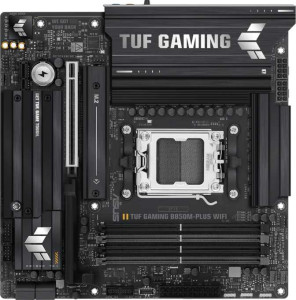
Asus TUF Gaming B850M-Plus WiFi
Gigabyte B850M Aorus Elite WiFi6E Ice

Asus TUF Gaming B850M-Plus WiFi Gigabyte B850M Aorus Elite WiFi6E Ice

Overview

When choosing between the Asus TUF Gaming B850M-Plus WiFi and the Gigabyte B850M Aorus Elite WiFi6E Ice, buyers are weighing two capable Micro-ATX motherboards built on the B850 chipset with AM5 socket support. While they share a strong common foundation — including DDR5 memory, PCIe 5.0, and Wi-Fi 6E — the two boards diverge meaningfully in areas like storage expansion, USB connectivity, and memory capacity headroom. Read on to see which board better suits your build.

Common Features

  • Both boards use the AM5 CPU socket.
  • Both boards feature the B850 chipset.
  • Both boards come in the Micro-ATX form factor.
  • Wi-Fi is available on both products.
  • Both boards support Wi-Fi 4 (802.11n), Wi-Fi 5 (802.11ac), Wi-Fi 6 (802.11ax), and Wi-Fi 6E (802.11ax).
  • Bluetooth is available on both products, at version 5.3.
  • Both boards are easy to overclock.
  • Both boards have 4 memory slots.
  • Both boards use DDR5 memory.
  • Both boards support 2 memory channels.
  • ECC memory is not supported on either product.
  • Neither board has USB 3.2 Gen 1 ports of the USB-C type on the rear panel.
  • Both boards provide 4 USB 2.0 rear ports.
  • Neither board has USB 4 40Gbps, USB 4 20Gbps, Thunderbolt 4, or Thunderbolt 3 ports.
  • Both boards include 1 DisplayPort output.
  • Both boards include 1 RJ45 ethernet port.
  • Both boards provide 2 USB 3.2 Gen 1 ports and 2 USB 3.0 ports through internal expansion headers.
  • Both boards provide 4 USB 2.0 ports through internal expansion headers.
  • Both boards provide 1 USB 3.2 Gen 2x2 port through internal expansion.
  • Both boards have 4 SATA 3 connectors and no SATA 2 connectors.
  • Neither board has a U.2 socket or an mSATA connector.
  • Both boards feature 1 PCIe 5.0 x16 slot and no PCIe 4.0 x16 or PCIe 3.0 x16 slots.
  • Both boards deliver 7.1 audio channels.
  • An S/PDIF Out port is present on both products.
  • Both boards support RAID 0, RAID 1, RAID 5, and RAID 10 (1+0), but neither supports RAID 0+1.

Main Differences

  • Maximum memory capacity is 192GB on Asus TUF Gaming B850M-Plus WiFi and 256GB on Gigabyte B850M Aorus Elite WiFi6E Ice.
  • Maximum overclocked RAM speed is 8000 MHz on Asus TUF Gaming B850M-Plus WiFi and 8200 MHz on Gigabyte B850M Aorus Elite WiFi6E Ice.
  • USB 3.2 Gen 2 ports (USB-A) count is 3 on Asus TUF Gaming B850M-Plus WiFi and 2 on Gigabyte B850M Aorus Elite WiFi6E Ice.
  • USB 3.2 Gen 1 ports (USB-A) count is 4 on Asus TUF Gaming B850M-Plus WiFi and 5 on Gigabyte B850M Aorus Elite WiFi6E Ice.
  • A USB 3.2 Gen 2 port (USB-C) is present on Gigabyte B850M Aorus Elite WiFi6E Ice but not available on Asus TUF Gaming B850M-Plus WiFi.
  • A USB 3.2 Gen 2x2 rear port is present on Asus TUF Gaming B850M-Plus WiFi but not available on Gigabyte B850M Aorus Elite WiFi6E Ice.
  • An HDMI output is present on Asus TUF Gaming B850M-Plus WiFi but not available on Gigabyte B850M Aorus Elite WiFi6E Ice.
  • Fan header count is 5 on Asus TUF Gaming B850M-Plus WiFi and 6 on Gigabyte B850M Aorus Elite WiFi6E Ice.
  • M.2 socket count is 3 on Asus TUF Gaming B850M-Plus WiFi and 2 on Gigabyte B850M Aorus Elite WiFi6E Ice.
  • A TPM connector is present on Gigabyte B850M Aorus Elite WiFi6E Ice but not available on Asus TUF Gaming B850M-Plus WiFi.
  • PCIe x1 slot count is 1 on Asus TUF Gaming B850M-Plus WiFi and 0 on Gigabyte B850M Aorus Elite WiFi6E Ice.
  • PCIe x4 slot count is 0 on Asus TUF Gaming B850M-Plus WiFi and 1 on Gigabyte B850M Aorus Elite WiFi6E Ice.
  • Audio connector count is 5 on Asus TUF Gaming B850M-Plus WiFi and 2 on Gigabyte B850M Aorus Elite WiFi6E Ice.
Specs Comparison
Asus TUF Gaming B850M-Plus WiFi

Asus TUF Gaming B850M-Plus WiFi

Gigabyte B850M Aorus Elite WiFi6E Ice

Gigabyte B850M Aorus Elite WiFi6E Ice

General info:
CPU socket AM5 AM5
chipset B850 B850
form factor Micro-ATX Micro-ATX
release date January 2025 January 2025
supports Wi-Fi
Wi-Fi version Wi-Fi 4 (802.11n), Wi-Fi 5 (802.11ac), Wi-Fi 6 (802.11ax), Wi-Fi 6E (802.11ax) Wi-Fi 4 (802.11n), Wi-Fi 5 (802.11ac), Wi-Fi 6 (802.11ax), Wi-Fi 6E (802.11ax)
Has Bluetooth
Bluetooth version 5.3 5.3
Easy to overclock
has RGB lighting
Easy to reset BIOS
Has dual BIOS
has aptX
CPU sockets 1 1
Has integrated graphics
warranty period 3 years 3 years
height 244 mm 244 mm
width 244 mm 244 mm
Has integrated CPU

In terms of general specifications, the Asus TUF Gaming B850M-Plus WiFi and the Gigabyte B850M Aorus Elite WiFi6E Ice are remarkably alike. Both boards are built around the AM5 socket with a B850 chipset, adopt the Micro-ATX form factor at identical 244 × 244 mm dimensions, and carry a 3-year warranty. For users planning a Ryzen build in a compact mid-tower or small case, either board fits the same physical and platform constraints without compromise.

Feature parity continues across connectivity and usability: both support Wi-Fi 6E (covering the full 802.11n/ac/ax spectrum), Bluetooth 5.3, and include dual BIOS and RGB lighting. Dual BIOS is a meaningful safety net for enthusiasts who overclock — if a bad flash bricks one BIOS chip, the board can recover automatically. Bluetooth 5.3 ensures low-latency, stable wireless peripheral connections. Neither board supports aptX audio or an integrated CPU, and neither offers a one-touch BIOS reset button, which is a minor inconvenience for frequent overclockers.

Based strictly on the provided general specs, these two motherboards are in a complete tie. Every attribute — platform, size, wireless standard, Bluetooth version, warranty, and feature set — is identical. No advantage can be assigned to either product from this group alone; the decision will need to rest on other spec groups such as VRM design, port selection, or pricing.

Memory:
maximum memory amount 192GB 256GB
overclocked RAM speed 8000 MHz 8200 MHz
memory slots 4 4
DDR memory version 5 5
memory channels 2 2
Supports ECC memory

The Asus TUF Gaming B850M-Plus WiFi and the Gigabyte B850M Aorus Elite WiFi6E Ice both support DDR5 memory with 4 memory slots and 2 memory channels. The Asus motherboard supports a maximum memory capacity of 192GB, while the Gigabyte model can handle up to 256GB, providing more flexibility for users needing larger memory configurations.

Both motherboards support overclocked RAM speeds, with the Asus board reaching up to 8000 MHz, while the Gigabyte board supports a slightly higher overclocked speed of 8200 MHz. Neither motherboard supports ECC memory, so they are not suitable for error-correcting memory configurations. The DDR memory version is identical between the two products, both using DDR5.

Overall, the Gigabyte board offers a higher maximum memory capacity and slightly better overclocked RAM speed compared to the Asus model, but both provide similar memory configurations in terms of slots, channels, and DDR memory version.

Ports:
USB 3.2 Gen 2 ports (USB-A) 3 2
USB 3.2 Gen 1 ports (USB-A) 4 5
USB 3.2 Gen 2 ports (USB-C) 0 1
USB 3.2 Gen 1 ports (USB-C) 0 0
USB 2.0 ports 4 4
USB 3.2 Gen 2x2 ports 1 0
USB 4 40Gbps ports 0 0
USB 4 20Gbps ports 0 0
Thunderbolt 4 ports 0 0
Thunderbolt 3 ports 0 0
has an HDMI output
DisplayPort outputs 1 1
RJ45 ports 1 1
Has USB Type-C
eSATA ports 0 0
DVI outputs 0 0
has a VGA connector
PS/2 ports 0 0

The Asus TUF Gaming B850M-Plus WiFi and the Gigabyte B850M Aorus Elite WiFi6E Ice offer different USB port configurations. The Asus board provides 3 USB 3.2 Gen 2 (USB-A) ports, 4 USB 3.2 Gen 1 (USB-A) ports, and 4 USB 2.0 ports, but does not include any USB 3.2 Gen 2 (USB-C) ports or USB 4 ports. In contrast, the Gigabyte board offers 2 USB 3.2 Gen 2 (USB-A) ports, 5 USB 3.2 Gen 1 (USB-A) ports, 1 USB 3.2 Gen 2 (USB-C) port, and lacks USB 3.2 Gen 2x2 or USB 4 40Gbps ports, similar to the Asus board. Both motherboards feature a single USB 2.0 port and do not have eSATA or Thunderbolt ports.

When it comes to display connectivity, the Asus board includes an HDMI output and a DisplayPort, whereas the Gigabyte board does not offer an HDMI output but has DisplayPort support. Both motherboards have one RJ45 port for wired networking and include a USB Type-C port, but the Asus board lacks a USB 3.2 Gen 2 (USB-C) port, while the Gigabyte board includes one. Neither board includes DVI outputs or VGA connectors, and both lack PS/2 ports.

In summary, the main differences between the two products are in the USB port options and display outputs. The Gigabyte board has an extra USB 3.2 Gen 2 (USB-C) port, while the Asus board includes an HDMI output, which the Gigabyte lacks. However, both motherboards are quite similar in terms of overall ports and connectivity options, offering a similar range of USB and display options.

Connectors:
USB 3.2 Gen 1 ports (through expansion) 2 2
USB 3.2 Gen 2x2 ports (through expansion) 1 1
USB 2.0 ports (through expansion) 4 4
SATA 3 connectors 4 4
fan headers 5 6
USB 3.0 ports (through expansion) 2 2
M.2 sockets 3 2
Has TPM connector
U.2 sockets 0 0
Has mSATA connector
SATA 2 connectors 0 0

The Asus TUF Gaming B850M-Plus WiFi and the Gigabyte B850M Aorus Elite WiFi6E Ice share many similar connectors, including 2 USB 3.2 Gen 1 ports (through expansion), 1 USB 3.2 Gen 2x2 port (through expansion), 4 USB 2.0 ports (through expansion), and 4 SATA 3 connectors. Both motherboards also offer 2 USB 3.0 ports (through expansion). However, the Gigabyte board includes 6 fan headers, while the Asus board has 5 fan headers, providing slightly more flexibility for cooling setup on the Gigabyte board.

In terms of M.2 sockets, the Asus board offers 3, while the Gigabyte board has 2, providing more M.2 slots on the Asus model. The Gigabyte board has a TPM connector, which the Asus board lacks. Both motherboards do not include U.2 sockets or mSATA connectors, and neither supports SATA 2 connectors.

Overall, while the connectors are quite similar across both products, the Gigabyte board offers an additional fan header and a TPM connector, whereas the Asus board offers an extra M.2 socket for storage expansion.

Expansion slots:
PCIe 4.0 x16 slots 0 0
PCIe 5.0 x16 slots 1 1
PCIe 3.0 x16 slots 0 0
PCIe x1 slots 1 0
PCI slots 0 0
PCIe 2.0 x16 slots 0 0
PCIe x4 slots 0 1
PCIe x8 slots 0 0

The Asus TUF Gaming B850M-Plus WiFi and the Gigabyte B850M Aorus Elite WiFi6E Ice both feature one PCIe 5.0 x16 slot, allowing for high-speed graphics card support. Neither board includes any PCIe 4.0 x16 slots, PCIe 3.0 x16 slots, or PCI slots. However, there are differences in the additional expansion slots. The Asus board includes one PCIe x1 slot, while the Gigabyte board does not. On the other hand, the Gigabyte board provides one PCIe x4 slot, which the Asus board lacks.

Both motherboards have no PCIe 2.0 x16 slots or PCIe x8 slots, keeping their expansion slot configurations quite similar overall. The main difference lies in the availability of a PCIe x4 slot on the Gigabyte board versus the PCIe x1 slot on the Asus board, which may offer slightly different expansion possibilities depending on your needs.

In summary, both motherboards offer similar high-speed PCIe slots with a focus on PCIe 5.0 x16 support, but the Gigabyte board provides a bit more flexibility with the inclusion of a PCIe x4 slot, while the Asus board includes a PCIe x1 slot for other expansion options.

Audio:
audio channels 7.1 7.1
Has S/PDIF Out port
audio connectors 5 2

Both the Asus TUF Gaming B850M-Plus WiFi and the Gigabyte B850M Aorus Elite WiFi6E Ice support 7.1 audio channels, offering high-quality surround sound for users. Both motherboards also feature an S/PDIF Out port, allowing for digital audio output. However, there is a notable difference in the number of audio connectors. The Asus board provides 5 audio connectors, while the Gigabyte board offers only 2 audio connectors.

This difference in the number of connectors means that the Asus motherboard offers more flexibility for connecting additional audio devices or speakers compared to the Gigabyte model, which is more limited in this regard.

In summary, while both motherboards support the same audio channels and include an S/PDIF Out port, the Asus board offers a greater number of audio connectors, making it a better choice for users who need multiple audio device connections.

Storage:
Supports RAID 1
Supports RAID 10 (1+0)
Supports RAID 5
Supports RAID 0
Supports RAID 0+1

The Asus TUF Gaming B850M-Plus WiFi and the Gigabyte B850M Aorus Elite WiFi6E Ice both support a range of RAID configurations, including RAID 1, RAID 10 (1+0), RAID 5, and RAID 0. Neither motherboard supports RAID 0+1, so users looking for that specific RAID level will not find it on either board.

Both products offer identical RAID support options, so there are no differences in this specification between the two motherboards. They both provide solid RAID capabilities for users looking to configure their storage for redundancy or performance.

In summary, the storage capabilities of both the Asus and Gigabyte boards are nearly identical, with both offering the same RAID support and lacking RAID 0+1 functionality.

Comparison Summary & Verdict

Both boards deliver a solid B850 Micro-ATX foundation with AM5 compatibility, Wi-Fi 6E, Bluetooth 5.3, and full RAID support. However, their differences point to distinct audiences. The Asus TUF Gaming B850M-Plus WiFi stands out with three M.2 slots, a USB 3.2 Gen 2x2 rear port, an HDMI output, and five audio connectors — making it the stronger pick for users who prioritize local storage flexibility and richer multimedia connectivity. The Gigabyte B850M Aorus Elite WiFi6E Ice counters with a higher 256GB memory ceiling, faster 8200 MHz overclocked RAM support, a USB-C Gen 2 rear port, a TPM connector, and an extra fan header, appealing to users focused on memory-intensive workloads, security features, and superior thermal management. Choose the Asus for storage-heavy or media-rich setups; choose the Gigabyte for maximum RAM headroom and a more future-oriented I/O profile.

Asus TUF Gaming B850M-Plus WiFi
Buy Asus TUF Gaming B850M-Plus WiFi if...

Buy the Asus TUF Gaming B850M-Plus WiFi if you need more M.2 storage slots, a rear HDMI output, or a richer audio connector layout. It is also the better choice if you require a USB 3.2 Gen 2x2 rear port.

Gigabyte B850M Aorus Elite WiFi6E Ice
Buy Gigabyte B850M Aorus Elite WiFi6E Ice if...

Buy the Gigabyte B850M Aorus Elite WiFi6E Ice if you need maximum memory capacity up to 256GB, faster overclocked RAM support, a USB-C Gen 2 rear port, or a TPM connector for enhanced security.