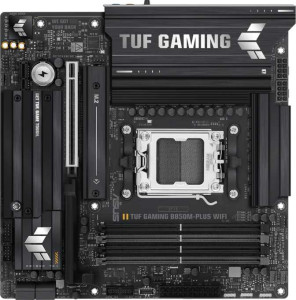
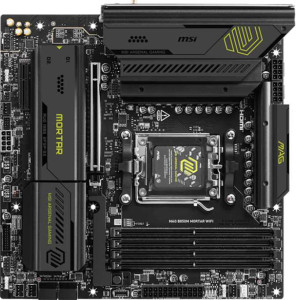
Both boards share the same core identity: AM5 socket, B850 chipset, and a Micro-ATX form factor at an identical 244 × 244 mm footprint. They both support Wi-Fi, Bluetooth, RGB lighting, dual BIOS, and carry a 3-year warranty — so the platform fundamentals are essentially a tie. Neither board has integrated graphics or an integrated CPU, which is expected at this tier.
The meaningful differences emerge in the details. The MSI MAG B850M Mortar WiFi supports Wi-Fi 7 (802.11be), while the Asus TUF tops out at Wi-Fi 6E. In practice, Wi-Fi 7 delivers significantly higher theoretical throughput and lower latency, particularly on the new 320 MHz channels — relevant if you have a Wi-Fi 7 router today or plan to upgrade soon. The MSI also edges ahead with Bluetooth 5.4 versus the Asus's 5.3, bringing minor improvements in connection reliability and energy efficiency. On top of that, the MSI offers an easy BIOS reset mechanism, while the Asus does not — a small but genuinely useful convenience during troubleshooting or after a failed overclock.
For this spec group, the MSI MAG B850M Mortar WiFi holds a clear advantage. Its Wi-Fi 7 support is the single most impactful differentiator — it is a forward-looking feature the Asus simply lacks — and the easier BIOS reset adds practical value. The Asus TUF is not meaningfully weaker in day-to-day use if you have no Wi-Fi 7 infrastructure, but on paper the MSI offers more for the same form factor and chipset.