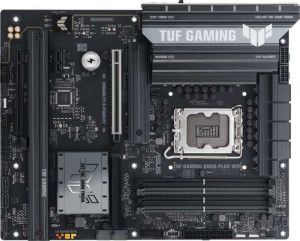
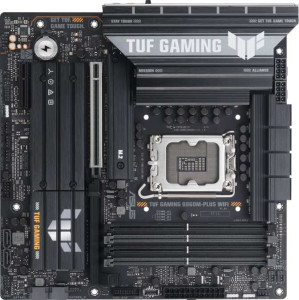
At their core, the Asus TUF Gaming B860-Plus WiFi and the B860M-Plus WiFi are built on the same foundation: identical LGA 1851 socket and B860 chipset, identical wireless capabilities up to Wi-Fi 7 and Bluetooth 5.4, and the same feature set including dual BIOS, easy BIOS reset, RGB lighting, and overclocking support. Even the warranty period and HDMI version are identical. For a user scanning this spec group, the two boards are functionally a mirror image of each other in almost every meaningful way.
The one and only differentiator here is form factor. The B860-Plus is a full ATX board measuring 305 × 244 mm, while the B860M-Plus is a Micro-ATX board at 244 × 244 mm — 61 mm narrower. In practice, this means the M-Plus fits into smaller Mid-Tower or Micro-ATX cases, making it the right pick for a more compact build. The trade-off is that a smaller PCB typically means fewer expansion slots and headers, which may matter depending on your planned configuration — though those details fall outside this spec group.
Edge: Tied on features; form factor decides the winner for your use case. If case size is not a constraint and you want maximum expandability headroom, the B860-Plus (ATX) has the physical advantage. If you are targeting a smaller, cleaner build, the B860M-Plus (Micro-ATX) delivers the exact same general feature set in a more compact footprint. Neither board holds an advantage in connectivity, wireless, or platform support within this group.