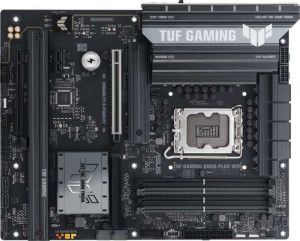
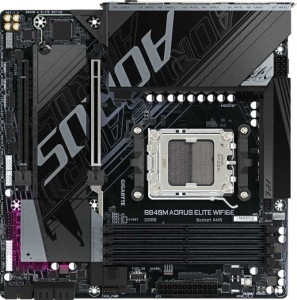
The most fundamental difference between these two boards is their CPU socket: the Asus TUF Gaming B860-Plus WiFi uses LGA 1851, making it an Intel platform board, while the Gigabyte B840M Aorus Elite WiFi6E uses AM5, targeting AMD Ryzen processors. This means these boards are not interchangeable — your CPU choice determines which board is even relevant to you. Beyond platform, form factor is another major split: the TUF is a full ATX (305 × 244 mm), offering more expansion room, while the Gigabyte is a compact Micro-ATX (244 × 244 mm), better suited for smaller builds.
On connectivity, the TUF holds a meaningful edge: it supports up to Wi-Fi 7 (802.11be), the latest standard offering significantly higher throughput and lower latency on compatible routers, whereas the Gigabyte tops out at Wi-Fi 6E. The TUF also has a marginally newer Bluetooth 5.4 versus the Gigabyte's 5.3, though the real-world difference is minor. Both boards share HDMI 2.1, dual BIOS, and the same 3-year warranty. Notably, the TUF includes RGB lighting and an easy BIOS reset mechanism, features absent on the Gigabyte — small but relevant quality-of-life advantages for builders and enthusiasts.
Overall, neither board is universally superior — the right choice is dictated first by your CPU platform. Within their respective ecosystems, the Asus TUF Gaming B860-Plus WiFi has a clearer feature edge: Wi-Fi 7 support, easier BIOS management, RGB, and a larger ATX layout give it more flexibility and future-proofing. The Gigabyte B840M Aorus Elite WiFi6E trades those extras for a smaller footprint, which is a worthwhile advantage only if your build specifically benefits from the Micro-ATX size.