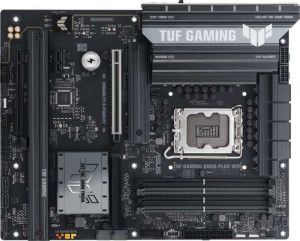
Asus TUF Gaming B860-Plus WiFi
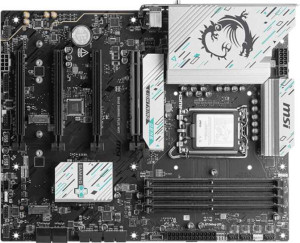
MSI B860 Gaming Plus WiFi

Asus TUF Gaming B860-Plus WiFi MSI B860 Gaming Plus WiFi

Overview

Choosing between the Asus TUF Gaming B860-Plus WiFi and the MSI B860 Gaming Plus WiFi means weighing two capable B860-chipset ATX motherboards that share the same LGA 1851 socket, Wi-Fi 7 support, and DDR5 memory platform. While they cover a lot of the same ground, key battlegrounds emerge around rear port variety, audio connectivity, and internal expansion options. Read on for a full spec-by-spec breakdown to find out which board is the right fit for your next build.

Common Features

  • Both boards use the LGA 1851 CPU socket.
  • Both boards feature the B860 chipset.
  • Both boards use the ATX form factor.
  • Wi-Fi is supported on both boards, covering Wi-Fi 4, Wi-Fi 5, Wi-Fi 6, Wi-Fi 6E, and Wi-Fi 7.
  • Bluetooth 5.4 is available on both boards.
  • Both boards include an HDMI 2.1 output.
  • Both boards support a maximum of 256GB of memory.
  • Both boards have 4 memory slots.
  • Both boards use DDR5 memory.
  • Both boards have 2 memory channels.
  • ECC memory is not supported on either board.
  • Both boards have 2 USB 3.2 Gen 2 Type-A ports on the rear panel.
  • Neither board has a rear USB 3.2 Gen 2 Type-C port.
  • Neither board has a Thunderbolt 3 port.
  • Both boards include 1 DisplayPort output.
  • Both boards include 1 RJ45 networking port.
  • Both boards have 4 SATA 3 connectors.
  • Both boards have 6 fan headers.
  • Both boards have 3 M.2 sockets.
  • Both boards include 1 USB-C 3.2 Gen 2 port through internal expansion.
  • Both boards have 1 PCIe 5.0 x16 slot and 1 PCIe 4.0 x16 slot.
  • Both boards support 7.1 audio channels.
  • Both boards support RAID 0, RAID 1, RAID 5, and RAID 10.

Main Differences

  • Height is 244 mm on Asus TUF Gaming B860-Plus WiFi and 243.8 mm on MSI B860 Gaming Plus WiFi.
  • Width is 305 mm on Asus TUF Gaming B860-Plus WiFi and 304.8 mm on MSI B860 Gaming Plus WiFi.
  • Maximum overclocked RAM speed is 8666 MHz on Asus TUF Gaming B860-Plus WiFi and 8600 MHz on MSI B860 Gaming Plus WiFi.
  • USB 3.2 Gen 1 Type-A rear ports number 3 on Asus TUF Gaming B860-Plus WiFi and 2 on MSI B860 Gaming Plus WiFi.
  • USB 2.0 rear ports number 2 on Asus TUF Gaming B860-Plus WiFi and 4 on MSI B860 Gaming Plus WiFi.
  • A USB 3.2 Gen 2x2 rear port is present on Asus TUF Gaming B860-Plus WiFi but not available on MSI B860 Gaming Plus WiFi.
  • A USB 4 40Gbps port is present on MSI B860 Gaming Plus WiFi but not available on Asus TUF Gaming B860-Plus WiFi.
  • A Thunderbolt 4 port is present on MSI B860 Gaming Plus WiFi but not available on Asus TUF Gaming B860-Plus WiFi.
  • Internal USB 3.2 Gen 1 expansion ports number 2 on Asus TUF Gaming B860-Plus WiFi and 4 on MSI B860 Gaming Plus WiFi.
  • Internal USB 2.0 expansion ports number 2 on Asus TUF Gaming B860-Plus WiFi and 4 on MSI B860 Gaming Plus WiFi.
  • Internal USB 3.0 expansion ports number 2 on Asus TUF Gaming B860-Plus WiFi and 4 on MSI B860 Gaming Plus WiFi.
  • A TPM connector is present on MSI B860 Gaming Plus WiFi but not available on Asus TUF Gaming B860-Plus WiFi.
  • PCIe x1 slots number 1 on Asus TUF Gaming B860-Plus WiFi and 2 on MSI B860 Gaming Plus WiFi.
  • An S/PDIF Out port is present on Asus TUF Gaming B860-Plus WiFi but not available on MSI B860 Gaming Plus WiFi.
  • Audio connectors number 5 on Asus TUF Gaming B860-Plus WiFi and 3 on MSI B860 Gaming Plus WiFi.
Specs Comparison
Asus TUF Gaming B860-Plus WiFi

Asus TUF Gaming B860-Plus WiFi

MSI B860 Gaming Plus WiFi

MSI B860 Gaming Plus WiFi

General info:
CPU socket LGA 1851 LGA 1851
chipset B860 B860
form factor ATX ATX
release date January 2025 January 2025
supports Wi-Fi
Wi-Fi version Wi-Fi 4 (802.11n), Wi-Fi 5 (802.11ac), Wi-Fi 6 (802.11ax), Wi-Fi 6E (802.11ax), Wi-Fi 7 (802.11be) Wi-Fi 4 (802.11n), Wi-Fi 5 (802.11ac), Wi-Fi 6 (802.11ax), Wi-Fi 6E (802.11ax), Wi-Fi 7 (802.11be)
Has Bluetooth
Bluetooth version 5.4 5.4
HDMI version HDMI 2.1 HDMI 2.1
Easy to overclock
has RGB lighting
Easy to reset BIOS
Has dual BIOS
has aptX
CPU sockets 1 1
Has integrated graphics
warranty period 3 years 3 years
height 244 mm 243.8 mm
width 305 mm 304.8 mm
Has integrated CPU

In terms of general specifications, the Asus TUF Gaming B860-Plus WiFi and the MSI B860 Gaming Plus WiFi are remarkably aligned. Both boards share the same LGA 1851 socket and B860 chipset, use a standard ATX form factor, and offer identical connectivity credentials: Wi-Fi 7 (backwards compatible through Wi-Fi 4), Bluetooth 5.4, and HDMI 2.1. Both support overclocking, feature RGB lighting, offer easy BIOS reset, and include a dual BIOS — a meaningful safety net that lets users recover from a failed flash without needing extra hardware. Neither board has integrated graphics or an integrated CPU, which is standard for this class of motherboard.

The only measurable difference between the two lies in their physical dimensions: the Asus measures 244 × 305 mm while the MSI comes in at 243.8 × 304.8 mm — a delta of 0.2 mm on each side. In practice, this is a manufacturing tolerance difference with zero real-world impact; both will fit identically in any ATX-compatible case. Warranty coverage is also identical at 3 years for both.

Based strictly on the general info specs, these two boards are essentially tied. There is no meaningful differentiator in this category — connectivity, platform, form factor, feature set, and warranty are all equivalent. A buyer choosing between them on these specs alone would need to look to other spec groups, such as memory support, storage options, or audio, to find a decisive advantage.
Memory:
maximum memory amount 256GB 256GB
overclocked RAM speed 8666 MHz 8600 MHz
memory slots 4 4
DDR memory version 5 5
memory channels 2 2
Supports ECC memory

The memory configurations of these two boards are nearly identical across the board. Both support DDR5 with 4 slots, a maximum capacity of 256GB, and operate in dual-channel mode — the latter being particularly important, as dual-channel memory delivers significantly higher bandwidth than single-channel, benefiting CPU-intensive workloads, gaming, and content creation alike. Neither board supports ECC memory, which is expected at this non-workstation chipset tier.

The sole differentiator here is the maximum overclocked RAM speed: the Asus TUF Gaming B860-Plus WiFi tops out at 8666 MHz, versus 8600 MHz for the MSI B860 Gaming Plus WiFi. While a higher ceiling is technically an advantage, a gap of just 66 MHz is negligible in practice — at these extreme frequencies, real-world performance differences between the two would be imperceptible in virtually any application or benchmark.

This category is effectively a tie. The Asus holds a marginal numerical edge in peak overclocked speed, but it carries no meaningful real-world weight. Users focused on memory capacity, slot count, or DDR generation will find both boards equally capable.

Ports:
USB 3.2 Gen 2 ports (USB-A) 2 2
USB 3.2 Gen 1 ports (USB-A) 3 2
USB 3.2 Gen 2 ports (USB-C) 0 0
USB 3.2 Gen 1 ports (USB-C) 0 0
USB 2.0 ports 2 4
USB 3.2 Gen 2x2 ports 1 0
USB 4 40Gbps ports 0 1
USB 4 20Gbps ports 0 0
Thunderbolt 4 ports 0 1
Thunderbolt 3 ports 0 0
has an HDMI output
DisplayPort outputs 1 1
RJ45 ports 1 1
Has USB Type-C
eSATA ports 0 0
DVI outputs 0 0
has a VGA connector
PS/2 ports 0 0

While both boards share a solid common foundation — dual USB 3.2 Gen 2 Type-A ports, HDMI, DisplayPort, and a single RJ45 — the rear I/O panel is where a meaningful divergence emerges. The MSI B860 Gaming Plus WiFi includes a Thunderbolt 4 port paired with a USB 4 40Gbps port, while the Asus TUF Gaming B860-Plus WiFi offers neither. Thunderbolt 4 is a significant real-world feature: it supports up to 40Gbps data transfers, can drive high-resolution external displays, power compatible devices, and even connect external GPU enclosures — capabilities that no other port on either board can match.

The Asus counters with a USB 3.2 Gen 2x2 port (20Gbps), which is a capable high-speed option useful for fast NVMe enclosures or high-speed storage docks — but its bandwidth ceiling is half that of the MSI's Thunderbolt 4 connection. The Asus also edges ahead with 3 USB 3.2 Gen 1 Type-A ports versus MSI's 2, though this advantage is minor and partially offset by the MSI offering 4 USB 2.0 ports to Asus's 2, which matters for users connecting multiple legacy peripherals like keyboards, mice, or dongles.

The MSI B860 Gaming Plus WiFi holds a clear edge in this category. Thunderbolt 4 is a premium feature that meaningfully expands a system's connectivity options — from pro-grade peripherals to external displays and storage — and its presence on the MSI is a genuine differentiator that the Asus's Gen 2x2 port cannot fully replicate.

Connectors:
USB 3.2 Gen 1 ports (through expansion) 2 4
USB-C 3.2 Gen 2 ports (through expansion) 1 1
USB 2.0 ports (through expansion) 2 4
SATA 3 connectors 4 4
fan headers 6 6
USB 3.0 ports (through expansion) 2 4
M.2 sockets 3 3
Has TPM connector
U.2 sockets 0 0
Has mSATA connector
SATA 2 connectors 0 0

Strip away the identical entries — 3 M.2 sockets, 4 SATA 3 connectors, 6 fan headers, and a single USB-C 3.2 Gen 2 internal header — and two points of divergence come into focus. The MSI B860 Gaming Plus WiFi provides double the internal USB expansion headers of the Asus: 4 USB 3.2 Gen 1 and 4 USB 2.0 internal ports versus the Asus TUF Gaming B860-Plus WiFi's 2 of each. For users building cases with multiple front-panel USB connections or adding internal expansion cards that require USB headers, this additional headroom is a practical advantage.

The second differentiator is the MSI's inclusion of a TPM connector, which the Asus lacks. A dedicated TPM header allows users to install a discrete TPM module — relevant for enterprise environments, security-conscious builds, or certain compliance requirements. While modern platforms often handle TPM functionality through firmware, having a physical header provides flexibility that the Asus simply does not offer.

The MSI B860 Gaming Plus WiFi takes this category. Its superior internal USB header count gives builders more front-panel and expansion flexibility, and the TPM connector adds a security-oriented option absent from the Asus. Neither advantage is dramatic for a typical home build, but for system integrators or users with specific expansion needs, the MSI is the more accommodating platform here.

Expansion slots:
PCIe 4.0 x16 slots 1 1
PCIe 5.0 x16 slots 1 1
PCIe 3.0 x16 slots 0 0
PCIe x1 slots 1 2
PCI slots 0 0
PCIe 2.0 x16 slots 0 0
PCIe x4 slots 0 0
PCIe x8 slots 0 0

Both boards offer the same high-bandwidth slot configuration: one PCIe 5.0 x16 slot for a primary GPU and one PCIe 4.0 x16 slot for a secondary card or other expansion. The PCIe 5.0 primary slot is the headline here — it doubles the available bandwidth over PCIe 4.0, ensuring the board is ready for current and near-future graphics cards or NVMe expansion cards that can saturate that bandwidth. For the vast majority of single-GPU gaming or workstation builds, this shared foundation is entirely sufficient.

The only difference between the two lies in the number of PCIe x1 slots: the MSI B860 Gaming Plus WiFi provides 2, while the Asus TUF Gaming B860-Plus WiFi offers just 1. PCIe x1 slots are typically used for add-in cards such as sound cards, capture cards, USB expansion cards, or networking adapters. Having a second slot means users can install two such cards simultaneously without consuming the secondary x16 slot — a meaningful advantage for more complex or media-production-oriented builds.

The MSI B860 Gaming Plus WiFi holds a modest but real edge here. The core GPU slot configuration is identical, so neither board has an advantage for primary graphics. However, the extra PCIe x1 slot gives the MSI more flexibility for users who rely on multiple add-in cards, making it the more versatile choice for expanded builds.

Audio:
audio channels 7.1 7.1
Has S/PDIF Out port
audio connectors 5 3

Audio is a category where the Asus TUF Gaming B860-Plus WiFi pulls ahead noticeably. Both boards support 7.1 surround sound, which is the standard for immersive gaming and home theater setups, but the similarities largely end there. The Asus equips its rear panel with 5 audio connectors compared to just 3 on the MSI. More physical jacks means users can simultaneously connect a wider range of analog audio devices — front and rear speakers, a subwoofer, and a microphone — without relying on a splitter or external audio interface.

The more significant gap is the Asus's inclusion of an S/PDIF optical output, which the MSI omits entirely. S/PDIF is the standard digital audio output used to connect a motherboard directly to an AV receiver, a soundbar, or a dedicated DAC via optical cable, transmitting a clean digital signal that bypasses the motherboard's analog circuitry. For users with a home theater receiver or high-quality external audio equipment, this port is not a luxury — it is often the preferred connection method for achieving the best possible sound quality.

The Asus TUF Gaming B860-Plus WiFi wins this category clearly. Its higher analog connector count offers more simultaneous hookup flexibility, and the S/PDIF output adds a digital audio pathway that the MSI simply cannot provide. Users who care about audio quality or have existing optical-capable equipment will find the Asus meaningfully better equipped.

Storage:
Supports RAID 1
Supports RAID 10 (1+0)
Supports RAID 5
Supports RAID 0
Supports RAID 0+1

On the storage configuration front, these two boards are in complete lockstep. Both support RAID 0 (striping for maximum performance), RAID 1 (mirroring for redundancy), RAID 5 (striped with parity for a balance of speed and fault tolerance), and RAID 10 (a combination of mirroring and striping offering both speed and redundancy). Neither supports RAID 0+1, but this is a minor omission given that RAID 10 covers the same fundamental use case with better fault tolerance characteristics.

This storage spec set is a tie — there is no differentiator between the two boards here. Users planning multi-drive arrays for NAS-style redundancy, high-throughput workstations, or data-protection setups will find both platforms equally capable of meeting their needs without compromise.

Comparison Summary & Verdict

The Asus TUF Gaming B860-Plus WiFi and MSI B860 Gaming Plus WiFi are closely matched B860 motherboards that share Wi-Fi 7, DDR5 support up to 256GB across four slots, three M.2 sockets, and full RAID support. Yet their differences point each board toward a distinct type of builder. The Asus TUF Gaming B860-Plus WiFi is the stronger choice for users who value audio versatility, delivering five audio connectors plus an S/PDIF Out port, as well as a USB 3.2 Gen 2x2 port for high-bandwidth peripherals. The MSI B860 Gaming Plus WiFi shines for those who demand cutting-edge connectivity, with a Thunderbolt 4 port, a USB 4 40Gbps port, a TPM connector for added security, and significantly more internal USB expansion headers. Your decision should come down to whether a richer audio setup or future-proof high-speed port connectivity is the higher priority for your system.

Asus TUF Gaming B860-Plus WiFi
Buy Asus TUF Gaming B860-Plus WiFi if...

Buy the Asus TUF Gaming B860-Plus WiFi if you want a richer audio setup with 5 connectors and S/PDIF Out, or need a USB 3.2 Gen 2x2 port for high-speed peripherals.

MSI B860 Gaming Plus WiFi
Buy MSI B860 Gaming Plus WiFi if...

Buy the MSI B860 Gaming Plus WiFi if cutting-edge connectivity is a priority, as it offers Thunderbolt 4, a USB 4 40Gbps port, a TPM connector, and more internal USB expansion headers.