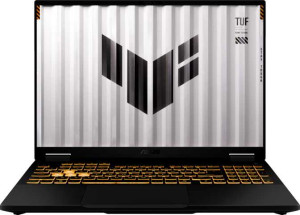
Asus TUF Gaming F16 (2025) FX608 16"
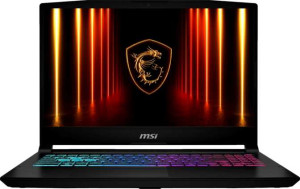
MSI Katana 15 HX B14W (2025) 15.6"

Asus TUF Gaming F16 (2025) FX608 16" MSI Katana 15 HX B14W (2025) 15.6"

Overview

Welcome to our in-depth specification comparison between the Asus TUF Gaming F16 (2025) FX608 16″ and the MSI Katana 15 HX B14W (2025) 15.6″. Both are gaming laptops built around the same Blackwell GPU architecture and a 165Hz QHD+ display, yet they take noticeably different approaches to CPU performance, portability, and connectivity. Read on to discover how these two 2025 contenders stack up across every key specification category.

Common Features

  • Both are gaming laptops.
  • Neither device uses a fanless design.
  • Both laptops feature a backlit keyboard.
  • Neither laptop is weather-sealed or splashproof.
  • Neither device has a rugged build.
  • Both share a display resolution of 2560 x 1600 px.
  • Both use an LCD, LED-backlit, IPS display type.
  • Neither laptop has a touch screen.
  • Both displays have a refresh rate of 165Hz.
  • Both support up to 4 external displays.
  • Both come with 32GB of RAM.
  • Both have a RAM speed of 5600 MHz.
  • Both use flash storage.
  • Both have 8GB of VRAM.
  • Both deliver a floating-point performance of 23.22 TFLOPS.
  • Both use GDDR7 memory.
  • Both have a texture rate of 362.9 GTexels/s.
  • Both have a pixel rate of 121 GPixel/s.
  • Both scored 19987 on the PassMark (G3D) benchmark.
  • Both have 1 USB 3.2 Gen 2 Type-C port and 3 USB 3.2 Gen 2 Type-A ports.
  • Neither device has any USB 4 20Gbps, USB 3.2 Gen 1, or Thunderbolt 3 ports.
  • Both laptops include an HDMI output.
  • Both laptops have a USB Type-C port.
  • Both support sleep-and-charge via USB ports.
  • Neither uses a MagSafe power adapter.
  • Both have stereo speakers.
  • Both include a 3.5mm audio jack.
  • Both support ray tracing.
  • Both support DLSS.
  • Neither laptop supports Dolby Atmos.
  • Neither includes a stylus.
  • Neither has a fingerprint scanner.
  • Both have 1 microphone.
  • Both have a clock multiplier of 22.
  • Both support Intel Resizable BAR.
  • Both use the Blackwell GPU architecture.
  • Neither has LHR (Lite Hash Rate) restrictions.
  • Both have a Thermal Design Power (TDP) of 50W.
  • Both support 3D.
  • Both support multi-display technology.
  • Both support OpenCL version 3.

Main Differences

  • Weight is 2200g on Asus TUF Gaming F16 (2025) FX608 16″ and 2400g on MSI Katana 15 HX B14W (2025) 15.6″.
  • Volume is 1618.842 cm³ on Asus TUF Gaming F16 (2025) FX608 16″ and 2351.45 cm³ on MSI Katana 15 HX B14W (2025) 15.6″.
  • Width is 354mm on Asus TUF Gaming F16 (2025) FX608 16″ and 359mm on MSI Katana 15 HX B14W (2025) 15.6″.
  • Height is 269mm on Asus TUF Gaming F16 (2025) FX608 16″ and 262mm on MSI Katana 15 HX B14W (2025) 15.6″.
  • Thickness is 17mm on Asus TUF Gaming F16 (2025) FX608 16″ and 25mm on MSI Katana 15 HX B14W (2025) 15.6″.
  • Screen size is 16″ on Asus TUF Gaming F16 (2025) FX608 16″ and 15.6″ on MSI Katana 15 HX B14W (2025) 15.6″.
  • Pixel density is 188 ppi on Asus TUF Gaming F16 (2025) FX608 16″ and 193 ppi on MSI Katana 15 HX B14W (2025) 15.6″.
  • Anti-reflection coating is present on Asus TUF Gaming F16 (2025) FX608 16″ but not available on MSI Katana 15 HX B14W (2025) 15.6″.
  • CPU speed is 8 x 2.2 & 8 x 1.6 GHz on Asus TUF Gaming F16 (2025) FX608 16″ and 8 x 2.2 & 16 x 1.6 GHz on MSI Katana 15 HX B14W (2025) 15.6″.
  • CPU thread count is 24 on Asus TUF Gaming F16 (2025) FX608 16″ and 32 on MSI Katana 15 HX B14W (2025) 15.6″.
  • Maximum memory is 64GB on Asus TUF Gaming F16 (2025) FX608 16″ and 96GB on MSI Katana 15 HX B14W (2025) 15.6″.
  • Turbo clock speed is 5.2GHz on Asus TUF Gaming F16 (2025) FX608 16″ and 5.8GHz on MSI Katana 15 HX B14W (2025) 15.6″.
  • Geekbench 6 multi-core score is 13325 on Asus TUF Gaming F16 (2025) FX608 16″ and 15655 on MSI Katana 15 HX B14W (2025) 15.6″.
  • Geekbench 6 single-core score is 2443 on Asus TUF Gaming F16 (2025) FX608 16″ and 2680 on MSI Katana 15 HX B14W (2025) 15.6″.
  • PassMark score is 34910 on Asus TUF Gaming F16 (2025) FX608 16″ and 45332 on MSI Katana 15 HX B14W (2025) 15.6″.
  • PassMark single-core score is 3862 on Asus TUF Gaming F16 (2025) FX608 16″ and 4245 on MSI Katana 15 HX B14W (2025) 15.6″.
  • A USB 4 40Gbps port is present on Asus TUF Gaming F16 (2025) FX608 16″ but not available on MSI Katana 15 HX B14W (2025) 15.6″.
  • A Thunderbolt 4 port is present on Asus TUF Gaming F16 (2025) FX608 16″ but not available on MSI Katana 15 HX B14W (2025) 15.6″.
  • An RJ45 (Ethernet) port is present on Asus TUF Gaming F16 (2025) FX608 16″ but not available on MSI Katana 15 HX B14W (2025) 15.6″.
  • Battery size is 90Wh on Asus TUF Gaming F16 (2025) FX608 16″ and 75Wh on MSI Katana 15 HX B14W (2025) 15.6″.
  • 3D facial recognition is available on Asus TUF Gaming F16 (2025) FX608 16″ but not on MSI Katana 15 HX B14W (2025) 15.6″.
  • Voice command support is present on Asus TUF Gaming F16 (2025) FX608 16″ but not on MSI Katana 15 HX B14W (2025) 15.6″.
  • The integrated GPU is UHD Graphics 710 on Asus TUF Gaming F16 (2025) FX608 16″ and UHD Graphics 770 on MSI Katana 15 HX B14W (2025) 15.6″.
  • L3 cache is 30MB on Asus TUF Gaming F16 (2025) FX608 16″ and 36MB on MSI Katana 15 HX B14W (2025) 15.6″.
  • GPU execution units number 16 on Asus TUF Gaming F16 (2025) FX608 16″ and 32 on MSI Katana 15 HX B14W (2025) 15.6″.
Specs Comparison
Asus TUF Gaming F16 (2025) FX608 16"

Asus TUF Gaming F16 (2025) FX608 16"

MSI Katana 15 HX B14W (2025) 15.6"

MSI Katana 15 HX B14W (2025) 15.6"

Design:
Type Gaming Gaming
weight 2200 g 2400 g
Uses a fanless design
Has a backlit keyboard
volume 1618.842 cm³ 2351.45 cm³
width 354 mm 359 mm
height 269 mm 262 mm
thickness 17 mm 25 mm
is weather-sealed (splashproof)
has a rugged build

Both laptops are purpose-built gaming machines and share the same baseline design DNA: active cooling (no fanless design), a backlit keyboard for low-light gaming sessions, and no weather sealing or rugged reinforcement. These shared omissions are entirely typical for the gaming segment, so neither product stands out — or falls behind — on those fronts.

Where the two diverge meaningfully is in physical footprint and portability. The Asus TUF Gaming F16 is notably slimmer at 17 mm thick versus the MSI Katana 15's 25 mm — an 8 mm difference that is immediately perceptible when sliding either machine into a bag. That slimmer chassis also contributes to a significantly smaller overall volume: 1,618 cm³ for the TUF F16 compared to 2,351 cm³ for the Katana 15, meaning the Asus occupies roughly 31% less physical space. Combined with a 200 g weight advantage (2,200 g vs. 2,400 g), the TUF F16 is the more portable of the two on every measurable dimension — and this is despite housing a larger 16″ panel versus the Katana's 15.6″ screen.

The edge in this group goes clearly to the Asus TUF Gaming F16. Its ability to fit a bigger display into a lighter, thinner, and more compact chassis is a genuine engineering advantage for users who need to carry their machine regularly. The MSI Katana 15 is not unusually bulky for a gaming laptop, but the extra thickness and weight offer no compensating design benefit based on the available specs.

Display:
screen size 16" 15.6"
resolution 2560 x 1600 px 2560 x 1600 px
pixel density 188 ppi 193 ppi
Display type LCD, LED-backlit, IPS LCD, LED-backlit, IPS
has a touch screen
refresh rate 165Hz 165Hz
has anti-reflection coating
supported displays 4 4

On paper, these two displays are remarkably close. Both share the same 2560 x 1600 resolution, identical 165 Hz refresh rate, and the same IPS LCD panel technology — meaning color viewing angles, response characteristics, and motion clarity are in the same ballpark. The pixel density difference (188 ppi on the TUF F16 vs. 193 ppi on the Katana 15) is a direct consequence of fitting the same resolution into a 16″ versus 15.6″ panel; in practice, both figures are sharp enough that the 5 ppi gap is imperceptible at normal viewing distances.

The single meaningful differentiator in this group is the anti-reflection coating present on the Asus TUF Gaming F16 and absent on the MSI Katana 15. This is not a cosmetic detail — in any environment with overhead lighting, windows, or mixed ambient light (a dorm room, a LAN party, a coffee shop), an uncoated panel will reflect glare directly back at the user, washing out dark scenes and causing eye fatigue during extended sessions. The TUF F16's coated panel handles these conditions noticeably better, making it the more versatile display for real-world use outside a blacked-out gaming den.

The edge here belongs to the Asus TUF Gaming F16. The core display specs are a virtual tie, but the anti-reflection coating is a practical, everyday advantage that the Katana 15 simply cannot match based on the available data.

Performance:
RAM 32GB 32GB
RAM speed 5600 MHz 5600 MHz
Uses flash storage
CPU speed 8 x 2.2 & 8 x 1.6 GHz 8 x 2.2 & 16 x 1.6 GHz
CPU threads 24 threads 32 threads
VRAM 8GB 8GB
floating-point performance 23.22 TFLOPS 23.22 TFLOPS
GDDR version GDDR7 GDDR7
texture rate 362.9 GTexels/s 362.9 GTexels/s
pixel rate 121 GPixel/s 121 GPixel/s
Is an NVMe SSD
DirectX version DirectX 12 Ultimate DirectX 12 Ultimate
GPU clock speed 2235 MHz 2235 MHz
uses multithreading
maximum memory amount 64GB 96GB
DDR memory version 5 5
turbo clock speed 5.2GHz 5.8GHz
GPU turbo 2520 MHz 2520 MHz
memory slots 2 2
PCI Express (PCIe) version 4 4
semiconductor size 4 nm 4 nm
has XeSS (XMX)
Supports 64-bit

GPU performance is a dead heat between these two machines. Identical 23.22 TFLOPS of floating-point output, the same GDDR7 VRAM, matching clock and boost speeds, and equivalent texture and pixel fill rates mean gaming frame rates will be functionally indistinguishable. For buyers focused purely on in-game performance, the GPU side of the equation offers no basis for choosing one over the other.

The CPU tells a more interesting story. Both processors share the same high-performance core configuration (8 cores at up to 2.2 GHz), but the MSI Katana 15 adds 16 efficiency cores to the Asus TUF F16's 8 — giving the Katana a total of 32 threads versus 24. Paired with a higher turbo clock of 5.8 GHz versus 5.2 GHz, the Katana 15's CPU has a measurable advantage in workloads that scale with thread count — such as video rendering, game streaming, compilation, or running background tasks alongside a game. The efficiency cores also help the processor handle mixed workloads without monopolizing high-performance cores.

The Katana 15 also supports a higher maximum RAM of 96 GB compared to the TUF F16's 64 GB ceiling — a gap that matters little for gaming today but becomes relevant for users who plan to use this machine for memory-intensive creative or professional workloads long-term. Taken together, the CPU thread advantage, higher turbo speed, and greater memory headroom give the MSI Katana 15 HX B14W a clear edge in overall compute performance, even though both machines are evenly matched where it counts most for gaming: the GPU.

Benchmarks:
Geekbench 6 result (multi) 13325 15655
Geekbench 6 result (single) 2443 2680
PassMark (G3D) result 19987 19987
PassMark result 34910 45332
PassMark result (single) 3862 4245

The benchmark results put hard numbers behind what the spec sheet already implied. GPU performance is locked in a tie: both laptops post an identical PassMark G3D score of 19,987, confirming that real-world gaming frame rates will be essentially interchangeable between the two machines — no amount of optimization on either side will break that symmetry.

CPU benchmarks, however, tell a different story. The MSI Katana 15 outpaces the TUF F16 across every measured CPU dimension. Its Geekbench 6 multi-core score of 15,655 is roughly 17% higher than the TUF F16's 13,325, and even in single-core performance — where extra thread counts matter less — the Katana leads with 2,680 versus 2,443. The overall PassMark result reinforces this gap convincingly: 45,332 against 34,910, a difference of nearly 30%. That delta is large enough to be felt in practice during CPU-bound tasks like content creation, compiling, or streaming gameplay while simultaneously running a game.

The verdict here is unambiguous. For GPU-driven gaming workloads, the two laptops are equals. For everything that leans on the processor — whether that is creative software, multitasking, or future-proofing — the MSI Katana 15 HX B14W holds a substantial and measurable lead across all five benchmarks in this group.

Connectivity:
USB 3.2 Gen 2 ports (USB-C) 1 1
USB 3.2 Gen 2 ports (USB-A) 3 3
USB 4 20Gbps ports 0 0
USB 4 40Gbps ports 1 0
Thunderbolt 4 ports 1 0
USB 3.2 Gen 1 ports (USB-C) 0 0
USB 3.2 Gen 1 ports (USB-A) 0 0
Thunderbolt 3 ports 0 0
has an HDMI output
Has USB Type-C
supports Wi-Fi
Wi-Fi version Wi-Fi 6E (802.11ax), Wi-Fi 6 (802.11ax), Wi-Fi 5 (802.11ac), Wi-Fi 4 (802.11n) Wi-Fi 6E (802.11ax), Wi-Fi 6 (802.11ax), Wi-Fi 5 (802.11ac), Wi-Fi 4 (802.11n)
has an external memory slot
Bluetooth version 5.3 5.3
RJ45 ports 1 0
HDMI ports 1 1
HDMI version HDMI 2.1 HDMI 2.1
DisplayPort outputs 0 0
USB 2.0 ports 0 0
has AirPlay
mini DisplayPort outputs 0 0
has a VGA connector

Wired and wireless fundamentals are largely shared territory here — both laptops offer the same USB-A and USB-C port count, identical Wi-Fi 6E and Bluetooth 5.3 support, and a single HDMI 2.1 output capable of driving a 4K high-refresh-rate external display. For the majority of everyday peripherals, either machine will handle the job without adapters.

The gaps, however, are meaningful. The Asus TUF Gaming F16 includes a Thunderbolt 4 / USB 4 40Gbps port, which the MSI Katana 15 lacks entirely. This opens the door to an ecosystem of high-bandwidth accessories — external GPUs, Thunderbolt docks, ultra-fast NVMe enclosures, and daisy-chained displays — none of which are accessible on the Katana 15 via its USB-C port alone. Additionally, the TUF F16 includes a dedicated RJ45 ethernet port, absent on the Katana 15. For competitive gaming, where a wired connection eliminates the latency variance of wireless, this is a notable practical advantage — Katana 15 users would need a USB-to-ethernet adapter to achieve the same.

The Asus TUF Gaming F16 takes a clear win in connectivity. The Thunderbolt 4 port future-proofs the machine for high-bandwidth peripherals, and the built-in ethernet jack is a genuine convenience that gaming-focused users will appreciate without needing to carry extra hardware.

Battery:
battery size 90 Wh 75 Wh
Has sleep-and-charge USB ports
Has a MagSafe power adapter

Battery capacity is one of the starker contrasts across this entire comparison. The Asus TUF Gaming F16 packs a 90 Wh battery against the MSI Katana 15's 75 Wh — a 20% larger reservoir of energy. In a category where gaming laptops are already fighting an uphill battle against power-hungry components, that extra 15 Wh translates directly into meaningfully longer unplugged sessions, whether gaming, streaming, or doing lighter productivity work away from a desk.

Both machines share sleep-and-charge USB ports, which allow connected devices like phones to charge even when the laptop itself is off or sleeping — a small but practical convenience that neither machine has an advantage on. Neither offers a MagSafe-style magnetic power connector, which is consistent with the Windows gaming laptop segment broadly.

With a larger battery tucked into a lighter and slimmer chassis — as established in the Design group — the Asus TUF Gaming F16 is the clear winner here. It delivers more battery capacity while simultaneously being the more portable machine, which is an unusually favorable combination in the gaming laptop space.

Features:
release date January 2025 January 2025
has stereo speakers
has a socket for a 3.5 mm audio jack
supports ray tracing
supports DLSS
has Dolby Atmos
Stylus included
Has a fingerprint scanner
number of microphones 1 1
Uses 3D facial recognition
has voice commands
has a front camera
Has S/PDIF Out port
has a gyroscope
has GPS
has an accelerometer
has a compass
Has an optical disc drive

For gaming-focused features, these two laptops are essentially identical: both support ray tracing and DLSS, giving gamers access to the same visual fidelity and AI-upscaling capabilities. Stereo speakers, a 3.5 mm audio jack, a front camera, and a single microphone are shared across the board — as is the absence of Dolby Atmos, a fingerprint scanner, and an optical drive. None of these shared omissions are surprising in this segment.

The one differentiator worth noting is the Asus TUF Gaming F16's inclusion of 3D facial recognition and voice commands, both absent on the MSI Katana 15. The 3D facial recognition enables Windows Hello login — a fast, hands-free way to unlock the machine without typing a password. It is a convenience feature rather than a performance one, but for users who frequently lock and unlock their laptop, it is a genuinely useful daily quality-of-life advantage that the Katana 15 cannot offer.

This group does not surface any dramatic capability gaps, but the edge goes to the Asus TUF Gaming F16 by virtue of its 3D facial recognition. It is the only differentiator in an otherwise evenly matched feature set, and it adds a layer of convenience that is noticeable in regular use.

Miscellaneous:
clock multiplier 22 22
AMD SAM / Intel Resizable BAR Intel Resizable BAR Intel Resizable BAR
GPU architecture Blackwell Blackwell
has LHR
Thermal Design Power (TDP) 50W 50W
Supports 3D
Supports multi-display technology
OpenCL version 3 3
OpenGL version 4.6 4.6
Supports ECC memory
memory bus width 128-bit 128-bit
effective memory speed 25400 MHz 25400 MHz
maximum memory bandwidth 405.8 GB/s 405.8 GB/s
render output units (ROPs) 48 48
texture mapping units (TMUs) 144 144
shading units 4608 4608
Has Double Precision Floating Point (DPFP)
GPU memory speed 2000 MHz 2000 MHz
GPU name UHD Graphics 710 UHD Graphics 770
Type Laptop Laptop
instruction sets MMX, F16C, FMA3, AES, AVX, AVX2, SSE 4.1, SSE 4.2 MMX, F16C, FMA3, AES, AVX2, AVX, SSE 4.1, SSE 4.2
L3 cache 30 MB 36 MB
Has an unlocked multiplier
Has NX bit
CPU temperature 100 °C 100 °C
GPU execution units 16 32
Has integrated graphics
memory channels 2 2
RAM speed (max) 5600 MHz 5600 MHz
Uses big.LITTLE technology

At the architectural level, these two machines share a remarkable amount of common ground: identical Blackwell GPU architecture, the same 128-bit memory bus, matching bandwidth, identical shader and TMU counts, the same TDP, and equivalent OpenCL and OpenGL support. For the vast majority of technical compatibility considerations — API support, memory throughput, discrete GPU rendering — they are functionally equivalent.

The meaningful differences surface in the integrated graphics and CPU cache. The MSI Katana 15 carries the UHD Graphics 770 with 32 execution units, doubling the TUF F16's UHD Graphics 710 at 16 execution units. Integrated graphics rarely come into play on a dedicated gaming laptop under normal conditions, but they matter when the discrete GPU is powered down for efficiency during light workloads or when driving an external display through certain ports. The Katana 15 also holds a 36 MB L3 cache versus the TUF F16's 30 MB — a 20% larger cache that reduces how often the CPU must reach out to slower main memory, benefiting latency-sensitive tasks and large working-set workloads.

Neither difference is likely to shift gaming frame rates, but taken together they give the MSI Katana 15 HX B14W a modest technical edge in this group — stronger integrated graphics for non-gaming scenarios and a larger CPU cache that contributes to the compute performance advantage already observed in the Benchmarks group.

Comparison Summary & Verdict

After examining every specification, a clear picture emerges for each contender. The Asus TUF Gaming F16 (2025) FX608 16″ stands out for users who value portability and premium connectivity: it is lighter at 2200g, considerably slimmer at just 17mm thick, and uniquely offers a Thunderbolt 4 and USB 4 40Gbps port, a built-in RJ45 Ethernet port, a larger 90Wh battery, an anti-reflection display coating, and 3D facial recognition. It is the better pick for on-the-go professionals and gamers who need versatile I/O. The MSI Katana 15 HX B14W (2025) 15.6″, on the other hand, is the stronger pure-performance machine: its 32 CPU threads, 5.8GHz turbo clock, 36MB L3 cache, and higher benchmark scores across Geekbench 6 and PassMark make it ideal for users who want maximum processing headroom. Its support for up to 96GB of RAM also makes it more future-proof for demanding workloads.

Asus TUF Gaming F16 (2025) FX608 16
Buy Asus TUF Gaming F16 (2025) FX608 16" if...

Buy the Asus TUF Gaming F16 (2025) FX608 16″ if you prioritize a slimmer, lighter build with a larger battery, Thunderbolt 4 connectivity, a built-in Ethernet port, and an anti-reflection display for on-the-go gaming.

MSI Katana 15 HX B14W (2025) 15.6
Buy MSI Katana 15 HX B14W (2025) 15.6" if...

Buy the MSI Katana 15 HX B14W (2025) 15.6″ if raw CPU performance is your top priority, as its higher thread count, faster turbo clock speed, and superior benchmark scores give it a clear edge for demanding tasks and future upgradability up to 96GB of RAM.