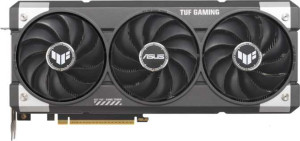
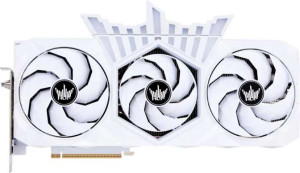
At first glance, the clock speeds of both cards appear nearly identical — the Asus TUF RTX 5060 Ti actually leads at base with 2407 MHz versus the Galax RTX 5070 Ti HOF's 2295 MHz, and their boost clocks converge to near parity at 2572 MHz and 2580 MHz respectively. However, clock speed alone tells only a fraction of the performance story. What truly separates these two cards is the sheer scale of their underlying silicon: the 5070 Ti HOF fields 8960 shading units, 280 TMUs, and 96 ROPs — roughly double the shader and rasterization resources of the 5060 Ti's 4608 shading units, 144 TMUs, and 48 ROPs.
That hardware gulf translates directly into the throughput numbers. The 5070 Ti HOF delivers 46.23 TFLOPS of floating-point performance and a texture rate of 722.4 GTexels/s, compared to 23.7 TFLOPS and 370.4 GTexels/s on the 5060 Ti — approximately a 2× advantage across every compute and fill-rate metric. In practice, this means the 5070 Ti HOF can push significantly more geometry and shading work per frame, which becomes especially impactful at higher resolutions and in scenes with heavy draw calls or complex lighting. The pixel rate gap — 247.7 GPixel/s versus 123.5 GPixel/s — further reinforces that the 5070 Ti HOF is built for a substantially higher performance tier. Memory speed is the one area where the two cards are fully equal at 1750 MHz, and both support Double Precision Floating Point, which matters for compute workloads but is a secondary consideration for gaming.
The Galax RTX 5070 Ti HOF holds a decisive and unambiguous performance advantage in this group. Its roughly 2× lead in raw compute, texture throughput, and pixel fill rate is not a marginal gain — it reflects a fundamentally larger GPU. The 5060 Ti's marginally higher base clock is a statistical curiosity that does not offset this gap in any meaningful scenario. Users prioritizing maximum rendering performance should clearly favor the 5070 Ti HOF, while the 5060 Ti remains competitive only where its lower tier price-to-performance ratio is the primary consideration — a factor outside the scope of these specs alone.