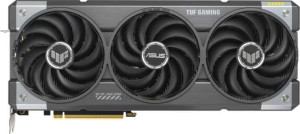
At their core, the Asus TUF RTX 5070 OC and the Zotac RTX 5070 Solid OC share the same fundamental GPU silicon: identical base clocks of 2325 MHz, matching shader counts of 6144 units, the same 192 TMUs, 80 ROPs, and equal memory speeds of 1750 MHz. This means their out-of-the-box architectural capabilities are equivalent — both cards process geometry, handle rasterization, and feed their memory interfaces at the same rate when running at base frequency.
The real separation emerges at boost. The Asus TUF reaches a GPU turbo of 2610 MHz versus the Zotac's 2542 MHz — a 68 MHz advantage that compounds across all throughput metrics. This translates directly into the Asus leading in floating-point performance at 32.07 TFLOPS versus 31.24 TFLOPS, a texture rate of 501.1 GTexels/s versus 488.1 GTexels/s, and a pixel rate of 208.8 GPixel/s against 203.4 GPixel/s. In practice, this ~2.6% boost headroom advantage is unlikely to be visible as a consistent framerate gap in most gaming scenarios, but it does give the Asus a modest edge in sustained workloads — particularly in compute-heavy tasks or scenarios where the GPU can sustain its maximum turbo frequency.
Overall, the Asus TUF RTX 5070 OC holds a narrow but real performance edge in this group, driven entirely by its higher boost clock. For pure gaming, the difference will rarely be perceptible, but for users doing GPU-accelerated compute, rendering, or AI workloads where every TFLOP counts, the Asus is the measurably faster card based strictly on these specs.