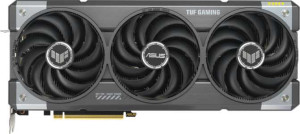
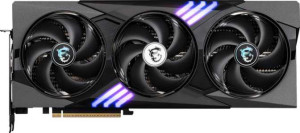
At their foundation, both cards are built on the same silicon: identical 2295 MHz base clocks, 8960 shading units, 280 TMUs, and 96 ROPs. This shared architecture means they draw from the same theoretical well of compute resources, and both support Double Precision Floating Point — relevant for certain professional and scientific workloads on top of gaming.
The real divergence emerges under sustained load, where boost clocks tell the true story. The Asus TUF Gaming RTX 5070 Ti OC Edition boosts to 2588 MHz versus the MSI Gaming Trio Plus's 2452 MHz — a gap of 136 MHz, or roughly 5.5%. That difference cascades directly into every derived throughput metric: the Asus card delivers 46.38 TFLOPS of floating-point performance against the MSI's 43.94 TFLOPS, and leads in both pixel fill rate (248.4 vs 235.4 GPixel/s) and texture throughput (724.6 vs 686.6 GTexels/s). In practice, these gains translate to marginally higher average framerates and smoother performance in compute-heavy rendering scenarios — not a transformative leap, but a consistent, measurable advantage the Asus card holds across the board.
The Asus TUF OC Edition holds a clear performance edge in this group. The MSI Trio Plus is not a slow card by any measure, but its lower turbo clock means it leaves some performance on the table that the Asus factory overclock captures. Users prioritizing raw throughput from the same GPU generation should favor the Asus variant.