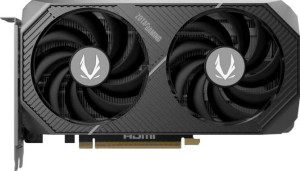
At first glance, the Zotac RTX 5060 Ti appears to have a clock speed advantage, running its base and boost clocks at 2407 / 2632 MHz compared to the Asus RTX 5070 Ti's 2295 / 2452 MHz. However, clock speed alone is a misleading metric when comparing GPUs of different tiers — what truly determines throughput is how many execution units are doing work at those clocks.
The RTX 5070 Ti completely dominates in shader and compute resources: it fields 8960 shading units, 280 TMUs, and 96 ROPs, versus the 5060 Ti's 4608 / 144 / 48 respectively — roughly double across the board. This hardware advantage directly translates to nearly twice the real-world throughput: 43.94 TFLOPS of floating-point performance versus 24.26 TFLOPS, a 235.4 GPixel/s pixel fill rate versus 126.3 GPixel/s, and a texture rate of 686.6 GTexels/s versus 379 GTexels/s. In practice, this means the 5070 Ti can push significantly higher resolutions and frame rates, handle more complex geometry, and process heavier compute workloads — all simultaneously. Both cards share identical 1750 MHz memory speeds and support Double Precision Floating Point, so neither holds an edge there.
The verdict for this group is clear: the Asus RTX 5070 Ti holds a commanding performance advantage. The 5060 Ti's higher clock speeds are entirely offset by its smaller GPU die, making it a mid-range option while the 5070 Ti operates in a substantially higher performance tier.